
The Many lives of the Cat in Art History
Home / Creative Writing / The Many lives of the Cat in Art History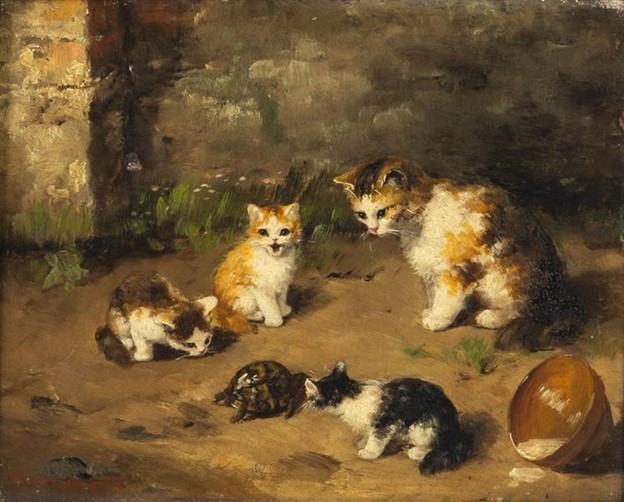

Janvi
PGDM Core
One of the funkiest songs that “Queen” has made is “Cool Cat” from the album “Hot Space”, it’s a very groovy song and I heavily recommend it, but I digress; upon hearing the song I felt compelled to analyze the origin of the cool cat, why don’t we have cool crocodiles and why is the elusive cat so omnipresent, across paintings, sculptures, movies and even songs, despite being a pet with little to no display of explicit affection yet they are a fan favorite.
The earliest appearance that the cat makes is in cave paintings, as old as 30,000 years ago, in the frescos of the Chauvet Cave in France. Ever since then the cat has metamorphosized in the way it has been represented in art. After the big cat, the domesticated cat comes in the picture, quite literally, in Ancient Egypt, where they were more than companions, they were worshipped and in general considered to be a good omen. From predators, they had now taken on the role of the protector; the part-cat goddess Bastet who presided over home and fertility is one such example.
Even in humanity’s earliest artmaking the cat was a creature of power, mystery, and imagination.
As we move ahead in time, we see that the Greeks had let the cat just be, well, a cat. It was domesticated, it was playful, it was kind of also over it. It was leaping for snacks, it had utterly and completely assimilated itself in the human household and it was a welcome and rather adored guest.
As the humankind became a lot more religious and Christian ethos started dictating the way people perceived cats, the creature became quite ambivalent in its representation, with it being represented along with saints but also having some connections to witchcraft. They were also a part and parcel of the household, lying around, sitting, sometimes looking at the artist, the artist’s disposition towards the creature bleeding through the artwork.
The creator of the Mona Lisa was also famously obsessed with the cat, Leonardo Da Vinci filled pages with sketches of cats, stretching, twisting, the anatomical nitty gritty being captured in all its glory.
While Europe was equivocal in the way it looked at the cat, Japan was doing something way more intriguing. During the E do period, cats became cultural protagonists; they would appear in the woodblock print as actors, shopkeepers and social creatures. Artist Utagawa Kuniyoshi drew them human-like, except better. There was also the Bakaneko, the shape shifting supernatural cat, because even in their most playful representation they still carried an air of mystery around them.
By the 19th century rolled around, cats were no longer just appearing in art, they were the subject of it, Louis Wain’s depictions of cats became an object of curiosity with his descent towards madness. This descent was characterized by the trippy images that he had started producing, replacing the posh, anthropomorphic cats he had once produced which got him international acclaim. Wain’s cats would go to school, wear fancy clothes, and have all sorts of adventures, his obsession with the cat was mirrored in his actual life as well where he was involved with all sorts of animal charities and cat clubs.
French painter Théophile Steinlen’s Chat Noir became an icon of the Parisian nightlife, Renoir on the other hand painted them with a certain softness that only exhibited the affection he had for these creatures. They would be lovingly tucked under children’s arms or vice versa!
The 20th century was another tumultous era for the cat, Picasso’s cats were ferocious symbols of violence, conflict and domination, Balthus’s representation of the cat elicited a certain unease in its spectator. Salvador Dalí’s images of cats again had a surreal quality to it, which took about 26 takes to get the perfect shot. Warhol in true Warhol fashion did not shy away from making the cat pop with bright colors and even brighter eyes lending a certain absurdity to the imagery.
Throughout the various representations of the cat, one cannot comment on what form has been the most accurate. The cat’s mind and proclivties remain a mystery to humans, and I suppose that explains their obsession with the creature. The internet and people at large are still quite taken with the cat and have been very candid about their affection for the creature, which includes the author of this piece.
Related Blogs

NVIDIA: THE CHIP DOMINANCE
S Hafsah Sayeedah PGDM Core Guided by curiosity and grounded in learning, she…

THE RISE OF CITIZEN JOURNALIM: A THREAT OR A REVOLUTION?
Anisha Kochar PGDM Core Observing quietly, writing deliberately, she looks for meaning in the…
Existentialism: A Guide to Create Your Own Living
Jaskaran Gill PGDM Core Driven by curiosity and an urge to write constantly, He looks…