Supply chain management course: Everything you need to know
Home / Academic / Supply chain management course: Everything you need to know
A supply chain management course reflects on the end-to-end procedure related to manufacturing, sourcing, planning, and delivering goods that is regarded as vital to carrying out operational effectiveness.
What is Supply Chain Management (SCM)?
Supply chain management is regarded as the centralized coordination that takes place about the overall flow of commodities, finances, and data. The key aspects involve incorporating logistics planning, manufacturing, and inventory control to maximize effectiveness and diminish waste that ultimately augments profitability and customer satisfaction. The demand for PGDM supply chain is consequently on the rise, which helps in determining metrics to compute the overall effectiveness of the supply chain.
Key components of a Supply chain
The five major components related to SCM are as follows:
Planning: It involves creating a strategy to meet demand by predicting requirements by streamlining operations to diminish expenses.
Sourcing: Supplier selection is focused on ordering raw materials and dealing with inventory management to make sure that production continues properly.
Production: The procedure includes testing, assembling and packaging products
Delivery: Logistics are coordinated to move finished goods and transport them to customers.
This has turned into an imperative aspect while including the subject in the SCM course after graduation.
SCM vs Logistics: Understanding the Difference
SCM differs largely from logistics, and this is taught thoroughly in every SCM course college in Hyderabad. SCM is regarded as a strategic and end-to-end coordination regarding the production of commodities and distributing them, whereas logistics is considered an operational subset that puts stress on the movement of the commodities effectively. Logistics planning carries out the warehousing and transportation to meet customer needs. SCM deals with the entire lifecycle that involves production, sourcing, and delivery. SCM also creates a competitive advantage that is well-equipped by students through the supply chain management course. The major focus of logistics is on warehouse management and inventory control. It can be inferred that SCM is mostly strategic and long-term, whereas logistics is operational and short-term.
Types of SCM courses in India
In India, SCM courses range from UG degrees to PG degrees to specialized certificates. The types of SCM courses in India are as follows:
PGDM in Logistics and SCM: Top universities such as IMT Hyderabad provide a 2-year full-time course on the curriculum with a major focus on comprehensive management strategy and logistics.
MBA in operations management: It provides a wider view that covers manufacturing and SCM.
Certificate in SCM: It includes a 9–12-month course that is acquired by professionals. SCM certification India is any day regarded as the easy way out for experts.
BBA in Logistics and SCM: Students pursue this course after class 12 that involves a 3-year foundational degree with a key focus on supply chain procedures.
PGDM in Supply chain management
A PGDM in SCM is a 2-year course approved by AICTE from institutes such as IMT Hyderabad that tailors roles in procurement management, logistics, and operations all throughout the sectors such as e-commerce and retail. Key topics include supply chain optimization, AI-driven logistics, warehousing, international trade, and ERP systems. The primary requirement is that a recognized university must accept XAT, CAT, and MAT with a bachelor’s degree to enroll in PGDM in SCM.
Online vs Offline SCM courses: Pros & Cons
The online SCM course provides a highly flexible as well as low-cost curriculum that is best fitted for working experts who are looking for self-paced learning. On the other hand, offline SCM courses offer a practical experience as well as structured learning, mostly for those preferring one-to-one interaction. Online courses offer flexibility and lower tuition fees, while offline courses provide hands-on workshops and better networking opportunities.
Eligibility and Admission Process for SCM Courses
A bachelor’s degree is mandatory with 50% aggregate marks in addition to qualifying marks in entrance exams that include CAT, CMAT, and XAT. Interested candidates are required to fill up the application form through the official page.
Career Scope after a Supply chain management course
Outstanding career opportunities are provided after completing the SCM course after graduation that are as follows:
- Logistics Managers
- Transportation Managers
- Purchasing managers
- Supply chain analysts
- Production managers
- Procurement specialists
Top Recruiting Companies for SCM Graduates
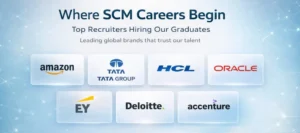
The top employers who prefer SCM graduates include logistics and e-commerce, manufacturing, retail, logistics, and operations. The top recruitment companies are as follows:
- Amazon
- Tata Group
- HCL
- Oracle
- EY
- Deloitte
- Accenture
Why choose IMT Hyderabad for SCM?
Among the top B-schools, IMT Hyderabad has been regarded as the top choice for the specialization that it provides in the field of logistics and SCM in association with CII, providing an industry-aligned curriculum. Students gain advantage from a 12-week faculty-supervised internship and use tools like Harvard Business School simulation projects to link theory with practical SCM challenges. With reinforced placement prospects, IMT Hyderabad stands out from others with a proper return-on-investment.
Final Thoughts
Supply chain management courses in India offer a powerful pathway for students and professionals looking to build dynamic, future-ready careers. With the rapid growth of e-commerce, manufacturing, and global trade, the demand for skilled supply chain professionals continues to rise across industries.
| Course Name | Page Link |
| PGDM General | Click Here |
| PGDM Finance | Click Here |
| PGDM Marketing | Click Here |
Related Blogs

SEO vs GEO: How Google Ad Decides What You See Online
Atharva Shivaji Walekar Atharva, a chemistry student, turned to business studies. He explores geopolitical…

The Lifecycles of Leadership: How Founders, Mid-Career, and Late-Career Leaders Differ
B-school classrooms are full of people at different stages of their leadership journey. Some of…

Information Fatigue: The age of the Infinite Scroll
Kashish Sehgal PGDM Marketing A quiet observer, she is drawn to the stories behind…

Solving Indian Manufacturing
Janvi PGDM Core Working in introspection, cultural quirks, and observations into writing, and…
Why Soft Skills Matter More Than Your GPA in Management
Introduction Globalisation has opened a much-needed avenue for business enterprises to expand their scope and…
Does Rebranding Work?
Kashish Sehgal A quiet observer, she is drawn to the stories behind people….