
The Impact of Social Media Trends on Consumer Behaviour in Marketing
Home / Academic / The Impact of Social Media Trends on Consumer Behaviour in Marketing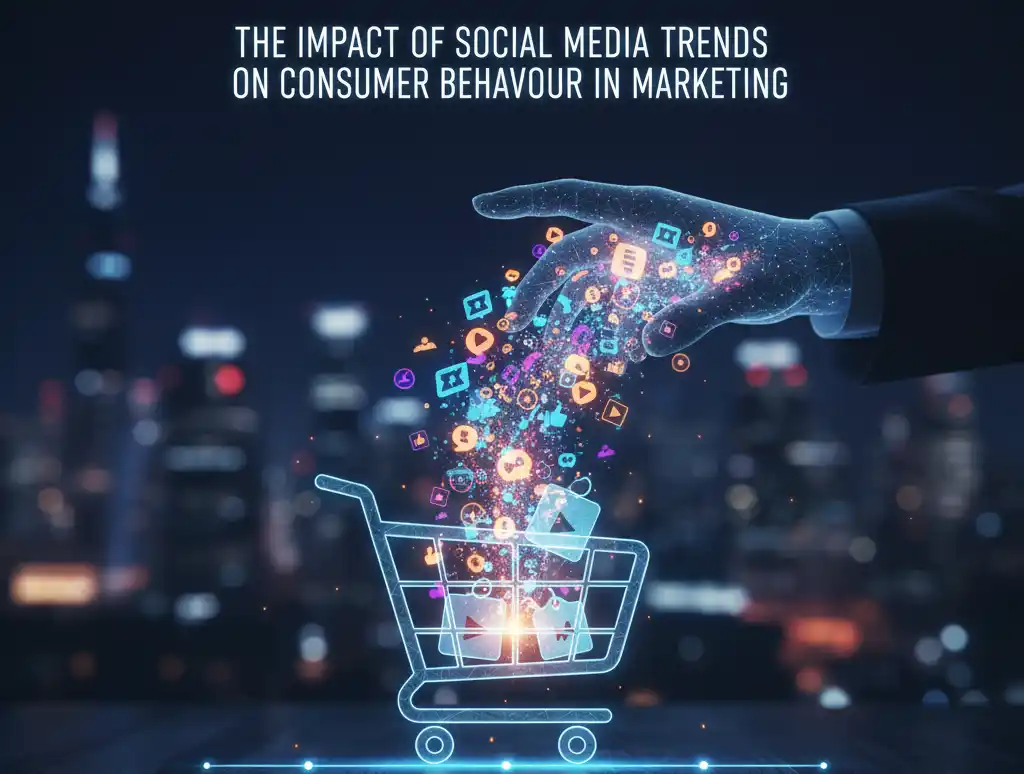
Introduction
In an era of pervasive connectivity, the impact of social media trends on consumer behaviour in marketing has become a defining force that marketers cannot afford to ignore. Social media platforms have evolved beyond mere communication tools to powerful drivers that shape how individuals discover, evaluate, and adopt products. As management students and future strategists, understanding these dynamics enables you to design campaigns that resonate authentically with audiences.
Consumer Behaviour in Marketing- How Social Media Has Become A Key Driver
It’s tough to think of modern marketing without social media. Every day, billions of people scroll, react, share, and sometimes buy, often without realising how these actions fit into a much larger economic pattern. For students exploring consumer behaviour in marketing, this shift offers a clear window into how emotion, habit, and technology mix. Social media isn’t just a communication tool anymore; it’s a behavioural mirror showing what people value at a given moment.
According to Statista (2025), there are now 5.4 billion social media users worldwide, which equates to around 64% of the global population. When so many people spend roughly two hours a day online, it makes sense that purchase decisions often begin there. The traditional marketing funnel feels outdated because discovery, comparison, and purchase can happen within a few minutes on a single app.
How Do Social Media Trends Influence Consumer Behaviour, Meaning, And Perception?
If we look at consumer behaviour meaning, it’s basically how people think and act when they choose what to buy. But online, choice is rarely private. People see what their friends or influencers recommend, and that subtly changes their sense of what’s “normal.” The Pew Research Centre, 2024, found that 72 % of adults aged 18–29 had bought at least one product after seeing it on social media.
That number doesn’t surprise many marketers. We tend to imitate the behaviour of our peers, especially when information moves fast. Trends make buying feel like joining a collective moment rather than making an isolated decision. Sometimes it’s about identity more than need.
Through What Mechanisms Do Social Media Trends Affect Consumer Behaviour In Marketing?
Honestly, most users never notice how much algorithms decide for them. When a video or product starts trending, the platform amplifies it again and again. McKinsey & Company, 2024, estimated that about 32 % of online purchases now start from algorithmic recommendations rather than active search. That’s a lot of invisible influence.
These systems favour whatever keeps attention longest: humour, surprise, controversy, and that means emotional posts travel faster than rational ones. For anyone studying consumer behaviour in marketing, it shows how digital design can steer desire almost automatically.
Do All Generations Project The Same Consumer Behaviour In Marketing?
Not exactly. Deloitte, 2025 reports that Gen Z users spend around 50 minutes more per day on social media than older adults and are twice as likely to buy after watching a short video. Millennials are slightly less impulsive but still rely heavily on influencer reviews. Older consumers engage differently; they watch longer videos, read comments, and make slower decisions.
So, the trend effect isn’t universal; it depends on how much a group values digital belonging versus functional need.
How Should Marketers Ethically Deploy Social Media Trends To Shape Consumer Behaviour In Marketing?
This part matters more than it gets credit for. The UK Competition and Markets Authority (2024) has already warned that hidden sponsorships and fake endorsements can mislead consumers. Marketers sometimes cross lines when they exploit fear of missing out or mimic authenticity they don’t have.
Privacy is another grey zone. Personalised trend ads often rely on behavioural data that users never knowingly share. Regulation is catching up, but ethical marketing starts with self-restraint, knowing when persuasion becomes manipulation.
What Future Directions Will Deepen The Impact Of Social Media Trends On Consumer Behaviour In Marketing?
If current predictions hold, the next few years will bring deeper integration of AI and immersive media. The World Economic Forum expects that by 2027, about 60 % of all brand–consumer interactions will pass through AI-assisted interfaces. That could mean personalised micro-trends, augmented-reality shopping, and ultra-targeted ads that feel like conversations.
In practical terms, marketers will need to think like anthropologists as much as analysts, reading emotions and social cues rather than just numbers.
A Brief Reflection For Management Students
At IMT Hyderabad, studying trends is not about copying viral content. It’s about recognising how culture, psychology, and economics intersect. In our view, the best marketers of the next decade will be those who can empathise with consumers while keeping ethics intact. Algorithms may shape exposure, but meaning still belongs to people.
Conclusion
Social media trends reveal how societies express taste and aspiration. They have redrawn the logic of consumer behaviour in marketing, turning buying into a social gesture rather than a solitary act. Data confirm the scale of this shift, yet statistics only tell half the story. Behind every metric lies a moment of attention, curiosity, or emotion.
Perhaps that’s the real lesson: marketing today isn’t about shouting louder, but it’s about understanding why people listen at all. And that understanding begins with careful observation of the subtle, ever-changing world of social media trends.
Related Blogs

PGDM vs MBA: Differences, Benefits, and Finding the Right Career Fit
Over the past decade, management education in India has expanded steadily. According to national enrolment…

Can India Be the Torch Bearer of the AI Marketing Future?
Introduction Every few years, a new wave defines how marketing is done. Once, it was…

Behavioral Economics in Daily Decision-Making
Abhishek Kumar Aditya This is Abhishek Kumar Aditya, a PGDM candidate at IMT Hyderabad,…
Does Rebranding Work?
Kashish Sehgal A quiet observer, she is drawn to the stories behind people….

Solving Indian Manufacturing
Janvi PGDM Core Working in introspection, cultural quirks, and observations into writing, and…
Can a PGDM Still Guarantee a Job in the AI Era?
Introduction The dedication to advanced studying and acquiring a higher educational qualification is something that…