
Marketing Research: Meaning, Types, Process, Marketing Metrics, and International Marketing
Home / Academic / Marketing Research: Meaning, Types, Process, Marketing Metrics, and International Marketing
What Is Marketing Research?
Marketing research is the systematic process of gathering, recording and analysing information about a market, its customers and the effectiveness of marketing activity, so that business decisions rest on evidence rather than instinct. It covers the whole marketing function, not just the market itself: product, pricing, promotion, distribution and customer satisfaction all fall within its scope.
Customer expectations shift quickly, and a single product launch can cost a great deal. Before a company launches a product, changes a price or enters a new country, this research tells it whether real demand exists, who the buyer is, what they are willing to pay and what competitors already offer. That evidence-led approach is what the rest of this guide sets out in detail, alongside the marketing metrics that track spend and the international dimension that governs cross-border growth.
What Is the Difference Between Market Research and Marketing Research?
The two terms are related but not identical, and the distinction matters. Market research is the narrower of the two: it studies a specific market, its customers and its competitors. The broader discipline studies the entire marketing function, of which market research is one part.
| Basis | Market Research | Marketing Research |
|---|---|---|
| Scope | Narrower; studies a specific market, its customers and competitors | Broader; studies the entire marketing function |
| Focus | Data about a particular market and its demand | Data about product, price, promotion and distribution, plus the market itself |
| Questions answered | Who is the customer? How large is the market? What do buyers want? | Which price works? Is the advertising effective? Which channel performs best? Plus all market questions |
| Relationship | A subset of the wider discipline | The umbrella discipline that includes market research |
| Example | Estimating demand for a new smartphone in a city | Testing that smartphone’s price, packaging, advertising and distribution |
In short, market research answers questions about the market, while the broader field answers questions about the whole of marketing.
What Are the Objectives of Marketing Research?
This research is carried out to achieve several connected objectives, each supporting a better commercial decision.
- Understanding customer needs: Identifying what customers actually want, how they behave and why they buy, so products and messages match real demand.
- Measuring customer satisfaction: Tracking how happy existing customers are, in order to improve retention and reduce churn.
- Identifying market opportunities: Spotting unmet needs, emerging segments and gaps that the business can profitably serve.
- Competitor analysis: Understanding the strengths, weaknesses, pricing and positioning of rivals to sharpen the company’s own strategy.
- Product development: Testing concepts, features and prototypes before launch to reduce the risk of failure.
- Pricing strategy: Assessing willingness to pay and price sensitivity to set prices that balance volume and margin.
- Risk reduction: Replacing assumptions with evidence, so that expensive decisions, from launches to market entry, carry less risk.
What Are the Types of Marketing Research?
Marketing research can be classified into different types based on the source of the study, primary or secondary, and by the nature of the data, qualitative or quantitative.
1. Primary Research
Primary research is original data collected first-hand for its specific problem. It is current and tailored, but it takes more time and money than using existing sources. The main methods are:
Surveys: Structured questionnaires conducted online, over the phone, or in person to collect responses from a large group of people. Surveys are ideal for measuring customer opinions, preferences, and buying behaviour.
Interviews: One-to-one conversations that provide detailed insights into a customer’s experiences, opinions, and motivations. They work well for exploring complex or sensitive topics.
Focus Groups: Guided discussions with a small group of participants to understand their perceptions, reactions, and opinions about a product, service, or marketing campaign.
Observation: Watching how customers behave in real-life situations, whether in a physical store or on a website. This method helps businesses understand actual behaviour rather than relying only on what customers say.
Experiments: Controlled tests, such as A/B testing or test marketing, where one variable—such as price, packaging, or advertising—is changed to measure its impact on customer behaviour.
2. Secondary Research
Secondary research uses data that already exists, gathered by someone else for another purpose. It is faster and cheaper than primary research and is usually the sensible starting point, though it may not fit the exact problem. Common sources are:
Government reports: Census, economic and statistical data that give reliable, large-scale context on population, income and industry.
Industry reports: Publications from market research firms, trade associations, and industry bodies that analyse market size, growth, competition, and emerging trends.
Company websites: Annual reports, investor presentations and product information that reveal competitor strategy and performance.
Research journals: Peer-reviewed academic studies that provide validated frameworks, methods and findings.
Market reports: Syndicated and published reports on specific markets, segments and consumer trends.
3. Qualitative vs Quantitative Research: What Is the Difference?
| Basis | Qualitative Research | Quantitative Research |
|---|---|---|
| Purpose | Exploratory; understands why and how | Conclusive; measures how much and how many |
| Nature of data | Non-numerical: words, opinions, motivations | Numerical: statistics, counts and scores |
| Methods | Interviews, focus groups, observation | Surveys, experiments, structured questionnaires |
| Sample size | Small; not statistically representative | Large; statistically representative |
| Output | Insights, themes and hypotheses | Measurable data, tested hypotheses and projections |
| Best for | Generating ideas and understanding motivation | Validating, sizing and tracking at scale |
What Is the Marketing Research Process?
The marketing research process is a step-by-step method businesses use to understand their customers, the market, and competitors before making important marketing decisions. Instead of relying on assumptions, companies collect and analyse data to gain insights that help them create better products, improve customer experiences, and develop effective marketing strategies.
Here are the six key steps involved in the marketing research process:
1. Define the Problem
Every research project begins with identifying the problem or opportunity. A clear understanding of the issue helps ensure the research stays focused and produces useful results.
Example: A clothing brand notices a drop in online sales and wants to understand why customers are no longer making purchases.
2. Set Research Objectives
Once the problem is identified, the next step is to decide what the research should achieve. These objectives guide the entire study and help determine what information needs to be collected.
Example objectives:
- Understand customer buying behaviour.
- Identify reasons for declining sales.
- Measure customer satisfaction.
3. Develop the Research Plan
At this stage, researchers decide how they will collect the required information. This includes selecting research methods, deciding on the target audience, and choosing the right data collection tools, such as surveys, interviews, focus groups, or observation.
A well-planned research strategy saves time, reduces costs, and improves the quality of the findings.
4. Collect the Data
Now it’s time to gather information. Data can come from two main sources:
- Primary data: Information collected directly from customers through surveys, interviews, questionnaires, or observations.
- Secondary data: Existing information from company records, industry reports, government publications, or online databases.
Collecting accurate and relevant data is essential because the final decisions will depend on it.
5. Analyse and Interpret the Data
After collecting the data, researchers organise and examine it to identify patterns, trends, and customer insights. The goal is to turn raw information into meaningful findings that answer the research questions.
For example, the analysis may reveal that customers prefer faster delivery options or find product prices too high.
6. Present Findings and Make Decisions
The final step is to present the research findings in a clear and simple format. Based on these insights, businesses can make informed decisions, such as launching a new product, improving customer service, adjusting pricing, or changing their marketing strategy.
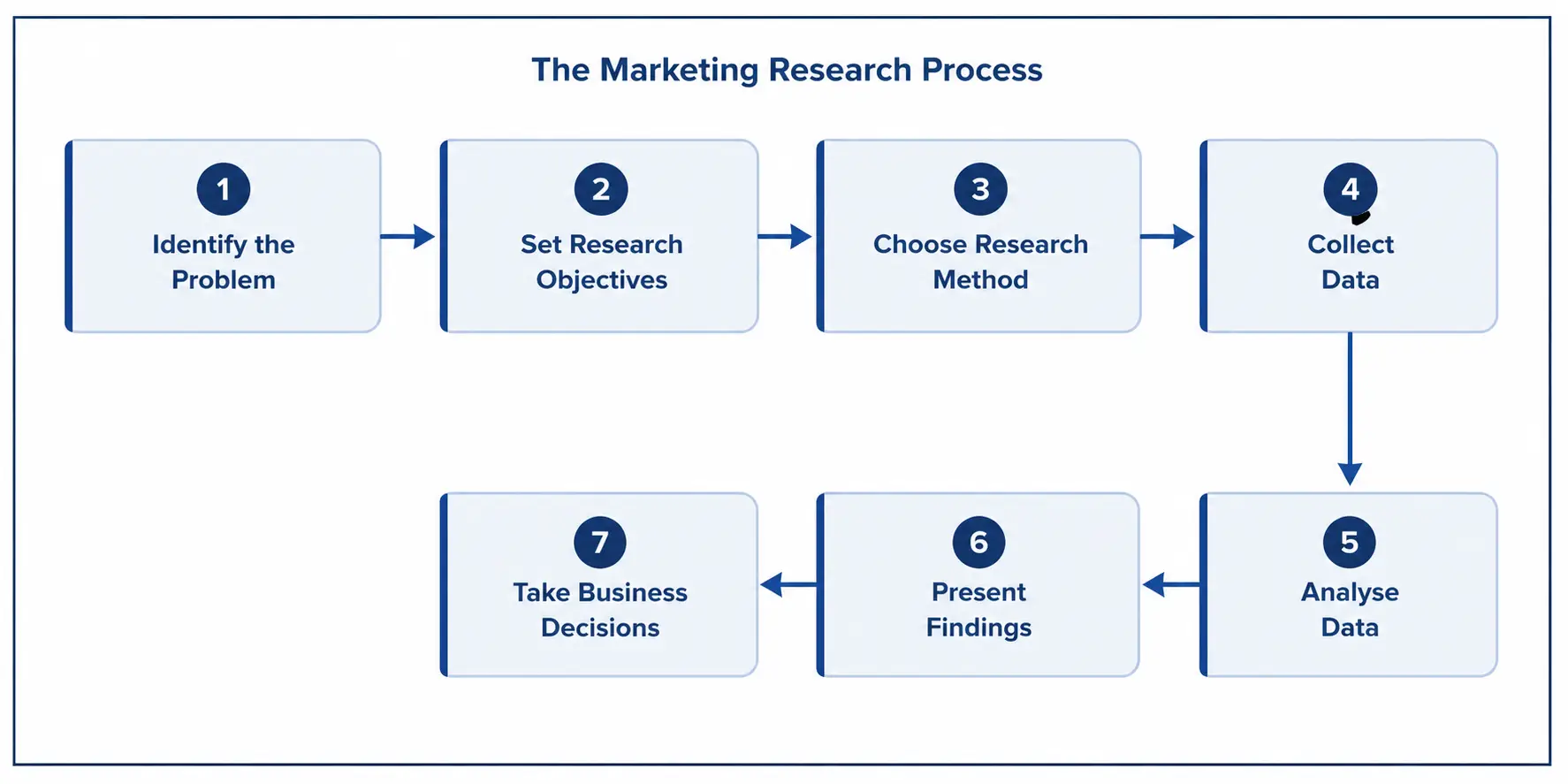
Figure 1: The seven-step marketing research process
Example: Imagine a coffee shop notices that fewer customers are visiting than before.
- Problem: Customer visits have declined.
- Objective: Find out why customers are choosing other cafés.
- Research Plan: Conduct an online survey and interview regular customers.
- Data Collection: Gather feedback on menu, prices, ambience, and service.
- Analysis: Most customers say they want healthier drink options and faster service.
- Decision: The café introduces a healthier menu and speeds up order processing.
By following the marketing research process, the coffee shop makes changes based on customer feedback instead of assumptions, increasing the chances of attracting more customers.
Which Marketing Metrics Should Marketers Track?
This kind of research does not end when a campaign goes live. It continues through the marketing metrics that measure whether the spending is working. The metrics below are the ones most marketers should track, because together they show how efficiently the business acquires customers, how much those customers are worth and how well marketing converts attention into revenue.
| Metric | What It Measures | Why It Matters |
|---|---|---|
| Customer Acquisition Cost (CAC) | Total sales and marketing spend divided by the number of new customers acquired | Shows how efficiently the business wins customers; rising CAC signals channel fatigue or weak targeting |
| Customer Lifetime Value (CLV) | Total profit expected from a customer over the whole relationship | Sets how much can be spent to acquire and retain a customer; a healthy CLV-to-CAC ratio is commonly cited as around three to one |
| Conversion Rate | Percentage of visitors or leads who take the desired action | Measures how effectively marketing turns interest into action across the funnel |
| Return on Marketing Investment (ROMI) | Revenue generated by marketing minus its cost, divided by the cost | Shows whether marketing spend is profitable and which activities deserve more budget |
| Net Promoter Score (NPS) | Percentage of promoters minus percentage of detractors, from a likelihood-to-recommend question | Captures customer loyalty and word-of-mouth potential in a single figure |
| Customer Retention Rate | Percentage of existing customers retained over a period | Reveals stickiness; retention is usually cheaper than acquisition and compounds CLV |
| Website Traffic | Volume and quality of visitors to the website | Indicates reach and top-of-funnel health; segmenting by source shows which channels perform |
| Bounce Rate | Percentage of visitors who leave after viewing only one page | Flags weak relevance, slow pages or poor targeting when it is high |
What Role Does Marketing Research Play in International Marketing?
International marketing multiplies risk, because assumptions that hold at home often fail abroad. Research is what turns cross-border expansion into a calculated move rather than a gamble, by testing every assumption against local reality before capital is committed. Its role spans several areas.
- Market entry strategy: Research identifies which markets to enter, the best entry mode, such as export, licensing, joint venture or a wholly-owned operation, and the right timing.
- Consumer behaviour across countries: Preferences, purchasing power, media habits and buying triggers differ sharply between markets, and research maps those differences.
- Cultural differences: Language, religion, symbolism, colour associations and social taboos shape how a product and its message are received. Misreading them is a common cause of failure.
- Pricing research: Willingness to pay, income levels and price sensitivity vary by country, so pricing must be researched market by market rather than converted from the home price.
- Competitor research: Each market has its own mix of local and global competitors and its own category leaders, which research identifies before entry.
- Localisation: Research guides how far to adapt the product, features, packaging, language and even the brand name to local expectations.
- Global branding: It helps balance a consistent global identity with local relevance, an approach often called glocalisation.
McDonald’s is an example of research-led localisation. Guided by local dietary and cultural norms, it removes beef and pork from its Indian menu and offers dishes such as the McAloo Tikki and McSpicy Paneer, while keeping the core brand experience recognisable worldwide.
What Career Opportunities Does Marketing Research Offer?
This field supports a wide range of careers across research agencies, consumer companies, consulting firms and technology businesses, and demand for professionals who can turn data into insight continues to grow. These roles are a good destination for graduates of a PGDM in Marketing, where research, analytics and consumer behaviour form part of the core curriculum. The table below lists common roles with indicative salary ranges in India.
| Job Role | Average Salary (Indicative) |
|---|---|
| Market Research Analyst | Rs. 3.5-7 LPA (up to about Rs. 12 LPA with experience) |
| Marketing Analyst | Rs. 4-9 LPA |
| Consumer Insights Analyst | Rs. 5-11 LPA |
| Brand Manager | Rs. 8-18 LPA (Rs. 20 LPA and above at senior level) |
| Product Marketing Manager | Rs. 11-25 LPA (up to about Rs. 37 LPA) |
| Research Consultant | Rs. 6-15 LPA (higher at established consulting firms) |
Salary ranges are indicative and vary considerably with experience, employer, city and specialisation. A postgraduate qualification from a strong institution, combined with data and analytics skills, tends to place candidates in the higher bands.
Frequently Asked Questions
What is marketing research?
It is the systematic process of gathering, recording and analysing information about a market, its customers and the effectiveness of marketing activity, so that product, pricing, promotion and distribution decisions rest on evidence. See the full definition above for its scope and purpose.
What are the types of marketing research?
Studies are classified by source of data into primary research, original data from surveys, interviews, focus groups, observation and experiments, and secondary research, existing data from government reports, industry reports, company websites, journals and market reports. They are also classified by nature of data into qualitative and quantitative research.
What is the difference between market research and marketing research?
Market research is narrower and studies a specific market, its customers and competitors. The broader discipline studies the entire marketing function, including product, price, promotion and distribution. Market research is a subset of it.
What are marketing metrics?
Marketing metrics are the measurements that show whether marketing is working. Common examples include Customer Acquisition Cost, Customer Lifetime Value, conversion rate, Return on Marketing Investment, Net Promoter Score, customer retention rate, website traffic and bounce rate. Together they show how efficiently a business acquires customers and how much value marketing creates.
Why is marketing research important in international marketing?
Assumptions that work at home often fail abroad. Research tests demand, consumer behaviour, cultural fit, pricing and competition in each target market, guiding market entry, localisation and global branding. Brands such as McDonald’s and Coca-Cola rely on it to decide what to keep global and what to adapt locally.
How is marketing research taught in PGDM marketing programmes?
In a PGDM in Marketing, it is a core subject. Students learn research design, primary and secondary methods, sampling, data analysis and the interpretation of marketing metrics, and they apply these skills through live industry projects, internships and a dissertation, so that they can both commission and conduct research in practice.
Which tools are used in marketing research?
Common tools include survey platforms for data collection, web analytics platforms for behavioural and website data, statistical software and spreadsheets for analysis, data visualisation tools for reporting, and social listening and CRM systems for customer insight. The choice depends on whether the study is primary or secondary and qualitative or quantitative.
What careers are available in marketing research?
Careers include market research analyst, marketing analyst, consumer insights analyst, brand manager, product marketing manager and research consultant, across research agencies, consumer goods companies, consulting firms and technology businesses. These roles are a common destination for graduates of a PGDM in Marketing.
Related Blogs

Can India Be the Torch Bearer of the AI Marketing Future?
Introduction Every few years, a new wave defines how marketing is done. Once, it was…

Top Finance Courses in India That Can Transform Your Career in 2026
Finance has always been among the highest-paying and most respected career paths in India. But…

Logistics Courses in India 2026: Eligibility, Fees, Career Scope & Top Colleges
Walk into a warehouse on the edge of a small Indian city at midnight and…

Top Courses for Financial Analysts to Build a Successful Finance Career
Finance is one of the few fields where the right qualification can shift your career…

PGDM vs MBA: Differences, Benefits, and Finding the Right Career Fit
Over the past decade, management education in India has expanded steadily. According to national enrolment…

Wealth Management Course in India: A 2026 Guide to Skills, Certifications, and a High-Growth Finance Career
India is in the middle of one of the largest wealth-creation waves in its history,…