
GMAT Admission 2026: Eligibility, Registration, Exam Pattern, Sample Papers and How to Use Your Score for PGDM
Home / PGDM / GMAT Admission 2026: Eligibility, Registration, Exam Pattern, Sample Papers and How to Use Your Score for PGDM
If you are aiming for a career in management, the GMAT is one of the few entrance tests that opens doors in India and abroad at the same time. Yet scoring well is only half the job. GMAT admission is really a two-part journey: you sit the exam set by GMAC, then you use that score to win a place at the business schools on your shortlist. Most guides stop at the first part. This one covers both – eligibility, registration, the exam pattern, free official sample papers, sensible score targets and what actually happens after you send your score to a B-school such as IMT Hyderabad.
GMAT admission is the process of taking the Graduate Management Admission Test (GMAT) and using your score to apply for MBA, PGDM and other management programmes. The exam lasts 2 hours 15 minutes, has 64 questions across three sections, is scored from 205 to 805 and stays valid for five years. In India, institutes such as IMT Hyderabad accept GMAT scores for PGDM admission.
What Is the GMAT Exam and Why Does It Matter in 2026?
The Graduate Management Admission Test is run by the Graduate Management Admission Council (GMAC). It measures the skills business schools care about most: problem solving, critical thinking and data analysis. According to GMAC, more than 7,700 programmes at over 2,400 business schools use the test, which makes it the most widely recognised entrance exam for graduate management study.
The current version of the exam (launched as the GMAT Focus Edition) fully replaced the older 10th edition in early 2024. It is shorter, has no essay section and introduces a section called Data Insights.
For Indian aspirants, the GMAT has a few clear advantages over once-a-year tests:
- Flexibility: you can book a slot almost any day of the year, at a test centre or online.
- Second chances: you can sit the exam up to five times in a rolling 12-month period.
- Long shelf life: your score stays valid for five years, so you can apply now or after a few years of work.
- Wider reach: one score works for Indian PGDM programmes and international MBAs.
GMAT Admission Eligibility: Who Can Take the Test?
GMAC keeps its own rules simple. The stricter requirements come from the schools you apply to, so it helps to check both.
- Age: you must be at least 18. Candidates aged 13 to 17 can test with written consent from a parent or guardian. There is no upper age limit.
- Education: GMAC sets no minimum qualification or percentage. However, most programmes, including the PGDM at IMT Hyderabad, require a recognised bachelor’s degree with a minimum aggregate.
- Work experience: not needed to sit the test. Some programmes prefer it, but freshers apply successfully every year.
- Nationality: there are no restrictions.
- ID: Indian candidates need a valid passport. Your name at registration must match your passport exactly, including the order of names.
Final-year students can take the GMAT too. Because the score lasts five years, testing in your final year is a smart way to keep your options open.
GMAT Exam Pattern 2026 at a Glance
The exam has three sections of 45 minutes each, with one optional 10-minute break. You choose the order in which you take them.
| Section | Questions | Time | What it tests |
|---|---|---|---|
| Quantitative Reasoning |
21 | 45 minutes | Problem Solving (arithmetic and algebra); no calculator |
| Verbal Reasoning |
23 | 45 minutes | Reading Comprehension and Critical Reasoning |
| Data Insights | 20 | 45 minutes | Data Sufficiency, Multi-Source Reasoning, Table Analysis, Graphics Interpretation and Two-Part Analysis; on-screen calculator |
| Total | 64 | 2 hours 15 minutes |
Total score 205–805; each section 60–90 |
The test is computer-adaptive, so the difficulty of each question responds to how you are doing. You can bookmark questions and change up to three answers per section before you move on. There is no penalty for a wrong answer, but unanswered questions cost you heavily, so finishing every section matters more than perfecting a single tough item. You can read GMAC’s full breakdown on its official exam content page.
Read More: XAT Exam 2027
How to Register for the GMAT: Step by Step
- Create an account on mba.com.
- Enter your personal details exactly as they appear on your passport.
- Choose your delivery mode: test centre or online.
- Pick a date and time. Slots open up to six months ahead and close 24 hours before the exam.
- Pay the fee. It is currently around US$275 at a test centre and US$300 online, plus applicable taxes in India. Fees change, so confirm the amount on mba.com before you pay.
Rescheduling starts at US$55 if you change your date more than 60 days in advance, and costs more as the test day approaches. Book eight to ten weeks before your target application deadline. That leaves room for a retake, since you must wait at least 16 days between attempts.
Test Centre or Online: Which Should You Choose?
A test centre is the calmer choice if your internet connection or home space is unreliable, and it costs a little less. The online exam lets you test from home with slots around the clock, but you must pass room and system checks and follow strict proctoring rules. If you choose online, run the system check a few days before, not on the morning of the test.
Read More: PGDM Entrance Exams in India
GMAT Sample Papers and Official Question Papers
Many students search for “GMAT question papers”, expecting past papers like those released for university exams. GMAC does not publish past papers, because questions are reused within its adaptive question bank. The closest – and only reliable – equivalents are GMAC’s own sample questions and practice exams:
| Resource | What you get | Link |
|---|---|---|
| Official sample questions | Quant, Verbal and Data Insights questions with answers and explanations | GMAT sample questions |
| Multi-Source Reasoning sample | Interactive Data Insights question | Multi-Source Reasoning question |
| Table Analysis sample | Interactive Data Insights question | Table Analysis question |
| Graphics Interpretation sample | Interactive Data Insights question | Graphics Interpretation question |
| Two-Part Analysis sample | Interactive Data Insights question | Two-Part Analysis question |
| GMAT Official Starter Kit (free) | 70+ real questions and two full-length practice exams scored like the real test | GMAT Official Starter Kit |
Be wary of PDFs promising “leaked” GMAT papers. They break GMAC’s rules and are usually old 10th-edition content, with Sentence Correction and essay questions that no longer appear on the exam.
How to Use Mock Tests Well
Mock tests are only as useful as the review that follows them. A simple routine works best:
- Start with a diagnostic. Take one official practice exam before you study, so you know your baseline.
- Simulate test day. Sit full-length mocks in one go, at the same time of day as your booked slot.
- Keep an error log. For every miss, note whether it was a concept gap, a careless slip or a timing problem.
- Know your pace. The official timings work out to just over two minutes per Quant question, just under two minutes per Verbal question and about two and a quarter minutes per Data Insights question.
- Save your best mocks. Keep one official practice exam for the final fortnight as a dress rehearsal.
Read More: How to Crack WAT-PI- A Complete Guide
What Is a Good GMAT Score for PGDM in India?
There is no single “good” score; it depends on the programme and your wider profile. As a rough guide, a total of 645 or above is widely seen as competitive, and top one-year programmes in India often look for scores above 700. In recent admission cycles, IMT Hyderabad has listed a GMAT Focus score of 645 or above among its merit scholarship criteria, so check the current scholarship policy when you apply.
Remember that your score is one part of the picture. Business schools also weigh your academic record, work experience, interview performance and how clearly you can explain why you want a management career.
How GMAT Fits into PGDM Admission at IMT Hyderabad

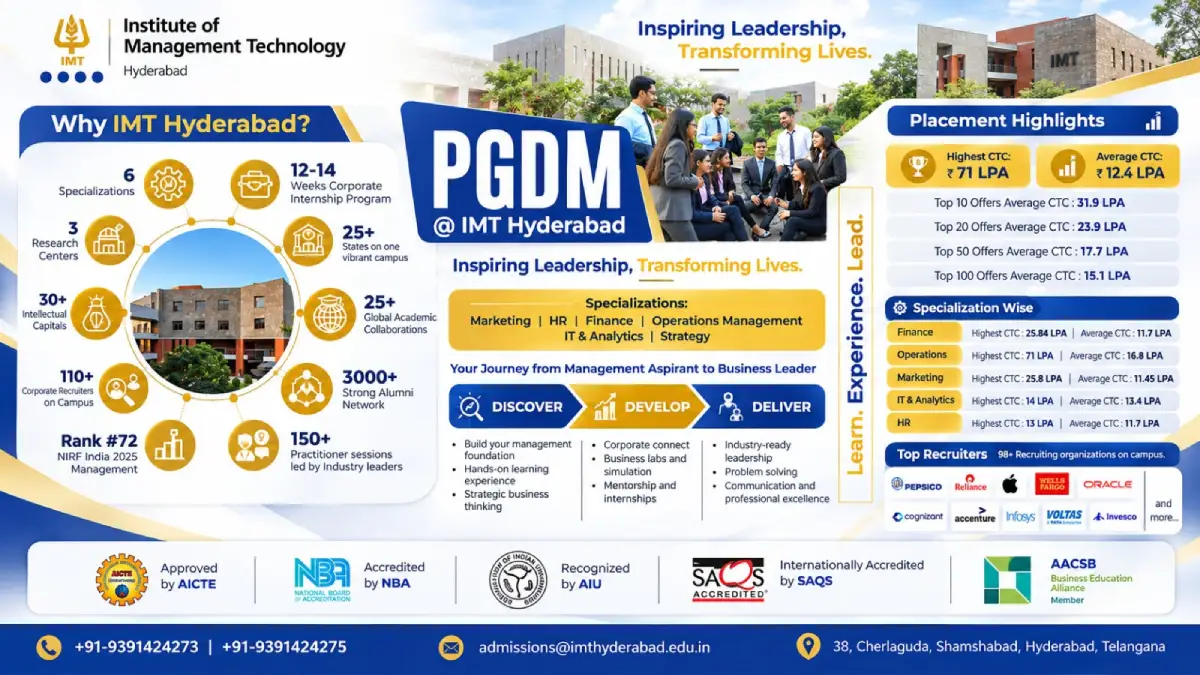
IMT Hyderabad accepts GMAT scores alongside CAT and XAT for its two-year, full-time, AICTE-approved residential programmes: the flagship PGDM programme, PGDM in Finance, PGDM in Marketing and PGDM in Logistics and Supply Chain Management. International applicants can apply with a CAT, XAT or GMAT score. If you submit more than one score, the institute considers your best one.
How IMT Hyderabad Uses Your Score for GMAT Admission
The process is straightforward. You register on the IMT Hyderabad PGDM admissions portal and update your GMAT score before the stated deadline. IMT looks at your aggregate score rather than sectional cut-offs, then combines it with your academic and professional profile to shortlist candidates. Shortlisted applicants attend the selection process, which includes a personal interview, and offers follow once evaluation is complete. The admissions FAQs answer common questions on scores, percentages and documents.
GMAT Admission Checklist for IMT Hyderabad Applicants
- A valid GMAT score (scores last five years – check the accepted test window for your batch)
- A recognised bachelor’s degree with the minimum aggregate stated for your batch
- Your passport or government ID, matching your application name
- Mark sheets and degree certificate, plus CGPA conversion if relevant
- An up-to-date CV showing internships or work experience
- Clear answers to “Why management?” and “Why IMT Hyderabad?” for the interview
It is worth looking at placement outcomes at IMT Hyderabad and the Global Immersion Programme before your interview, so your answers are specific rather than general.
A 12-Week GMAT Study and Application Timeline
Planning backwards from your application deadline is the simplest way to stay in control of your GMAT admission journey.
| Weeks | Focus | Milestone |
|---|---|---|
| 1–2 | Diagnostic test; revise core Quant and Verbal concepts | Baseline score and error log set up |
| 3–6 | Section-wise practice using official questions | Accuracy above 70% in untimed sets |
| 7–9 | Timed mixed sets; first full-length mocks | Pacing under control in all three sections |
| 10–11 | Full mocks under test conditions; targeted review | Mock scores stable near your target |
| 12 | Final official practice exam; light revision; test day | Official score |
| After the test | Send your score; complete applications; prepare for interviews | Shortlist and offer |
Common Mistakes to Avoid
- Name mismatch: a passport that does not match your registration can stop you at the door.
- Booking too late: last-minute slots are scarce near peak deadlines, and you lose the chance to retake.
- Using outdated material: books with Sentence Correction, essays or a 200–800 scale are for the old exam.
- Ignoring Data Insights: it counts as much as Quant and Verbal, and it is new to most students.
- Treating the score as everything: a strong interview and a clear career story often decide close calls.
Frequently Asked Questions
Is the GMAT accepted for PGDM admission in India?
Yes. Many Indian business schools accept the GMAT, including IMT Hyderabad for its full-time PGDM programmes. Several premium institutes also use it for one-year and executive programmes.
How many times can I take the GMAT?
You can take the GMAT up to five times in a rolling 12-month period, with at least 16 days between attempts. There is no lifetime limit.
How long is a GMAT score valid?
A GMAT score is valid for five years from your test date.
Can I take the GMAT without work experience?
Yes. GMAC does not require work experience. Freshers and final-year students can sit the exam and apply to PGDM programmes.
Does IMT Hyderabad accept GMAT scores?
Yes. IMT Hyderabad accepts GMAT, CAT and XAT scores for its PGDM programmes, and it considers your best score if you submit more than one.
What GMAT score do I need for GMAT admission at IMT Hyderabad?
There is no published cut-off, and the institute looks at aggregate scores rather than sectional cut-offs. A score of 645 or above is competitive and has featured in IMT Hyderabad’s scholarship criteria in recent cycles.
Where can I find GMAT question papers?
GMAC does not release past papers. Use the free official sample questions and the GMAT Official Starter Kit on mba.com, which includes two full-length practice exams.
Is the GMAT easier than CAT?
Neither is simply easier. The GMAT focuses on reasoning and data interpretation with no negative marking, while CAT tests speed and depth across a fixed annual window. Many students sit both to widen their options.
Final Thoughts
A strong GMAT score gives you rare flexibility: one test, five years of validity and access to programmes in India and overseas. Treat GMAT admission as a project with two halves – prepare with official material and well-reviewed mocks, then turn your score into an offer with a sharp application and a confident interview. If you are ready to take the next step, explore the PGDM programmes at IMT Hyderabad and start your application today.
Related Blogs

PG Diploma in Logistics: Scope, Eligibility, and Career Opportunities in India
Logistics has moved from a back-office function to one of the most strategically important areas…

PGDM Course Subjects at IMT Hyderabad: A Complete Guide to the Curriculum
Choosing a postgraduate management programme is a significant decision, and understanding the PGDM course subjects…
UPI, India’s Own Payment Method: A Modern Lesson for PGDM Courses and Future Business Leaders
Summary The Unified Payments Interface, known widely as UPI, has become the defining symbol of…

Why Hyderabad Is India’s Best City for MBA/PGDM in 2026: A Complete Guide
Introduction: The City You Choose Could Define Your Career When it comes to pursuing a…

Best Finance Courses in India 2026 — Complete Guide by IMT Hyderabad
1. Introduction — Why Finance Education Matters Right Now in India India’s financial ecosystem is…

Services Marketing: A Complete Guide to Marketing the Intangible
Services marketing is the branch of marketing that focuses on promoting and selling intangible offerings,…