UPI, India’s Own Payment Method: A Modern Lesson for PGDM Courses and Future Business Leaders
Home / PGDM / UPI, India’s Own Payment Method: A Modern Lesson for PGDM Courses and Future Business Leaders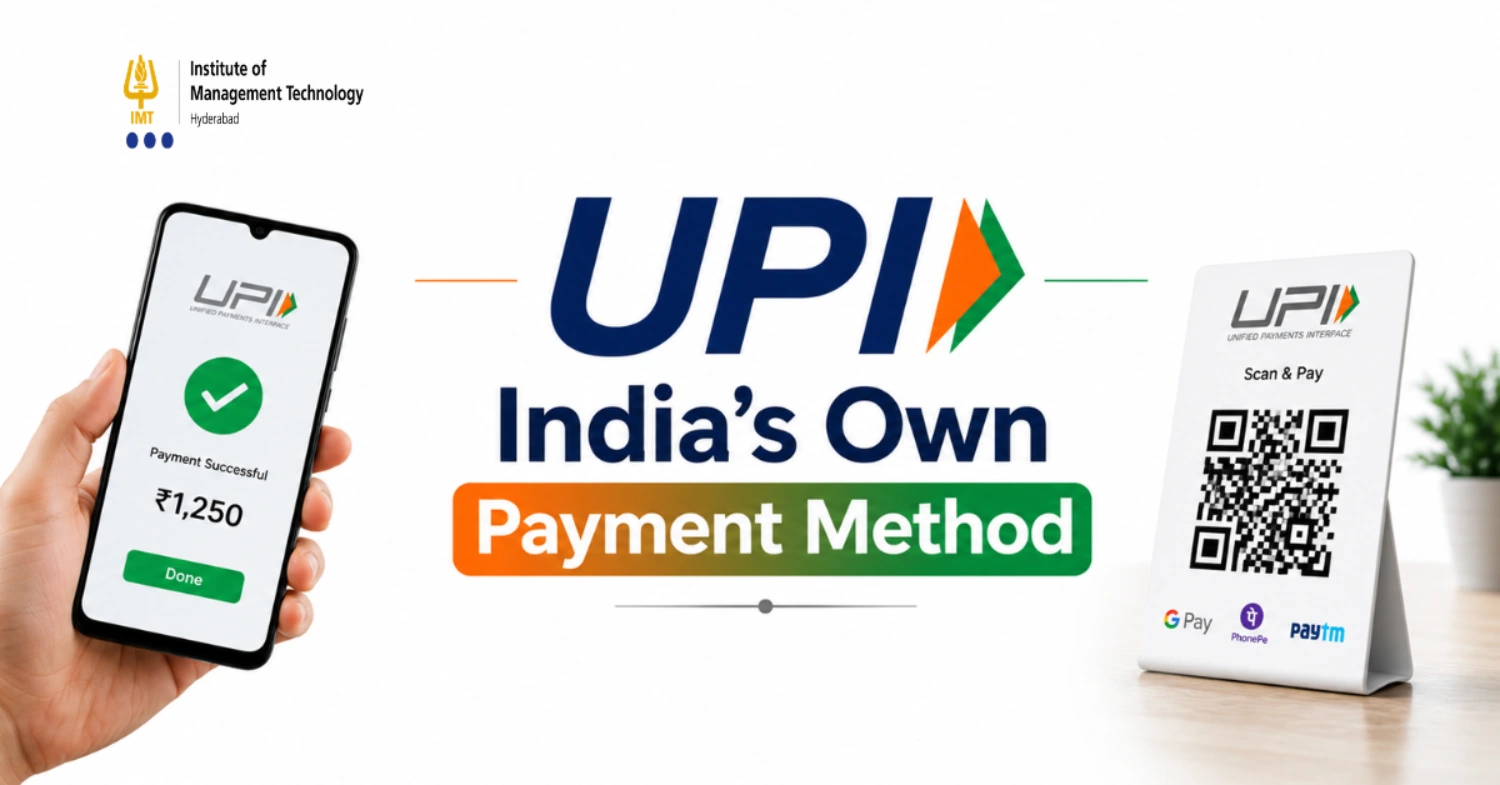
Summary
The Unified Payments Interface, known widely as UPI, has become the defining symbol of India’s digital economy. Built by the National Payments Corporation of India and regulated by the Reserve Bank of India, it now processes billions of transactions every month and accounts for close to half of all real-time payments made anywhere in the world. This article explains how UPI works, why it grew so rapidly, and what verified global data reveals about its scale. It then connects these developments to management education, showing how PGDM courses at institutions such as IMT Hyderabad prepare students to lead within a fast-changing digital economy.
Introduction
Few innovations have reshaped daily life in India as quickly as the Unified Payments Interface. A decade ago, cash dominated almost every purchase. Today, a vegetable seller, a large retailer, and a multinational bank all accept the same instant payment system through a simple mobile application. UPI is frequently described as India’s own payment method because it was designed within India, for Indian conditions, and is now studied across the world as a model of digital public infrastructure. For students considering PGDM courses, understanding this transformation is essential because the abilities it demands are exactly what the best management colleges in India aim to build.
What Is UPI and Why Is It Called India’s Own Payment Method?
UPI is a real-time payment system that allows money to move instantly between bank accounts through a mobile phone. It was launched on 11 April 2016 by the National Payments Corporation of India, operating under the regulatory oversight of the Reserve Bank of India, as recorded by the Press Information Bureau of the Government of India. A user can link several bank accounts to a single application and then send or receive funds using a virtual payment address or a quick response code, without sharing sensitive account numbers each time.
The description of UPI as India’s own payment method rests on three points. First, it was developed domestically by an Indian institution rather than imported from abroad. Second, it was built as open and interoperable public infrastructure, which means that any bank or approved application can connect to it. Third, it was designed for Indian realities, including small ticket purchases, large numbers of first time digital users, and a vast network of small merchants. These design choices help explain why the system spread so widely in such a short period and why it is now treated as a benchmark for instant mobile payments around the world.
How Did UPI Grow So Quickly Across India?
The scale of growth is difficult to overstate. According to the Press Information Bureau, annual transaction volume rose from about 2 crore transactions in the financial year 2016-17 to more than 24,162 crore transactions in the financial year 2025-26, which represents an increase of nearly twelve thousand times. Over the same period, the annual value of transactions grew from approximately 0.07 lakh crore rupees to around 314 lakh crore rupees, a rise of more than four thousand times.
Several factors drove this expansion. Low-cost mobile data, widespread smartphone ownership, and the rapid spread of quick response codes made acceptance simple and inexpensive for merchants of every size. The same government source records that 56.86 crore quick response codes were deployed to about 6.5 crore merchants during the financial year 2024-25. Person-to-merchant payments now account for roughly 63 percent of total transaction volume, and a striking 86 percent of these merchant payments are for amounts below 500 rupees. This pattern confirms that UPI has become the everyday tool for routine purchases such as groceries and street vendor bills, rather than a system reserved only for large transfers, and it is a central reason behind India’s rapid move toward a cashless economy.
| Indicator | Financial Year 2016-17 | Financial Year 2025-26 | Approximate change |
|---|---|---|---|
| Annual transaction volume | About 2 crore | More than 24,162 crore | Nearly 12,000 times |
| Annual transaction value | About 0.07 lakh crore rupees | About 314 lakh crore rupees | More than 4,000 times |
| Highest monthly volume | Not applicable | 2,163 crore (December 2025) | New all-time record |
Source: National Payments Corporation of India data, as reported by the Press Information Bureau, Government of India.
What Do the Most Recent UPI Figures Reveal?
Monthly data confirms that the system continues to set new records. The Press Information Bureau notes that December 2025 recorded 2,163 crore transactions, equal to 21.63 billion, the highest monthly volume in the entire history of UPI. A few months earlier, during the festive season, Business Standard reported that October 2025 transactions reached a value of about 27.28 lakh crore rupees across 20.7 billion transactions, with an average of 668 million transactions on each day of the month. The figures show steady year on year growth in both the number and the value of payments, driven by deeper use in everyday retail.
| Month (2025) | Volume (billion transactions) | Value (lakh crore rupees) |
|---|---|---|
| January | 16.99 | 23.48 |
| July | 19.47 | 25.08 |
| October | 20.70 | 27.28 |
| December | 21.63 | 27.97 |
Source: National Payments Corporation of India data, as reported by Business Standard and the Press Information Bureau, Government of India.
How Does UPI Compare With the Rest of the World?
The importance of UPI is not limited to India. The global payments technology firm ACI Worldwide, in its Prime Time for Real-Time 2024 report, found that India recorded 129.3 billion real-time payment transactions in 2023. That figure was about 49 percent of all real-time payments made anywhere in the world, and it was greater than the next ten largest markets combined. The same research placed Brazil in second position with roughly 14 percent of global volume, followed by Thailand, China, and South Korea. ACI Worldwide also reported that 84 percent of every electronic payment made in India is now real-time, which is one of the highest proportions of any major economy.
International recognition has followed this scale. As shared with the Indian Parliament and reported by the India Brand Equity Foundation, the International Monetary Fund in a June 2025 report described UPI as the world’s largest retail fast payment system measured by transaction volume. The Government of India confirmed the same position through the Press Information Bureau, noting that the system has become a global standard for interoperable and inclusive digital payments.
| Country | Real-time transactions in 2023 | Share of global volume |
|---|---|---|
| India | 129.3 billion | About 49 percent |
| Brazil | 37.4 billion | About 14 percent |
| Thailand | Not specified | About 8 percent |
| China | Not specified | About 7 percent |
| South Korea | Not specified | About 3 percent |
Source: ACI Worldwide, Prime Time for Real-Time 2024 report.
Why Is UPI More Than a Simple Payment Tool?
The significance of UPI extends well beyond convenience. By lowering the cost of accepting digital payments to nearly zero, it has brought millions of small traders, street vendors, and rural businesses into the formal financial system, which has strengthened financial inclusion across the country. It has also created an entire industry of financial technology companies that build services on top of the basic payment layer, including small lending, insurance, expense management, and investment products.
For businesses, UPI has changed how value is collected, recorded, and analysed. Every transaction generates structured data that can guide inventory decisions, marketing, and credit assessment. Newer features, such as credit lines offered through UPI, offline payments through UPI Lite, and acceptance in selected foreign countries, continue to widen its uses. The system therefore sits at the meeting point of finance, technology, operations, and marketing. These are the very disciplines that a Post Graduate Diploma in Management seeks to develop, which is why digital payments have become a frequent subject of study within business schools in India.
How Is UPI Expanding Beyond India’s Borders?
UPI is no longer confined to India. As recorded by the Press Information Bureau, the system, together with the related work of NPCI International, is being adopted or integrated by several countries, including the United Arab Emirates, Singapore, Sri Lanka, and France, which allows Indian residents and travellers to make and receive payments abroad. This cross-border expansion supports remittance flows and strengthens India’s position in the global financial landscape. Industry analysts at PwC have projected that the platform could reach about one billion transactions on a single day within the next few years, although such forward-looking estimates should be treated as projections rather than confirmed figures. Even on a cautious view, the direction of travel is clear, and it points toward a deeper role for instant digital payments in trade, services, and everyday commerce.
What Does the UPI Story Mean for Students Choosing PGDM Courses?
The rise of UPI offers a clear lesson for anyone considering postgraduate management study. The professionals who designed, scaled, and now manage this system combine knowledge of finance, technology, supply chains, marketing, and general management. These are precisely the areas covered by a Post Graduate Diploma in Management, commonly known as a PGDM. As digital payments reshape banking, retail, logistics, and information technology, employers increasingly seek graduates who can connect business strategy with digital systems. This demand is one reason why PGDM courses, including PGDM finance colleges and programmes in logistics and information technology, continue to attract strong interest from prospective students who are searching for the best management colleges in India.
How Do PGDM Courses at IMT Hyderabad Connect With the Digital Economy?
The Institute of Management Technology, Hyderabad, described on its official admissions page as one of the top PGDM colleges in India, offers an industry-driven, two-year, full-time residential PGDM programme with strong placements and an established alumni network. According to the institute, the programme is approved by the All India Council for Technical Education and is offered across specialisations that map closely to the skills required by a digital economy. These specialisations include General Management, Finance, Marketing, Information Technology, and Logistics and Supply Chain Management.
Each specialisation has a clear link to the world that UPI has helped to create. The table below shows how a system of real-time payments connects to the major fields of study within the postgraduate diploma offered at IMT Hyderabad.
| PGDM specialisation | Relevance to a UPI-driven digital economy |
|---|---|
| Finance | Designing and managing digital payment products, using payment data for lending, and handling risk and compliance within banking and financial services |
| Logistics and Supply Chain Management | Coordinating payments across suppliers, supporting e-commerce fulfilment, and enabling cash-light last-mile delivery |
| Information Technology | Building, scaling, and securing the platforms and data systems that power real-time payments |
| Marketing | Understanding consumer behaviour in cashless retail and encouraging merchant adoption of digital payments |
| General Management | Leading organisations through digital transformation and converting payment data into business strategy |
Source: IMT Hyderabad official admissions information.
Prospective applicants usually evaluate eligibility, entrance requirements, accreditation, fees, and placement outcomes before choosing a programme. The institute states that admission to the PGDM programme is based on scores from recognised national entrance examinations such as CAT, XAT, and GMAT, together with a Bachelor’s degree, and that candidates appearing in their final year may also apply. Detailed and current information on fees, the structure of each specialisation, and recent placement records should be checked directly on the official IMT Hyderabad admissions page and the institute website, because these figures are reviewed in every admission cycle. [VERIFY: confirm the exact PGDM fee, intake per specialisation, and the most recent placement averages against the official IMT Hyderabad admissions and placements pages before publication.]
Key Takeaways for Prospective Students
UPI demonstrates how a well-designed digital system can transform an entire economy within a single decade. Its scale, with more than 24,000 crore transactions in a single financial year and close to half of the world’s real-time payments, makes it one of the most significant financial innovations of the modern era. For students, the deeper lesson is that the digital economy rewards professionals who can combine financial insight, technological understanding, and management skill. PGDM courses at institutions such as IMT Hyderabad are structured to build exactly this combination, preparing graduates to lead within a payment landscape that India itself helped to define.
References
- Press Information Bureau, Government of India. UPI Completes 10 Glorious Years, Emerges as World’s Largest Real-Time Payments Platform. Available at: https://www.pib.gov.in/PressReleasePage.aspx?PRID=2257087®=3&lang=1
- Press Information Bureau, Government of India. UPI Recognized as World’s Largest Real-Time Payment System by IMF. Available at: https://www.pib.gov.in/PressReleasePage.aspx?PRID=2200569®=3&lang=1
- National Payments Corporation of India. Unified Payments Interface (UPI) Ecosystem Statistics. Available at: https://www.npci.org.in/what-we-do/upi/upi-ecosystem-statistics
- ACI Worldwide. Real-Time Payments in India, Prime Time for Real-Time 2024 Report. Available at: https://www.aciworldwide.com/real-time/india
- Business Standard. UPI Transactions Surge to Record 27.28 Trillion Rupees in October Festive Rush. Available at: https://www.business-standard.com/economy/news/upi-transactions-hit-record-high-of-rs-27-28-lakh-crore-in-oct-125110300839_1.html
- India Brand Equity Foundation (IBEF). UPI Recognized as World’s Largest Real-Time Payment System by IMF. Available at: https://www.ibef.org/news/upi-recognized-as-world-s-largest-real-time-payment-system-by-imf
- Institute of Management Technology, Hyderabad. PGDM Admissions. Available at: https://www.imthyderabad.edu.in/admissions/pgdm
- Institute of Management Technology, Hyderabad. Official Institute Website. Available at: https://www.imthyderabad.edu.in/
Related Blogs

PGDM Course Subjects at IMT Hyderabad: A Complete Guide to the Curriculum
Choosing a postgraduate management programme is a significant decision, and understanding the PGDM course subjects…
PG Diploma in Logistics: Scope, Eligibility, and Career Opportunities in India
Logistics has moved from a back-office function to one of the most strategically important areas…
Services Marketing: A Complete Guide to Marketing the Intangible
Services marketing is the branch of marketing that focuses on promoting and selling intangible offerings,…
Why Hyderabad Is India’s Best City for MBA/PGDM in 2026: A Complete Guide
Introduction: The City You Choose Could Define Your Career When it comes to pursuing a…

Best Finance Courses in India 2026 — Complete Guide by IMT Hyderabad
1. Introduction — Why Finance Education Matters Right Now in India India’s financial ecosystem is…