How Reliance Jio Revolutionized India’s Telecom Industry: Strategic Lessons for PGDM Students
Home / Case Study / How Reliance Jio Revolutionized India’s Telecom Industry: Strategic Lessons for PGDM Students
Summary
This case study examines how Reliance Jio transformed India’s telecommunications industry within a few years of its commercial launch in 2016. It explains the pricing, network, marketing and platform decisions that allowed a late entrant to become the country’s largest mobile operator. The study is written for prospective students who are exploring the PGDM curriculum and management education in India. Each business decision is linked to a field of management study, including marketing, operations, finance and strategy, so that readers can understand how classroom frameworks apply to a major and well documented Indian enterprise. The aim is learning rather than promotion.
Introduction
Reliance Jio offers one of the clearest recent examples of how a single strategic move can reshape an entire industry. When Jio launched its services in September 2016, India’s mobile market was crowded, prices were high, and data use was limited. Within a short period, Jio changed how more than a billion people connect, communicate and transact. For students considering the top PGDM colleges in India, the Jio story provides a structured way to study competition, pricing, operations and digital strategy together. This case study presents the verified facts and figures, and then draws out the lessons that ambitious managers should understand.
What was the Indian telecom market like before Jio?
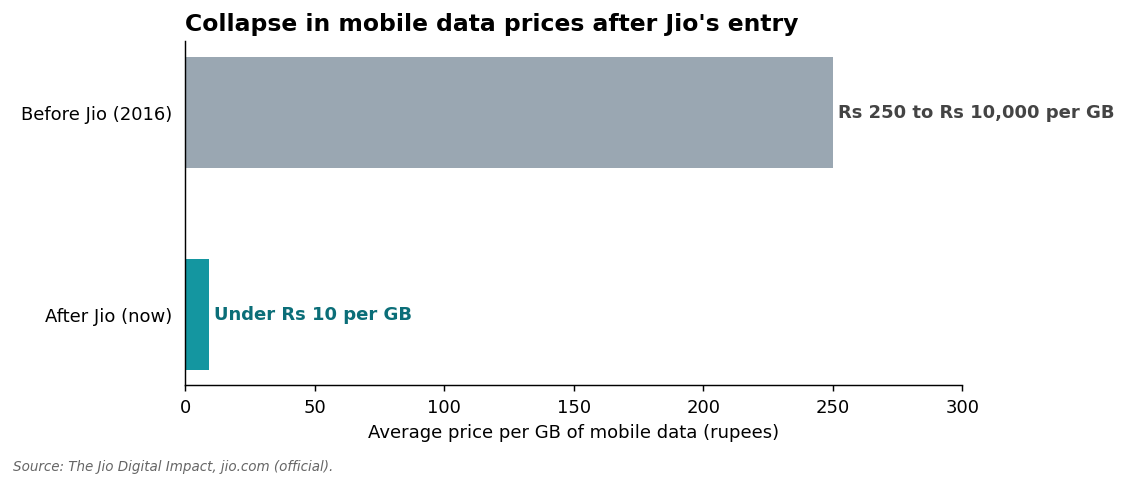
Before Jio entered the market in 2016, mobile data in India was expensive and scarce. The price of one gigabyte of data ranged from around 250 rupees to as much as 10,000 rupees, and the average user consumed only about 240 megabytes each month. India’s share of global mobile data traffic stood at less than one percent, and most subscribers used their phones mainly for voice calls and text messages. The market was led by established operators such as Bharti Airtel, Vodafone and Idea, each offering plans at relatively high data costs. A large part of the population remained outside the digital economy because connectivity was simply unaffordable. This was the gap that Jio set out to close, and the size of that gap explains the scale of what followed.
How did Jio’s launch strategy disrupt the market?
Jio’s commercial launch on 5 September 2016 was built around a bold introductory plan. Under its Welcome Offer, the company provided free voice calls, free data and free messaging for a limited period, an approach that instantly attracted a very large number of subscribers. Unlike the incumbents, which still earned a large share of revenue from voice calls, Jio made voice calls free and competed almost entirely on the price and quality of data. The result was an immediate and dramatic shift. The average price of data fell to less than ten rupees per gigabyte, compared with the earlier range of 250 to 10,000 rupees. For a marketing student, this is a clear study of penetration pricing, where a very low introductory price is used to win a large customer base quickly and to change long term buying habits across the whole market.
Why was network and infrastructure investment central to the strategy?
The free launch was possible only because of years of preparation. Jio built a nationwide fourth generation network from the ground up, designed for data first rather than adapted from older voice networks. This network now reaches more than ninety nine percent of the population, connects around twenty five million homes through fibre, and is supported by roughly nine thousand digital stores, more than one million merchant partners and about three million associates who help customers join and use the service. Building this capacity required enormous and patient capital investment before any revenue was earned. For students interested in a PGDM in logistics and supply chain management, this is an instructive example. It shows how investment in infrastructure, distribution and operational capacity can create an advantage that competitors find very difficult to copy.
How did Jio change consumer behaviour and the data economy?
The effect on everyday life was profound. After Jio, per capita data usage in India rose roughly one hundred times, and the country’s share of global mobile data traffic climbed from about one percent to around twenty one percent. To bring users who were still on older networks into the data economy, Jio developed affordable devices, and about one hundred million people used the JioPhone to move from second generation to fourth generation services. Cheap and plentiful data supported rapid growth in digital payments, online education, streaming entertainment and electronic commerce. The case demonstrates how a change in the price and availability of a single input, in this case data, can unlock demand across many connected industries and can accelerate the growth of a national digital economy.
| Indicator | Before Jio (2016) | After Jio |
|---|---|---|
| Average price per gigabyte of data | Rs 250 to Rs 10,000 | Under Rs 10 |
| Per capita data usage | Low, about 240 MB per month | Around 100 times higher |
| India’s share of global mobile data traffic | Less than 1 percent | About 21 percent |
Figures sourced from The Jio Digital Impact, jio.com (official). See references.
How did competition and the industry structure change?
Jio’s entry reshaped the competitive structure of the entire industry. Faced with free voice and very low data prices, the older operators were forced to reduce their own tariffs sharply, which placed severe pressure on their revenues and profits. Several companies could not survive the new conditions. Operators such as Aircel and Tata Docomo exited the market, while Vodafone and Idea, once strong rivals, merged in 2018 in order to compete. A market that had once contained around a dozen operators was reduced to a small number of large players. For a student of strategy and economics, this is a clear illustration of how a disruptive entrant can trigger industry consolidation and permanently change the basis on which firms compete.
How did Jio convert disruption into a digital platform business?
Jio did not remain only a telecom operator. Its parent reorganised the digital businesses under a holding company, Jio Platforms, which was established in 2019. In 2020, Jio Platforms raised about 152,056 crore rupees, equal to more than twenty billion United States dollars, in exchange for a 32.97 percent stake, attracting global investors that included Meta and Google. Meta alone invested 43,574 crore rupees for a 9.99 percent holding. In the 2025 financial year, Jio Platforms reported revenue of about 128,218 crore rupees. This phase of the story belongs to the study of finance and corporate strategy. It shows how a strong operating position can be converted into a valuable platform that attracts patient global capital and funds the next stage of growth.
Where does Jio stand today, and what do the figures show?
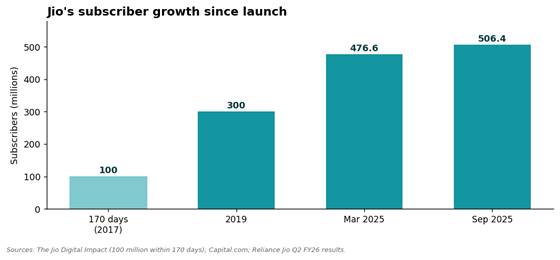
The scale of Jio today reflects the success of these decisions. The company crossed one hundred million users within one hundred and seventy days of launch, at a rate of about seven new users every second. By the quarter ending September 2025, its subscriber base had grown to 506.4 million, and its average revenue per user had risen to 211.4 rupees, up from 195.1 rupees a year earlier. Jio is now widely recognised as India’s largest mobile operator, with a base of more than 460 million subscribers and a leading position in the rollout of fifth generation services. These figures matter for students because they connect strategy to measurable outcomes such as subscriber growth, revenue per user and clear market leadership.
| Parameter | Detail |
|---|---|
| Commercial launch | 5 September 2016 |
| Users within 170 days | About 100 million |
| Subscribers, September 2025 | 506.4 million |
| Average revenue per user, September 2025 | Rs 211.4 |
| Jio Platforms revenue, FY2025 | About Rs 128,218 crore |
| Capital raised by Jio Platforms in 2020 | About Rs 152,056 crore for 32.97 percent |
Figures sourced from jio.com, Sunday Guardian and Wikipedia. See references.
What strategic lessons can PGDM students draw from the Jio case?
The Jio case is valuable because each major decision maps onto a field of management study. The pricing and brand building belong to marketing. The ground up network, the device ecosystem and the distribution system belong to operations and supply chain management. The reorganisation into Jio Platforms and the large investment round belong to finance and corporate strategy. The reading of an underserved market and the timing of entry belong to business strategy and economics. A student who studies Jio therefore practises thinking across several functions at the same time, which is exactly what employers expect from graduates of strong management programmes. The case also shows that disruption is rarely a matter of luck. It usually rests on long preparation, heavy investment and a clear view of unmet customer demand.
How does the IMT Hyderabad PGDM curriculum turn cases like Jio into capability?
Cases such as Jio are most useful when they are studied within a structured programme that builds both knowledge and judgement. The Institute of Management Technology, Hyderabad, established in 2011 as part of the IMT Group, offers a two year full time Post Graduate Diploma in Management whose curriculum is designed around this kind of applied learning. The first year is organised into three trimesters of core courses that are compulsory for all students, after which learners choose electives through a flexible system that lets them shape study around their goals. Students may specialise in Marketing, Finance and Accounting, Human Resource Management, Operations Management, or Business Analytics and Information Technology, and the institute offers focused tracks that include a pgdm in marketing and a PGDM in logistics and supply chain management through its PGDM in Logistic and Supply Chain Management track. This range allows a single case such as Jio to be examined from several angles within one classroom.
The programme is delivered with a strong industry orientation, and a meaningful share of teaching is led by senior corporate practitioners, which helps students connect frameworks to live business problems of the kind seen in the Jio case. The institute is approved by the All India Council for Technical Education, accredited by the National Board of Accreditation, holds South Asian Quality Assurance System accreditation, and is a member of international bodies including AACSB and EFMD. It has been ranked among management institutions in the National Institutional Ranking Framework, which places it among recognised providers of management education in India. Admission is based on national entrance examinations such as CAT, XAT and GMAT, followed by a structured selection process. Prospective students who are comparing the top PGDM colleges in India and studying the PGDM curriculum in detail should review the official programme pages and the latest placement report before applying IMT Hyderabad PGDM admissions.
The institute reports a strong placement record across sectors such as consulting, finance, information technology and marketing.
Read More: IMT Hyderabad Placement Report 2025
| Decision in the Jio Case | Related PGDM Area at IMT Hyderabad |
|---|---|
| Free launch and aggressive pricing | Marketing |
| Reorganisation into Jio Platforms and capital raising | Finance and Accounting |
| Ground up network, devices and distribution | Logistics and Supply Chain Management, and Operations |
| Use of customer and usage data | Business Analytics and Information Technology |
| Market entry timing and competitive strategy | General and Strategic Management |
Conclusion
Reliance Jio shows that lasting advantage comes from aligning strategy, operations, marketing and finance around a clear understanding of customer need. For prospective students, the value of the case lies not only in the scale of the outcome but in the discipline of analysing how that outcome was built. A rigorous postgraduate programme provides the frameworks and the guided practice needed to study such cases in depth and to apply the same thinking to new problems in a changing economy. Students who learn to read a business in this way are better prepared for the responsibilities of management.
Frequently Asked Questions (FAQs)
1. When did Reliance Jio launch and why was it disruptive?
Jio launched commercial services on 5 September 2016 with free voice calls and very low data prices, which forced the whole market to reduce tariffs and shifted competition to data.
2. What can PGDM students learn from the Reliance Jio case study?
The case illustrates penetration pricing, large scale network and supply chain investment, industry consolidation, and the move into a platform business, all within one example.
3. Does IMT Hyderabad offer a PGDM in logistics and supply chain management?
Yes. IMT Hyderabad offers a PGDM (LSCM) track along with Marketing, Finance, Information Technology and other specialisations.
References
-
- https://www.jio.com/aboutus/jio-digital-impact/
- https://www.bisinfotech.com/jio-and-the-transformation-of-the-indian-telecom-industry/
- https://www.hbsp.harvard.edu/product/W17175-PDF-ENG
- https://en.wikipedia.org/wiki/Jio_Platforms
- https://sundayguardianlive.com/business/jio-subscriber-base-crosses-500-million-arpu-rises-to-rs-2114-156701/amp/
- https://www.ril.com/news-media/press-releases/facebook-invest-rs43574-crore-jio-platforms-999-stake
- https://capital.com/en-int/learn/ipo/reliance-jio-infocomm-ipo
- https://franchisetimes.co.in/jio-telecom-disruption-india/
- https://www.imthyderabad.edu.in/studying-at-imt-hyderabad
- https://www.imthyderabad.edu.in/admissions/specializations
- https://www.imthyderabad.edu.in/admissions/pgdm
- https://www.mbauniverse.com/college/hyderabadmba/institute-of-management-technology-imt-
hyderabad/rankings - https://www.careers360.com/colleges/institute-of-management-technology-hyderabad
Related Blogs
How Titan Became One of the World’s Largest Watch Manufacturers
Summary This case study examines how Titan, a joint venture between the Tata Group and…
The Apple Comeback Under Tim Cook: A Business Case Study for PGDM Courses and Future Managers
Summary When Tim Cook became chief executive of Apple in 2011, many people doubted that…

Pepsi Vs Coca-Cola: The Cola Wars and What They Teach Future Business Leaders
Summary The rivalry between Pepsi and Coca-Cola, widely known as the Cola Wars, is one…
Zepto vs Blinkit vs Instamart: A Strategic PGDM Case Study of India’s Quick Commerce Revolution
Why is India’s quick commerce revolution worth studying? Quick commerce is the fastest-adopted retail format…
UPI Case Study: How India Built the World’s Largest Real-Time Payment Network
How did a payment system built in India go on to process nearly half of…