How Titan Became One of the World’s Largest Watch Manufacturers
Home / Case Study / How Titan Became One of the World’s Largest Watch Manufacturers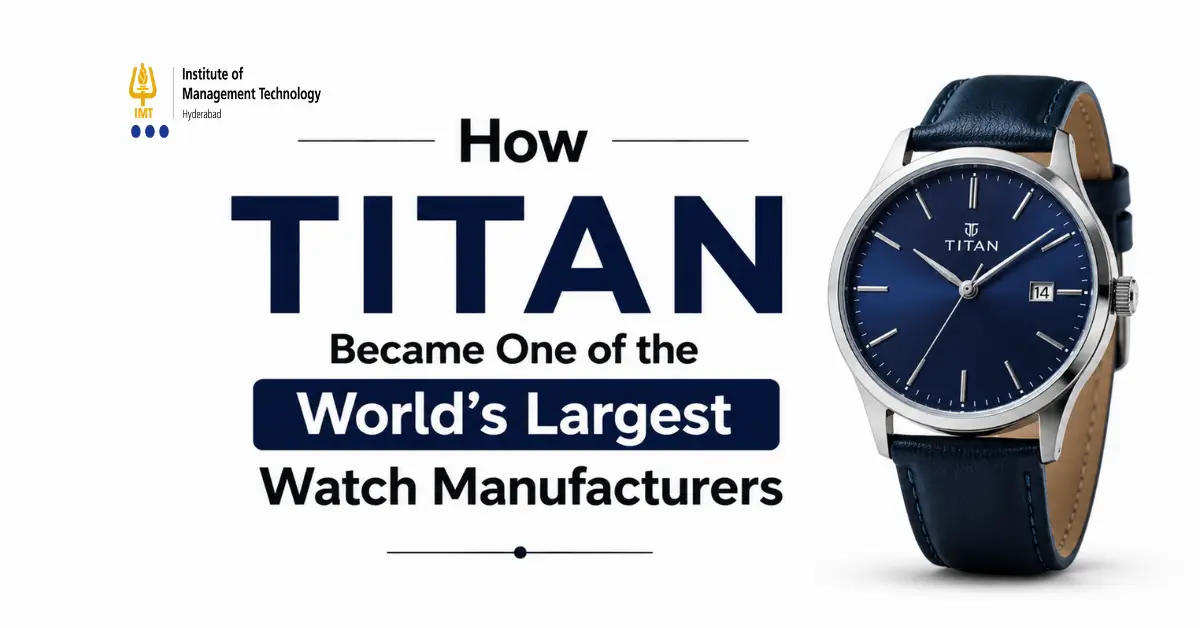
Summary
This case study examines how Titan, a joint venture between the Tata Group and the Tamil Nadu Industrial Development Corporation, grew from a new entrant in 1984 into the world’s fifth largest watch manufacturer and India’s most valuable consumer lifestyle company. It traces the decisions, and the mistakes, that built the business across branding, manufacturing, supply chain, retail and diversification. Unlike a simple success story, the study gives equal weight to two episodes where Titan nearly got it wrong, the costly retreat from Europe and the near collapse of Tanishq, because those decisions carry the sharpest lessons. The case is written for prospective students who are comparing PGDM courses and the best management colleges in India, and it links each business decision to a field of management study so that readers learn to think like managers rather than admire an outcome from a distance.
Introduction
Few Indian companies illustrate the link between strategy and execution as clearly as Titan. When operations began in 1984, the domestic watch market was small, conservative and led by a state owned incumbent whose mechanical watches were durable but plain. Within four decades Titan reshaped how a nation viewed watches, built a vertically integrated manufacturing base that rivals can still not easily match, and crossed fifty thousand crore rupees in annual income. The path was not smooth. Titan poured money into a European launch that failed, and its jewellery venture lost money for years before a single decision rescued it. For a management student, that mix of bold strategy, expensive error and disciplined recovery is exactly what makes the case worth studying.
How did Titan enter a watch market that an incumbent already controlled?
Titan commenced operations in 1984 as Titan Watches Limited, a joint venture between the Tata Group and the Tamil Nadu Industrial Development Corporation, and it launched its first quartz watch range in March 1987. At that time the market was led by the state owned manufacturer HMT, whose mechanical watches were reliable but dated. HMT had built a strong brand, yet it remained committed to mechanical movements and was slow to read the global shift to quartz. Titan saw the gap. Indian consumers were ready for watches that combined accurate quartz technology with attractive design, and no large producer was serving that need.
The founding leadership, guided by managing director Xerxes Desai, treated the watch not as an instrument for telling time but as a personal accessory that expressed taste. Early advertising made the point directly, presenting the Titan quartz as an international watch that could be bought in rupees, without a trip to Europe or a duty free shop. The strategy worked quickly. Titan sold its first one million watches by 1989. HMT eventually devoted part of its output to quartz in the early 1990s, but the move came too late, and the former champion lost share through the decade until the government finally closed its watch business in 2016. For a student of marketing strategy, the opening lesson is that a clear reading of unmet demand, paired with the courage to redefine a product category, can unseat an entrenched leader.
Why did Titan’s brand portfolio change how India bought watches?
A single product could not serve a market with very different incomes and tastes, so Titan built a portfolio of focused brands, each aimed at a distinct group of buyers. Sonata addressed value conscious customers and was strengthened after Titan ended its joint venture with Timex in 1998. Fastrack, launched as an independent youth brand in 2005, targeted young buyers with trendy and affordable designs. Raga was designed for women, while premium and luxury labels such as Xylys and Nebula served buyers at the higher end. To defend its position as foreign brands and cheap imports entered after liberalisation, Titan also invested heavily in advertising and signed the actor Aamir Khan as a brand endorser in 2004.
This is a textbook example of market segmentation and brand architecture. Rather than stretching one name across all price points, Titan gave each segment a brand it could identify with, which protected the company from price competition at the bottom of the market and from aspiration driven competition at the top. For a marketing student, the lesson is direct. Disciplined segmentation, supported by patient and consistent investment in brand equity, can change consumer behaviour across an entire category.
What did the failed push into Europe teach Titan about strategy?
Not every Titan decision succeeded, and the European venture is the clearest example. Titan made its first international move in 1989 by exporting watch movements, then launched its first watches in the Middle East in 1991, starting in the United Arab Emirates where a large resident Indian population already knew the brand. Encouraged by this, Xerxes Desai pursued a far more ambitious plan known internally as the Euro Watch Project. A special division was built at the Hosur plant to manufacture high quality cases and bracelets, European designers were hired, and the company planned a simultaneous launch across the United Kingdom, France, Spain, Austria and the Netherlands. The plan even included an attempt to acquire the exclusive Swiss brand Gerald Genta, whose owners reportedly demanded around forty million Swiss francs, a sum that proved too high.
The launch began in 1995 with a pan European advertising campaign of about ten million United States dollars. It did not work. European buyers did not accept a new Indian brand at the price point Titan wanted, distribution was difficult, and the company had to build an entirely new product line for the region. After years of mounting losses, Titan wound up its European operations, having absorbed losses of around one hundred and ten crore rupees on the continent over the decade. The episode reshaped the company’s thinking. When Titan returned to international expansion through the Gulf market, it chose a conservative and cautious approach built around established local distributors rather than a large advertising assault. For students of strategy and international business, the lesson is that ambition must be matched to market realities, that brand equity does not transfer automatically across borders, and that a disciplined retreat can be a sound decision rather than a failure of nerve.
How did manufacturing and supply chain become a competitive weapon?
The visible success of Titan rests on a less visible foundation of manufacturing strength. The company built a vertically integrated production base, most famously at its plant in Hosur near Bengaluru, supported by assembly units at Dehradun, Pantnagar and Roorkee and an electronic sub assembly facility in Goa. Titan sourced its early movement technology from the French firm France Ebauches and later developed deep in house engineering capability. Today the company produces between fifteen and eighteen million watches a year and remains the world’s fifth largest integrated own brand watch manufacturer by volume. Quartz still accounts for about ninety percent of output, which allows Titan to reach every income level across India, while a growing high end programme now includes mechanical and tourbillon watches developed in house.
Vertical integration gave Titan control over quality, cost and the pace of innovation, and it let the company introduce features and designs that competitors found hard to copy. For students interested in a PGDM in logistics and supply chain management, this part of the case is especially instructive, because it shows how the careful management of sourcing, production and distribution can become a durable competitive advantage rather than a routine support function.
| Operational indicator | Approximate figure |
|---|---|
| Year operations began | 1984, first quartz range launched March 1987 |
| Annual watch production | Around 15 to 18 million units |
| Quartz share of output | About 90 percent |
| Position in global watchmaking | World’s fifth largest integrated own brand manufacturer by volume |
| Share of India’s organised watch market | Around 60 percent |
| Main manufacturing site | Hosur, Tamil Nadu, with units at Dehradun, Pantnagar, Roorkee and Goa |
Figures sourced from Europa Star and Titan Company corporate information. See references.
How have Titan’s watch numbers and revenue actually grown?
The scale of the change is easier to grasp through numbers than through description. When Titan began, India produced only about one and a half million watches a year, of which the state owned HMT alone made around one million. Titan’s first set of five quartz watches, launched in 1987, was priced between three hundred and fifty and nine hundred rupees. The brand sold its first one million watches by 1989, and by 31 March 2018 its cumulative production since launch had reached around two hundred and twenty five million pieces. Today it makes between fifteen and eighteen million watches a year.
The more striking shift is in where the money comes from. Watches once generated about seventy percent of Titan’s revenue. Today the watches and wearables segment contributes only around eight percent, while jewellery, led by Tanishq, accounts for roughly eighty five percent and eyewear and other businesses make up the rest. The watch business did not shrink. It still grows in absolute terms. The company simply grew far faster in jewellery, which is the clearest possible illustration of how diversification reshaped the firm.
| Indicator | Figure |
|---|---|
| India’s annual watch output before Titan, mid 1980s | About 1.5 million, of which HMT made around 1 million |
| Price of the first Titan watches, 1987 | Between 350 and 900 rupees, for the first set of five models |
| Watches sold by 1989 | One million |
| Cumulative watches produced by 31 March 2018 | Around 225 million |
| Annual watch production today | Around 15 to 18 million |
| Watches as a share of company revenue | From about 70 percent historically to roughly 8 percent today |
| Jewellery as a share of company revenue, FY2025 | Around 85 percent |
| Share price, all time low | 1.35 rupees on 17 September 2001 |
| Share price, all time high | About 4,605 rupees on 8 May 2026 |
Figures sourced from Titan Company, Europa Star, Screener and exchange price records. See references.
How did Tanishq form, fail, and then bounce back?
The most valuable lesson in the Titan story is not a success but a recovery, and it belongs to Tanishq. The name combines Tan, the Tata connection and the idea of the body, with Nishq, an ancient word for a gold ornament. The journey from launch to rescue is the part of the case that rewards the closest study.
How Tanishq was formed
Titan entered the jewellery market in 1994 and opened its first Tanishq boutique on Cathedral Road in Chennai. The early collections were made in eighteen carat gold with diamonds and contemporary, European influenced designs, and the business was conceived partly with an eye on export markets. The reasoning seemed sound on paper. Eighteen carat gold is harder, more scratch resistant and less expensive than twenty two carat, so Titan expected lighter and more modern pieces to attract buyers who wanted design rather than weight.
Why Tanishq failed in its early years
The assumption was wrong, and it was wrong for cultural reasons that a closer reading of the customer would have revealed. In India, gold jewellery is bought as investment, as a store of family wealth, and for weddings and religious occasions, and twenty two carat purity is the accepted and auspicious standard. Buyers also trusted the neighbourhood jeweller their family had used for years. Tanishq’s eighteen carat European pieces spoke to almost none of these needs, and sales stayed weak through the financial years 1995 to 1996, 1996 to 1997 and 1997 to 1998.
The losses mounted. By 2001, Tanishq had absorbed accumulated losses of around one hundred and fifty crore rupees, and the strain showed in the share price. Titan touched its all time low of one rupee and thirty five paise on 17 September 2001, a figure worth holding in mind against the all time high of about four thousand six hundred rupees reached in May 2026. With the business in difficulty, the Tata Group commissioned a study, and the decision on whether to continue was left to the managing director, Xerxes Desai. He chose to stay in jewellery, but only after correcting the original mistakes rather than hoping the market would change.
How Tanishq bounced back
The first correction was to abandon the eighteen carat strategy and offer twenty two carat gold across the stores, in line with what customers actually wanted. The second was the introduction in 1999 of the Karatmeter, a device imported from Germany at a cost of around one million rupees per unit that used X rays to measure the purity of any gold ornament in about three minutes. Titan invited customers to walk in and test their existing jewellery for free. A survey by the National Council of Applied Economic Research had found that nearly forty four percent of gold jewellery sold in India was of eighteen carat purity or lower, against the twenty two carat standard, and when customers tested their own pieces, a large share were found to be less pure than promised.
Even then, sales did not move at first. Customers came to test their gold, discovered they had been short changed by their old jewellers, and left without buying, because Titan had exposed a problem without offering a way out. The breakthrough was a scheme called Impure to Pure. A customer whose jewellery tested between nineteen and twenty two carat could exchange it for genuine twenty two carat Tanishq jewellery by paying only the making charges. The offer converted distrust of the traditional jeweller into active trust in Tanishq, and it brought buyers into the stores in large numbers. Tanishq turned its first profit in the financial year 2000 to 2001 and went on to become the largest jewellery brand in India, later extended through Mia, Zoya and the online jeweller CaratLane. For students of marketing and consumer behaviour, the case is a complete lesson in itself. It shows the danger of assuming customer preferences rather than studying them, the difference between exposing a problem and solving it, and the long term value of building informed trust rather than relying on blind loyalty.
How did controlled retail build the brand and generate market intelligence?
A strong product needs an equally strong route to the customer. Titan was among the first Indian companies to invest in organised, branded retail at scale. It created dedicated stores under the World of Titan banner, multi brand formats such as Helios for watches, and exclusive boutiques for Tanishq and its sub brands. The wider Titan retail network has grown to more than three thousand three hundred stores across more than four hundred towns, with a retail footprint of several million square feet. Controlled retail allowed Titan to manage how its brands were presented, to gather direct information about customer preferences, and to deliver a consistent experience across the country.
This turned the act of buying a watch or a piece of jewellery into a considered and aspirational purchase rather than a routine transaction. Students of operations and of business analytics can study how this controlled distribution model supported brand building and data driven decision making at the same time, because the retail network became both a sales channel and a continuous source of market intelligence.
How did diversification reduce risk and create new growth?
Titan did not remain a single category business. After entering jewellery with Tanishq in 1994, it moved into eyewear through Titan Eyeplus in 2007, into youth accessories through Fastrack, into fragrances through Skinn in 2013, and later into wearables and ethnic wear. Over time, jewellery grew to become by far the largest contributor to company revenue, overtaking watches around 2010 and reducing the firm’s dependence on any single product line. This is a clear illustration of corporate strategy and portfolio management, and it maps neatly onto the Ansoff matrix, since Titan combined market penetration in watches with diversification into related lifestyle categories where its strengths in design, retail and brand trust could be reused.
The expansion was funded and managed with discipline, and new businesses were given time to mature rather than being judged only on short term results, a patience that the Tanishq turnaround had already proven was necessary. For students exploring PGDM finance colleges, the case offers a practical view of how diversification, capital allocation and patient investment shape the long term value of a company.
Which brands sit under Titan Company today, and when did it move beyond watches?
Titan Company now operates a portfolio of more than twenty consumer brands organised into clear business divisions. The decision to look beyond watches was taken early. The company renamed itself Titan Industries Limited in 1993 to signal ambitions beyond timepieces, and it made its first major move outside watches the very next year, when it launched Tanishq in jewellery in 1994. Eyewear followed with Titan Eyeplus in 2007, fragrances with Skinn in 2013, and over the following years the company added ethnic dresswear through Taneira, online jewellery through the acquisition of CaratLane, and a range of fashion accessories. The brands listed below are drawn from the official Titan Company website.
| Business division | Brands |
|---|---|
| Watches and wearables | Titan, Sonata, Fastrack, Raga by Titan, Nebula, Xylys, Octane, Edge, Zoop, Titan Clocks, SF, and the Titan Smart and Fastrack Smart wearable lines, sold through Titan World and Helios stores |
| Jewellery | Tanishq, Mia, Zoya and CaratLane |
| Eyewear | Titan Eyeplus and Fastrack Eyecare |
| Indian dresswear | Taneira |
| Fragrances and fashion accessories | Skinn, Fastrack Bags and IRTH |
| Premium and emerging | BeYon |
| Licensed and international brands | Favre-Leuba, and licensed names such as Police, Tommy Hilfiger, Kenneth Cole and Anne Klein |
Brand list sourced from the official Titan Company website. See references.
| Year | Move beyond the watch market |
|---|---|
| 1993 | Renamed Titan Industries Limited to signal ambitions beyond watches |
| 1994 | Entered jewellery with Tanishq, the first major business outside watches |
| 2005 | Launched Fastrack as an independent youth brand, later extended into accessories |
| 2007 | Entered eyewear with Titan Eyeplus |
| 2013 | Entered fragrances with Skinn |
| Later years | Added ethnic dresswear through Taneira and online jewellery through CaratLane [VERIFY exact years for Taneira and the CaratLane acquisition] |
Diversification timeline compiled from Titan Company and industry sources. See references.
Where does Titan stand today, and what do the figures show?
The scale of Titan today reflects decades of consistent execution. For the financial year ended March 2025, Titan reported consolidated total income of about fifty seven thousand eight hundred crore rupees, a rise of around twenty two percent over the previous year. In the financial year ended March 2026, the company announced that it had crossed seventy five thousand crore rupees, which it described as a landmark year. The watches and wearables business recorded income of around one thousand and twenty one crore rupees in the first quarter of the 2025 financial year, a rise of about fifteen percent, while jewellery remains the largest part of the group by a wide margin. The company is widely recognised as the world’s fifth largest watch manufacturer and sells its products in more than thirty countries.
These figures matter for students because they connect strategy to measurable results. A well chosen market position, supported by strong operations and steady brand investment, can be tracked through revenue, market share and global reach.
| Parameter | Detail |
|---|---|
| Parent group | Tata Group, with TIDCO |
| Founder and first managing director | Xerxes Desai |
| Global watch ranking | Fifth largest integrated own brand manufacturer by volume |
| Consolidated total income, FY ended March 2025 | About 57,800 crore rupees, up around 22 percent year on year |
| Company milestone, FY ended March 2026 | Crossed 75,000 crore rupees, described as a landmark year |
| Revenue mix, FY2025 | Jewellery around 85 percent, watches and wearables around 8 percent, eyewear and others the rest |
| Watches and wearables income, Q1 FY2025 | About 1,021 crore rupees, up around 15 percent |
| Countries served | More than 30 |
Figures sourced from Titan Company filings, Business Standard and Europa Star. See references. Confirm the latest full year figures before publication.
What management lessons can students draw from the Titan case?
The Titan story is valuable because each decision, and each error, maps onto a field of management study. The segmentation and branding choices belong to marketing. The Hosur production base and the in house engineering belong to operations and supply chain management. The diversification into jewellery and eyewear, and the patient funding of that expansion, belong to finance and corporate strategy. The controlled retail network and the customer data it generates connect to business analytics and information technology. The European retreat and the Tanishq recovery belong to general and strategic management, because both turned on senior leadership making a hard judgement under pressure.
Two lessons stand above the rest. First, customer assumptions are dangerous, and the Tanishq case shows that the cost of guessing rather than studying can run into years of losses. Second, patience matters, since Titan built its position over decades through consistent investment and the willingness to fix mistakes rather than abandon a business at the first setback. Both lessons apply to almost every organisation that students will later join or lead.
| Decision in the Titan case | Related field and PGDM specialisation |
|---|---|
| Entry against an entrenched incumbent | Marketing, and General and Strategic Management |
| Brand segmentation and portfolio architecture | Marketing |
| The failed European launch and disciplined retreat | Strategy and International Business |
| Hosur production and the in house engineering base | Logistics and Supply Chain Management, and Operations |
| The Tanishq losses, Karatmeter and Impure to Pure recovery | Marketing, Consumer Behaviour, and Strategy |
| Diversification and the funding of new categories | Finance and Accounting |
| Controlled retail and customer data | Business Analytics and Information Technology |
Mapping prepared for learning purposes.
How does the IMT Hyderabad PGDM connect theory to cases like Titan?
Cases such as Titan come alive when they are studied within a structured management programme. The Institute of Management Technology, Hyderabad, established in 2011 as part of the IMT Group and located on a campus at Shamshabad, offers a two year full time Post Graduate Diploma in Management built around applied learning. Students may specialise in areas that include General Management, Finance, Marketing, Information Technology, and Logistics and Supply Chain Management, so a learner drawn to the manufacturing side of the Titan story can pursue a PGDM in logistics and supply chain management, while one drawn to the diversification decisions can pursue a PGDM in finance. The first year is organised into core trimesters, after which students choose electives that align study with career goals.
The programme is delivered with a strong industry orientation, which helps students connect frameworks to live business problems of the kind seen in the Titan case. The institute is approved by the All India Council for Technical Education, accredited by the National Board of Accreditation, holds South Asian Quality Assurance System accreditation through AMDISA, and is recognised by the Association of Indian Universities as equivalent to an MBA. It is also a member of international bodies including AACSB and EFMD. Admission is based on national entrance examinations such as CAT, XAT and GMAT, followed by a structured selection process. Prospective students who are evaluating the best management colleges in India and comparing PGDM courses should review the official programme pages and the latest placement report for current details on fees, specialisations and recruitment outcomes.
The institute reports a strong placement record across sectors such as consulting, information technology, banking and financial services, and marketing.
Conclusion
Titan demonstrates that lasting business success comes from the steady alignment of strategy, operations, marketing and finance, and from the discipline to correct mistakes rather than walk away from them. For prospective students, the value of the case lies not only in the scale Titan reached but in how it got there, through a bold entry, a costly European lesson, a jewellery business rescued by a single insight into customer trust, and decades of patient diversification. A rigorous postgraduate programme provides the frameworks and the guided practice needed to study such cases in depth and to apply the same thinking to new problems. Students who learn to read a business in this way are better prepared for the responsibilities that follow graduation.
FAQs
Is Titan the largest watch manufacturer in the world?
Titan is widely recognised as the world’s fifth largest integrated own brand watch manufacturer by volume, and it is India’s leading watch company with around sixty percent of the organised market.
Why did Tanishq lose money in its early years?
Tanishq launched with eighteen carat jewellery in European designs, which misread Indian buyers who prefer twenty two carat gold. It recovered after switching to twenty two carat, introducing the Karatmeter, and launching the Impure to Pure exchange scheme.
What can management students learn from the Titan case study?
The case illustrates market segmentation, supply chain integration, retail strategy, corporate diversification, and the recovery from a failed European launch and an early jewellery loss, in one connected example.
Does IMT Hyderabad offer a PGDM in logistics and supply chain management?
Yes. IMT Hyderabad offers a PGDM in Logistics and Supply Chain Management, along with Finance, Marketing, Information Technology and General Management specialisations.
Related Blogs
UPI Case Study: How India Built the World’s Largest Real-Time Payment Network
How did a payment system built in India go on to process nearly half of…
The Apple Comeback Under Tim Cook: A Business Case Study for PGDM Courses and Future Managers
Summary When Tim Cook became chief executive of Apple in 2011, many people doubted that…
How Reliance Jio Revolutionized India’s Telecom Industry: Strategic Lessons for PGDM Students
Summary This case study examines how Reliance Jio transformed India’s telecommunications industry within a few…
Zepto vs Blinkit vs Instamart: A Strategic PGDM Case Study of India’s Quick Commerce Revolution
Why is India’s quick commerce revolution worth studying? Quick commerce is the fastest-adopted retail format…
Pepsi Vs Coca-Cola: The Cola Wars and What They Teach Future Business Leaders
Summary The rivalry between Pepsi and Coca-Cola, widely known as the Cola Wars, is one…