The Apple Comeback Under Tim Cook: A Business Case Study for PGDM Courses and Future Managers
Home / Case Study / The Apple Comeback Under Tim Cook: A Business Case Study for PGDM Courses and Future Managers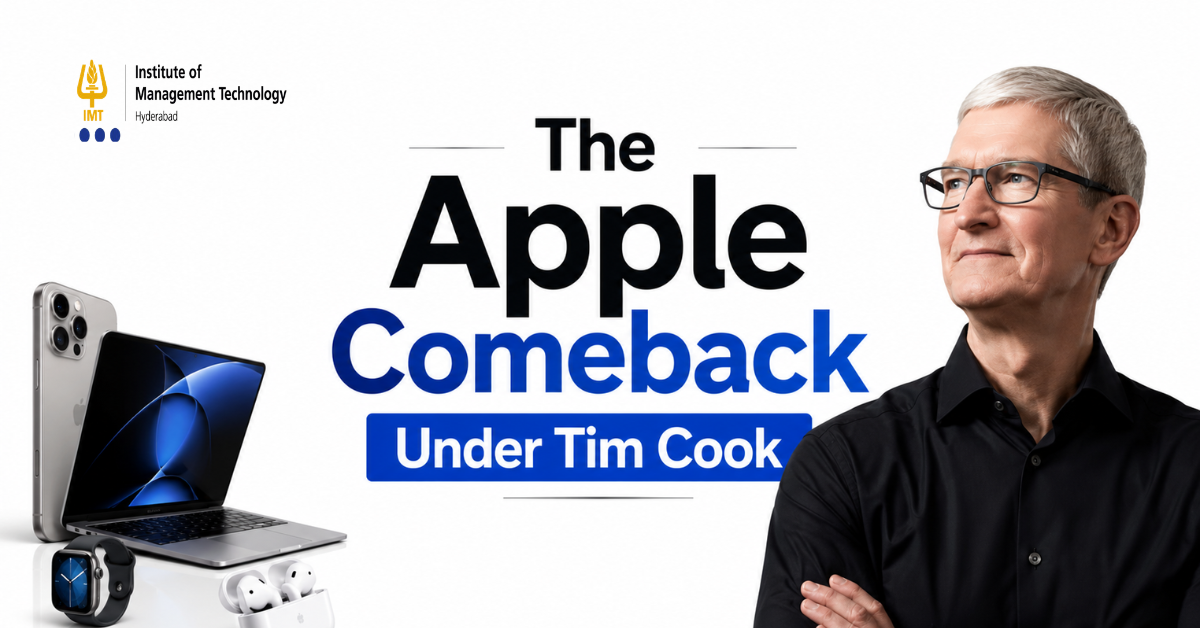
Summary
When Tim Cook became chief executive of Apple in 2011, many people doubted that the company could succeed without Steve Jobs. Fifteen years later, Apple has grown into one of the most valuable companies in the world, and Cook is preparing to hand over the role in September 2026. This article studies how operational discipline, financial strategy, and supply chain mastery shaped that journey. It is written for prospective students of management. The lessons connect directly to PGDM specialisations in finance, information technology, and logistics and supply chain management, helping admission seekers understand why these PGDM courses matter today.
Introduction
Business schools in India often teach through real cases, because students learn faster when theory meets practice. The story of Apple under Tim Cook is one such case. It shows that a company can grow not only through invention but also through careful management of operations, money, and people. For anyone considering PGDM courses, this story explains the skills that employers truly value. It also shows why specialisations such as finance, information technology, and logistics and supply chain management have become central to modern careers. The sections below examine the facts, the numbers, and the lessons for future managers.
Who is Tim Cook and why was his appointment doubted?
Tim Cook joined Apple in March 1998 and became chief executive in August 2011, shortly before the death of co-founder Steve Jobs, as reported by TechCrunch. At that time, the company carried a market value of about 350 billion dollars, a figure noted by Business Standard. Many observers in the technology industry questioned whether an executive known mainly for supply chain work could replace a leader famous for product vision. The doubt was understandable, because Apple was so closely linked to Jobs that few could picture the company without him. Yet Jobs himself had chosen Cook, since Cook had quietly built the systems that allowed Apple to deliver products on time and at very large scale.
How did supply chain management drive Apple’s early strength?
Before he became chief executive, Cook reshaped how Apple managed its products. He believed that unsold stock loses value quickly in a fast-moving technology market. Under his guidance, Apple reduced its inventory from about 31 days of stock to roughly two days by 1999, according to Business Standard. This approach, often called just-in-time inventory, freed up cash and lowered waste. Cook also used the company’s cash reserves to secure scarce parts in advance. In 2005, Apple invested more than one billion dollars in flash memory to guarantee supply for future products. These decisions allowed the company to launch devices on schedule while several competitors faced shortages.
Cook also introduced what is known as an asset-light model, in which products are designed in California but manufactured by partner factories in other countries. This model lowered the amount of money tied up in factories and equipment, and it later became a template for many large technology firms. The strength of this system was tested over time, and it allowed Apple to handle global disruptions better than many rivals. Such confidence in his abilities was clear even earlier, since Cook served as interim chief executive in 2009 when Jobs was on medical leave. This is the heart of logistics and supply chain management, and it is a skill that employers value greatly across industries.
Table 1. Key operational decisions and their effect
| Period | Decision | Result |
|---|---|---|
| 1998 to 1999 | Inventory cut from about 31 days to about 2 days | Less waste and more free cash |
| 2005 | Invested over 1 billion dollars in flash memory | Priority access to parts and on-time launches |
| August 2011 | Cook becomes chief executive, value near 350 billion dollars | Start of a long leadership tenure |
What were the financial results under Cook’s leadership?
The numbers tell a clear story. In the financial year 2011, the year Cook became chief executive, Apple reported annual revenue of about 108 billion dollars and earnings of about 26 billion dollars, as recorded in the company filing with the United States Securities and Exchange Commission. By the financial year 2025, Apple’s annual revenue had reached a record of about 416 billion dollars, as reported by CNBC. The market value of the company rose toward four trillion dollars, which placed Apple among the most valuable businesses in history. A large part of this growth came from services, which include the App Store, cloud storage, and subscriptions. Services revenue reached about 109 billion dollars in the financial year 2025, close to 26 percent of total sales, and these services carry higher profit margins than hardware. This higher margin mix lifted the gross margin to about 48 percent in a recent quarter.
Table 2. Apple growth under Tim Cook, a financial snapshot
| Measure | Around 2011 | Around 2025 to 2026 |
|---|---|---|
| Annual revenue | About 108 billion dollars | About 416 billion dollars in FY2025 |
| Market value | About 350 billion dollars | Close to 4 trillion dollars |
| Services revenue | A small share of sales | About 109 billion dollars, near 26 percent |
| Gross margin | About 38 percent | About 48 percent in a recent quarter |
Why is this a lesson in finance and not only in products?
Many students assume that a great company succeeds only because it makes great products. The Apple case proves that finance matters just as much. Cook and his finance teams managed costs, protected profit margins, and used the company’s large cash reserves with discipline. Apple shifted part of its business toward services, which earn higher margins, and this choice raised overall profitability without selling more hardware. The company also returned value to its shareholders over many years. For students of finance, the lesson is direct. Value is created not only by raising sales, but by managing margins, capital, and cash with care. This is exactly what PGDM finance colleges aim to teach, through subjects such as corporate finance, financial analysis, and investment management.
The shift toward services is worth studying closely, because it explains how a hardware company improved its profit quality. Hardware sales can rise and fall with each product cycle, but services such as subscriptions and the App Store produce steady income month after month. This steadier income, combined with higher margins, makes a company more stable and more valuable in the eyes of investors. A student who understands this difference between one-time sales and recurring revenue already grasps an idea that sits at the centre of modern corporate finance.
How does technology and the digital ecosystem fit the story?
Apple does not sell single products in isolation. It links hardware, software, and services into one connected experience, and this design keeps customers within its ecosystem. CNBC reported that this tight integration remains one of the biggest strengths of the company. A customer who owns an iPhone is likely to use Apple cloud storage, the App Store, and other paid services, which raises long-term revenue. The company has also moved into artificial intelligence features across its devices. For students who plan to study a postgraduate diploma in information technology, this shows an important truth. Technology value comes from well-designed systems and platforms, not from one device alone. Skills in data, software, and digital products are now central to management.
What does the India connection teach future managers?
Apple now assembles a growing share of its products in India through partners such as Foxconn and Tata Electronics, which shows how global supply chains are shifting toward the country. This trend matches the strong growth of the Indian logistics sector. According to the IMARC Group, logistics costs in India remain near 13 to 14 percent of gross domestic product, while mature economies operate closer to 8 to 9 percent. This gap means there is large room for skilled managers to improve efficiency and reduce cost. The sector is also expanding quickly, supported by government plans such as the National Logistics Policy and the PM GatiShakti master plan. For students, the message is clear. Demand for trained professionals in logistics and supply chain management is rising sharply across India, in e-commerce, manufacturing, retail, and pharmaceuticals.
The size of the opportunity is large. Research by Markets and Data projects that the Indian supply chain management market will grow from about 2.39 billion dollars in the financial year 2024 to about 5.55 billion dollars by the financial year 2032, at a compound annual growth rate of around 11 percent. Growth on this scale needs people who can plan, manage, and improve complex supply networks. This is why a specialisation in logistics and supply chain management has become one of the most practical choices for a prospective student in India today. The Apple example simply makes the idea concrete, because it shows what disciplined supply chain management can achieve at a global scale.
What is the leadership lesson from the planned succession?
In April 2026, Apple announced that Cook will become executive chairman and that John Ternus will become chief executive on 1 September 2026, as reported by TechCrunch. Cook explained that the decision rested on three factors, namely the strong performance of the company, its clear product plans, and the readiness of his successor. A planned succession is itself a management lesson. It shows that strong organisations prepare future leaders well in advance, rather than reacting to sudden change. This kind of thinking sits at the centre of general management, where strategy, leadership, and long-term planning are studied together. It is a reminder that good management protects a company beyond the time of any single leader.
What broader lessons does the Apple case offer management students?
Several clear lessons stand out from this study, and each one connects to a subject taught in a good management programme. The first lesson is that operational excellence creates real value, because the careful control of inventory, sourcing, and production can lift profit just as much as a new product. The second lesson is that a connected ecosystem of products and services keeps customers loyal and raises long-term income. The third lesson is that financial discipline, meaning the careful management of margins, costs, and capital, protects a company in difficult years. The fourth lesson is that strong organisations plan their leadership, so that change does not create fear. Together these lessons show that management is a complete discipline, and that success comes from many skills working as one.
How do these lessons connect to PGDM courses at IMT Hyderabad?
The Apple case touches three areas that map directly to formal management study, namely finance, information technology, and logistics and supply chain management. The Institute of Management Technology Hyderabad, which is part of the IMT Group, offers a two-year full-time residential PGDM with specialisations in these exact fields. Details on the programme are published on the official IMT Hyderabad admissions page. The programme is approved by the All India Council for Technical Education, accredited by the National Board of Accreditation, holds the South Asian Quality Assurance System accreditation, and carries equivalence to an MBA as recognised by the Association of Indian Universities. Admission is based on scores from CAT, XAT, GMAT, or CMAT, followed by a personal interview round. The basic eligibility is a bachelor degree with at least 50 percent marks.
The institute follows a trimester system and includes a long industry internship, along with a leadership development programme that builds communication and decision-making skills. The campus is residential and located near the Rajiv Gandhi International Airport in Hyderabad. The points below show how each specialisation links to the Apple case studied above, so that prospective students can see the practical value of each track.
Table 3. PGDM specialisations at IMT Hyderabad and their link to the Apple case
| Specialisation | Main focus | Connection to the Apple case |
|---|---|---|
| PGDM Finance | Corporate finance, margins, capital | How Apple managed margins, cash, and value |
| PGDM Information Technology | Digital systems and tech management | Apple hardware, software, and services ecosystem |
| PGDM Logistics and Supply Chain | Operations, inventory, sourcing | Cook’s just-in-time inventory and global sourcing |
| PGDM General Management | Strategy and leadership | Leadership transition and planned succession |
| PGDM Marketing | Brand and demand | Strong global brand and customer loyalty |
Table 4. IMT Hyderabad PGDM at a glance, for admission seekers
| Item | Detail |
|---|---|
| Programme | Two-year full-time residential PGDM |
| Specialisations | General Management, Finance, Marketing, Information Technology, Logistics and Supply Chain Management |
| Recognition | AICTE approved, NBA accredited, SAQS accreditation, AIU equivalence to MBA |
| Entrance exams | CAT, XAT, GMAT, or CMAT, followed by a personal interview |
| Eligibility | Bachelor degree with at least 50 percent marks |
| Fees | [VERIFY] Approximately INR 15 to 16 lakh for two years, reported to include accommodation and mess |
| Placements | [VERIFY] Average reported near INR 12 lakh per annum in recent batches |
| Ranking | [VERIFY] Featured in national-level management rankings, including NIRF |
| Campus | Residential campus near Rajiv Gandhi International Airport, Hyderabad |
What should a prospective student take away from this study?
The Apple story shows that management is a practical discipline, built on real decisions about products, money, operations, and people. A leader who understood supply chains helped turn a great product company into one of the most valuable businesses in the world. The same skills that powered this journey, namely finance, technology, operations, and strategy, are the core subjects of a well-planned PGDM programme. For a prospective student, the lesson is encouraging. The knowledge taught in a serious management course is the same knowledge that shapes global companies. A thoughtful choice of specialisation, matched to personal interest and market demand, can open a strong and lasting career.
Related Blogs
UPI Case Study: How India Built the World’s Largest Real-Time Payment Network
How did a payment system built in India go on to process nearly half of…
How Titan Became One of the World’s Largest Watch Manufacturers
Summary This case study examines how Titan, a joint venture between the Tata Group and…
Pepsi Vs Coca-Cola: The Cola Wars and What They Teach Future Business Leaders
Summary The rivalry between Pepsi and Coca-Cola, widely known as the Cola Wars, is one…
How Reliance Jio Revolutionized India’s Telecom Industry: Strategic Lessons for PGDM Students
Summary This case study examines how Reliance Jio transformed India’s telecommunications industry within a few…
Zepto vs Blinkit vs Instamart: A Strategic PGDM Case Study of India’s Quick Commerce Revolution
Why is India’s quick commerce revolution worth studying? Quick commerce is the fastest-adopted retail format…