
Information Fatigue: The age of the Infinite Scroll
Home / Academic / Information Fatigue: The age of the Infinite Scroll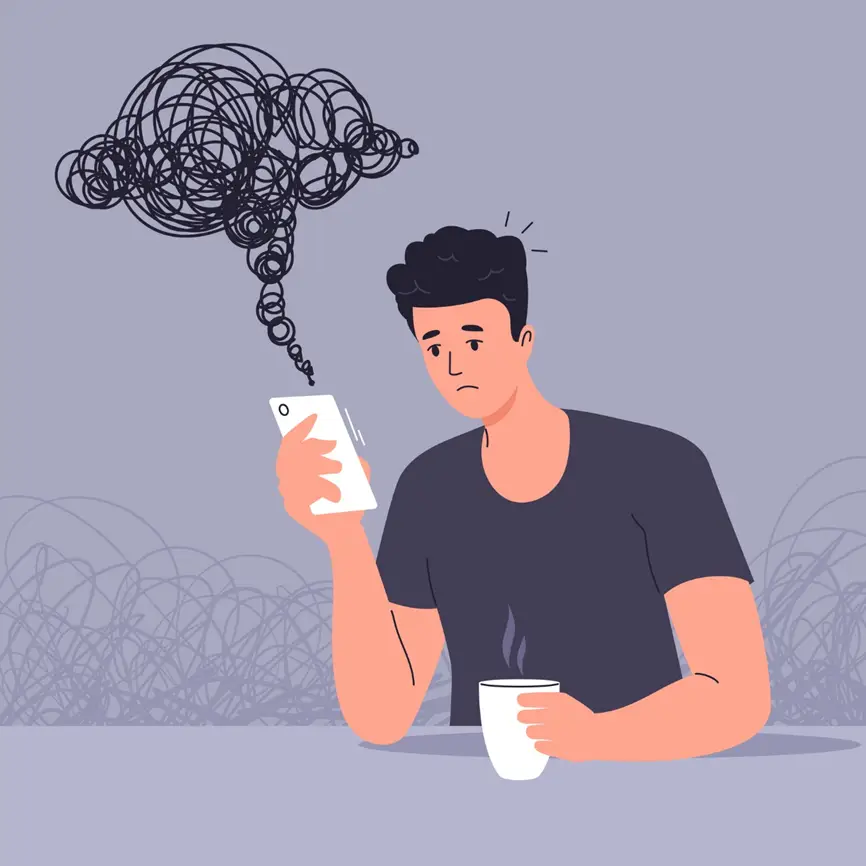

Kashish Sehgal
PGDM Marketing
The early 2000s gave rise to a specific kind of generational disconnect, as a Gen Z kid would explain to their parent that ‘music premieres on YouTube.’ To an older generation, this is nonsense, and to Gen Alpha, it’s ancient history. Yet, this anecdote can show us the shift of the internet from a tool we used to an environment we live in.
Coming from the generation that spent school days rote-learning the “importance of computers” for exams, only to go home and use those same machines to procrastinate for hours. That irony has evolved into something heavier: Information Fatigue.
We are consuming more than ever yet feeling less nourished. Dictionary.com recently named “Slop” a word of the year, a term for the low quality, AI generated content filling our feeds. The speed of the internet has blurred our cultural origins. Take the ‘Brat summer’ aesthetic for example- the gritty, low resolution Arial font on the lime green background. While the font came in use for everything, its roots are often lost on the people sharing it. On the internet, context is the first thing to die, we no longer realise where the things we see originate. We just scroll past them.
While the internet was initially pitched as a “Global Village,” a tool to bring us all together, it has fractured us. While the world collectively spends 11.5 billion hours on social media every day, we are not necessarily connecting with one another. Algorithms have long traded community for ‘niches.’ We are served content so specifically tailored to us that we no longer share an everyday reality. We sit in the same room yet inhabit entirely different digital universes. This uniting phenomenon has made us interested in nothing but our own screens.
For most of us, a ‘digital detox’ is no longer a realistic solution, no, it is a luxury. Our lives, jobs, and social structures are hardwired into the web. And it is not just a Gen Z problem either.
Facebook is currently overrun by AI generated content targeting older generations. We are seeing a mass desensitisation where relevance no longer matters. We watch a reel of someone complaining they are bored with the app, like said video because we feel the same, and then keep on scrolling mindlessly.
The “Infinite Scroll” came along in 2006. It was designed to make website experience seamless for the user, but it turned out to be one of the most effective psychological traps in history. In a physical book or a newspaper, there is a cue to stop, a sign that you have reached the end of a page or a chapter. The infinite scroll removes that cue completely. It tricks the brain into thinking that what we have in front of us is essential and endless, preventing us from ever reaching a point of satisfaction. It does not loop, it just consumes.
The most visible symptom of information fatigue is probably how we perceive time on the internet. Yesterday was last week, last week was a year ago and who even remembers what was happening last month?
Language and slang used to take years to migrate, and now, “brainrot” terms emerge and die within weeks of being coined. Fashion trends, frustratingly enough, have moved from being defined by decades to ‘cores’ that can barely last a month.
History tends to repeat itself, but we have never encountered a problem of having too much to know. We have so much on our hands, and yet we feel less informed.
Just 50 years ago, learning meant a trip to the library was required. Well, the library has exploded into our pockets, and the debris is hitting us all at once.
If we want to survive the age of the infinite scroll, we must pause to recognise that the “choice” of what we see is no longer ours; it belongs to an algorithm designed to keep us looking. The end of the feed is not coming. We have been the ones to stop looking for it.
Related Blogs

Can India Be the Torch Bearer of the AI Marketing Future?
Introduction Every few years, a new wave defines how marketing is done. Once, it was…
Does Rebranding Work?
Kashish Sehgal A quiet observer, she is drawn to the stories behind people….
FROM CLASSROOM TO C-SUITE: HOW MODERN MANAGEMENT SHAPES TOMORROW’S LEADERS
Introduction The aspiration to become a businessman is a common dream among many schoolgoers. However,…

Why Luxury Costs More?
Shruti Mishra Bringing fresh perspective to ideas, exploring the world and writing about…

Behavioral Economics in Daily Decision-Making
Abhishek Kumar Aditya This is Abhishek Kumar Aditya, a PGDM candidate at IMT Hyderabad,…

The Philosophy of Absence: What Does It Mean to Truly Be Alone
Devanshu A B.Com Honours graduate, this boy brings a calm, composed, and optimistic approach…