
Consumer Behaviour: A Complete Guide to Factors, Types, and the Buying Decision Process
Home / Academic / Consumer Behaviour: A Complete Guide to Factors, Types, and the Buying Decision Process
Consumer behaviour is the study of how individuals, groups and organisations select, buy, use and dispose of products, services and ideas to satisfy their needs and wants. Every time a customer compares two smartphones, abandons a shopping cart, renews a subscription or recommends a restaurant to a friend, they reveal a pattern of thinking and feeling that businesses are desperate to understand. In a crowded and increasingly digital marketplace, the brand that reads these patterns most accurately usually wins.
Understanding consumer behaviour matters because attention, trust and money are all scarce. Indian shoppers now move fluidly between a physical store, a marketplace app, a social feed and a quick-commerce delivery in a single afternoon, and they carry the memory of every past experience with them. Businesses that grasp the reasons behind these choices can design better products, set smarter prices, build stronger brands and create marketing that feels relevant rather than intrusive.
What Is Consumer Behaviour?
Consumer behaviour is the analysis of the mental, emotional and physical activities people perform when they search for, evaluate, purchase, use and dispose of goods and services. It seeks to answer a simple but powerful question: why do people buy what they buy? The field draws on psychology, sociology, economics and anthropology, which is why it is described as an interdisciplinary subject.
Scope and Objectives
The scope of consumer behaviour extends well beyond the moment of purchase. It covers pre-purchase activity such as need recognition and information search, the purchase act itself, and post-purchase behaviour such as satisfaction, repeat buying and word of mouth.
Its core objectives are to understand the decision-making process, to predict how consumers are likely to respond to marketing stimuli, and to influence choices ethically through better products and communication.
Consumer Vs Customer: What Is the Difference?
The terms consumer and customer are often used interchangeably, but they are not the same.
| Basis | Customer | Consumer |
|---|---|---|
| Meaning | The person who purchases the product | The person who uses or consumes it |
| Money | Pays for the product | May not pay for it |
| Example | A parent buying baby food | The infant who consumes it |
| Marketing focus | Price, offers, convenience | Experience, satisfaction, usage |
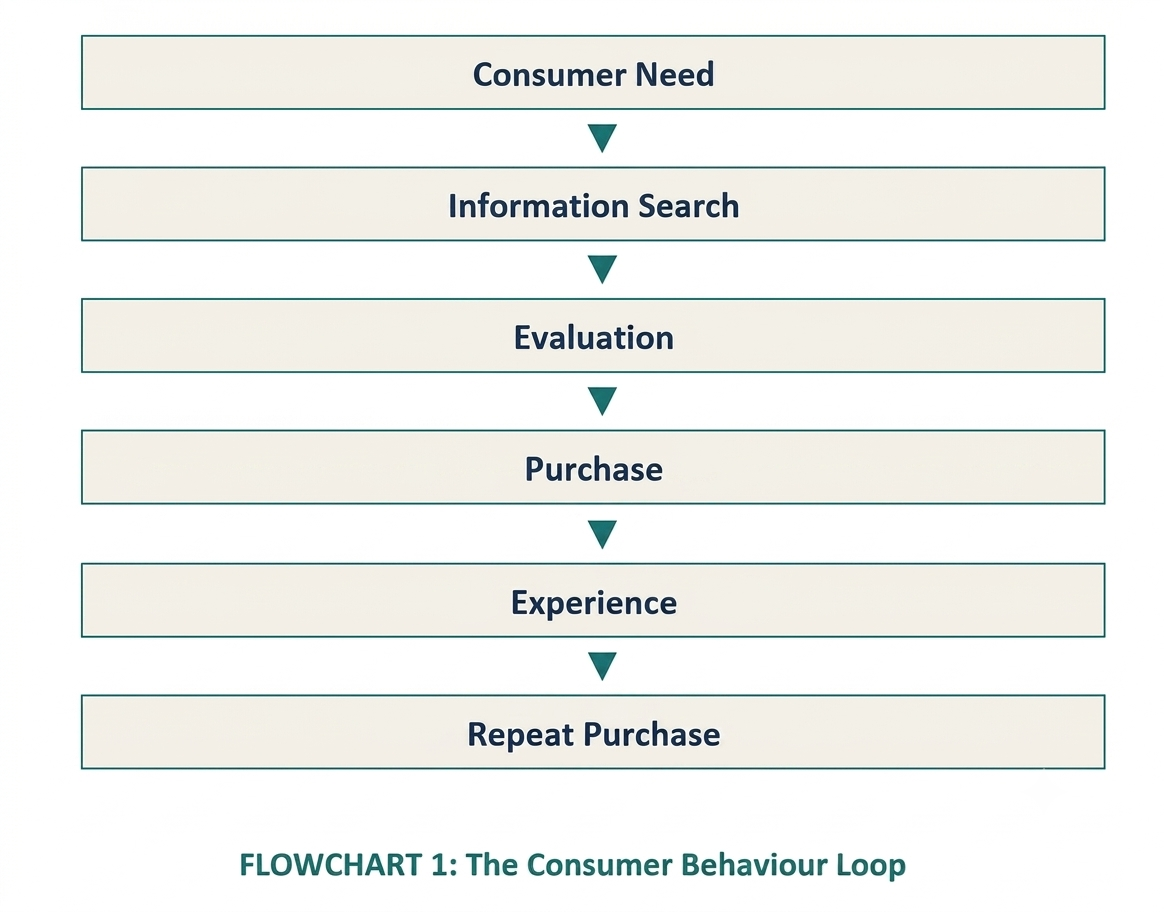
The consumer journey can be summarised as a repeating loop, shown below.
What Are the Characteristics of Consumer Behaviour?
Consumer behaviour has a set of defining characteristics that explain why it is so challenging, and so rewarding, to study. Each is illustrated below.
- Dynamic: It keeps changing with age, income, technology and trends. The way Indians booked travel through agents a decade ago has shifted almost entirely to apps.
- Complex: Many factors act at once, so a single purchase may reflect budget, peer opinion, mood and brand image together, as when choosing a wedding outfit.
- Goal-oriented: Consumers buy to solve a problem or achieve an outcome, such as buying a laptop to enable freelance work rather than for its own sake.
- Motivated: An underlying need drives action; hunger drives a food order, and the desire for status drives a premium purchase.
- Emotional: Feelings shape choices, which is why nostalgia-led advertising during festivals sells so effectively.
- Rational: Consumers also weigh costs and benefits, comparing specifications, warranties and reviews before a considered purchase.
- Influenced by culture: Festivals, religion and regional taste guide demand, seen in the surge of gold and appliance sales during Dhanteras.
What Factors Affect Consumer Behaviour?
Consumer decisions are shaped by six broad groups of factors: psychological, personal, social, cultural, economic and technological. These forces overlap and interact, and this is the largest and most examinable area of the subject.
Psychological Factors
Psychological factors operate inside the mind of the consumer. Motivation is the inner drive that pushes a person to act, often explained through Maslow’s hierarchy of needs. Perception is how a consumer interprets information, which is why the same advertisement can persuade one person and irritate another. Learning is the change in behaviour that comes from experience, memory stores brand associations for future recall, and attitudes and beliefs form the settled evaluations a consumer holds about a brand.
Example: A runner buys premium shoes because elite athletes endorse them. The endorsement shapes perception, the brand builds a positive attitude, and repeated exposure strengthens memory, so the premium price feels justified.
Personal Factors
Personal factors relate to an individual’s circumstances. Age and stage of life change needs, so a college student and a young parent buy very differently. Occupation and income set the budget and the category, a lifestyle shapes taste and priorities, personality influences brand fit, and the family life cycle, from single to newly married to nest with children, drives large shifts in spending.
Example: A newly married couple in a metro city typically increases spending on home appliances, furniture and insurance, while their discretionary spend on nightlife falls. Marketers of white goods target exactly this life stage.
Social Factors
Social factors come from the people and groups around the consumer. Family remains one of the strongest influences on Indian purchases, friends and reference groups set aspirations, and social media, influencers and online communities now shape opinion at scale. A reference group is any group a person looks to as a standard, whether they belong to it or aspire to.
Example: A shopper buys a skincare product after a trusted influencer demonstrates a visible result. The recommendation acts as social proof, lowering perceived risk and shortening the decision.
Cultural Factors
Cultural factors are the deepest and most enduring influences on behaviour. Culture provides shared values, religion and tradition guide many category choices, festivals create predictable demand peaks, and social class and regional preference shape both what and how people buy. India’s diversity makes this factor especially powerful, with taste, language and ritual varying sharply across regions.
Example: Buying peaks around Diwali, Eid, Christmas, Onam, Pongal and Durga Puja. Brands release festival editions, regional advertising and special financing precisely because culture drives a reliable surge in spending.
Economic Factors
Economic factors set the boundaries of what a consumer can afford. Inflation reduces real purchasing power and pushes shoppers towards value, income and employment determine confidence and category access, and interest rates affect big-ticket and credit-financed purchases such as homes and cars. During periods of high inflation, consumers trade down, delay upgrades and switch to smaller pack sizes.
Example: When food and fuel prices rise, many households shift from branded to private-label staples and buy smaller sachet packs, a pattern that fast-moving consumer goods companies plan for directly.
Technological Factors
Technological factors increasingly govern how people discover and buy. Artificial-intelligence recommendations, personalised advertising, voice search, chatbots, online reviews, mobile commerce and omnichannel shopping have all reshaped the path to purchase. Technology reduces friction, increases choice and makes past behaviour a live input into the next decision.
Example: Amazon’s recommendation engine suggests products based on browsing and purchase history, while Netflix personalises both titles and artwork for each viewer, so the storefront itself adapts to behaviour.
What Are the Types of Consumer Buying Behaviour?
There are four classic types of consumer buying behaviour, defined by two dimensions: the degree of buyer involvement and the degree of difference between brands. Understanding which type applies helps a marketer choose the right strategy.
1. Complex Buying Behaviour
This occurs when involvement is high and the differences between brands are significant. The consumer researches carefully, forms beliefs, then makes a considered choice. Buying a car, a laptop or a home falls here.
Marketing strategy: provide detailed information, comparison tools, demonstrations and reassurance, as premium electronics brands do with specification sheets and in-store trials.
2. Dissonance-Reducing Buying Behaviour
Here involvement is high but perceived differences between brands are small. The consumer fears making the wrong choice and seeks reassurance after buying to reduce post-purchase doubt, known as cognitive dissonance. Buying flooring, insurance or a mid-range appliance often fits this pattern.
Marketing strategy: offer strong warranties, clear after-sales support and follow-up communication that confirms the customer chose well.
3. Habitual Buying Behaviour
This applies when involvement is low and brand differences are small. Consumers buy out of habit rather than loyalty, with little search or evaluation. Everyday groceries such as salt, sugar and soap are typical.
Marketing strategy: build familiarity through repetition, distribution and shelf visibility, and use price promotions to prompt trial.
4. Variety-Seeking Buying Behaviour
This occurs when involvement is low but brand differences are significant. Consumers switch brands for novelty rather than dissatisfaction. Snacks, chocolates, soft drinks and personal-care products often see this.
Marketing strategy: market leaders encourage habit through prominence, while challengers offer new flavours, limited editions and sampling to tempt the switch.
What Are the Stages of the Consumer Buying Decision Process?
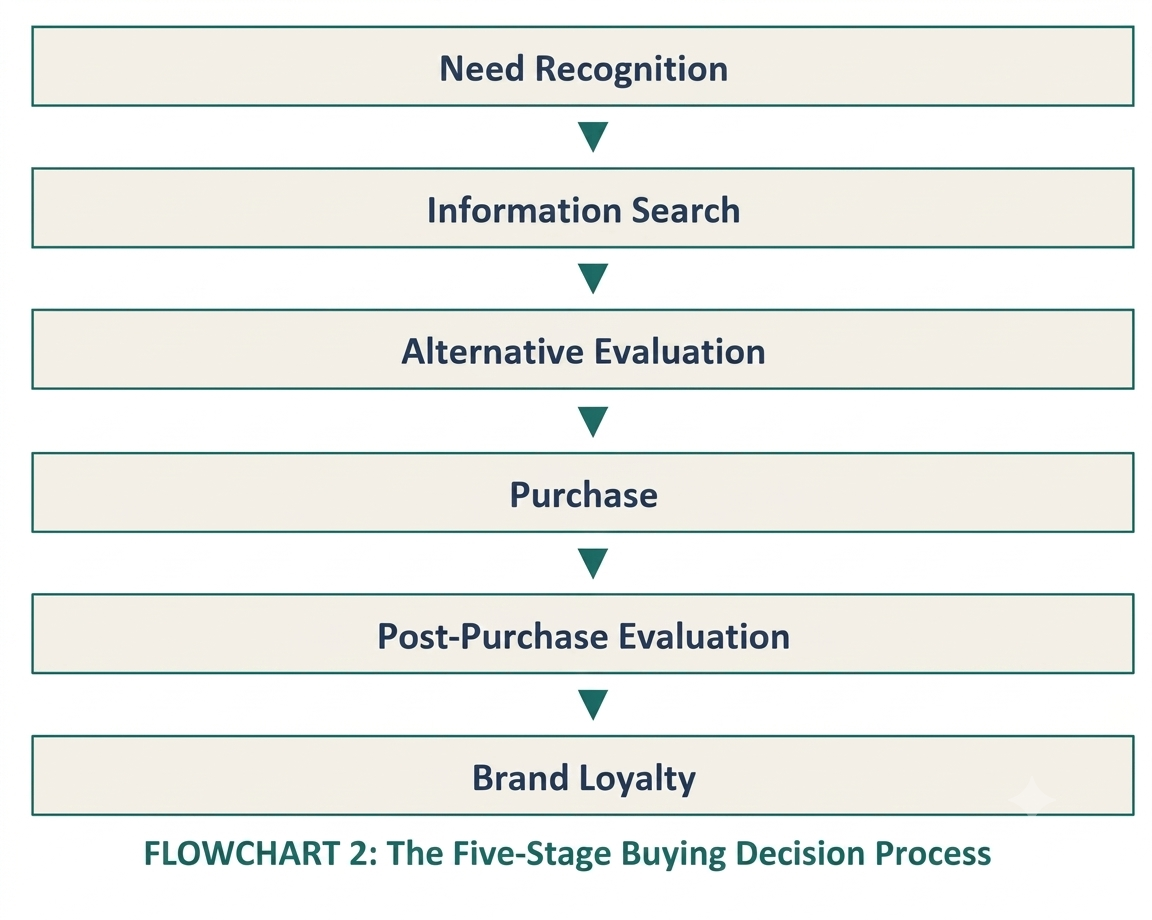
The consumer buying decision process has five stages: problem recognition, information search, evaluation of alternatives, purchase decision and post-purchase behaviour. To make the process concrete, follow one running example throughout: a young professional named Aisha buying a new smartphone.
Step 1: Problem Recognition
The process begins when the consumer perceives a gap between their current state and a desired one. Aisha’s three-year-old phone has a failing battery and a slow camera, so she recognises a need for a replacement. Marketers trigger this stage through advertising that highlights a problem or an aspiration.
Step 2: Information Search
The consumer gathers information from internal memory and external sources such as search engines, reviews, retail staff, friends and social media. Aisha reads expert reviews, watches video comparisons and asks colleagues. The brands that appear credibly at this stage enter her consideration set.
Step 3: Evaluation of Alternatives
The consumer compares options against the attributes that matter to them, such as camera quality, battery life, price and brand trust. Aisha weighs three shortlisted models, trading a higher price against a better camera. This is the decision point where positioning and perceived value are decisive.
Step 4: Purchase Decision
The consumer selects and buys, though the final choice can still be swayed by an unexpected discount, a stock shortage, a checkout obstacle or a last-minute peer opinion. Aisha chooses her preferred model and buys it online because an exchange offer and no-cost instalments tip the balance. Reducing friction at this point is critical, since a difficult checkout loses ready buyers.
Step 5: Post-Purchase Behaviour
After buying, the consumer evaluates whether the product met expectations. Satisfaction builds loyalty and advocacy, while disappointment creates dissonance and negative word of mouth. Aisha is delighted, writes a positive review and recommends the model, which feeds the next buyer’s information search. Strong onboarding, support and follow-up turn a single sale into a lasting relationship.
What Are the Major Consumer Behaviour Models?
Consumer behaviour models are frameworks that explain and predict how consumers decide. Five models are widely taught in management programmes.
Howard-Sheth Model
This model treats buying as a rational, systematic process in which inputs, such as product stimuli and social information, pass through the buyer’s internal states of perception and learning to produce an output, the purchase. Its strength is a detailed treatment of learning and repeat buying. Its limitation is complexity, which makes it hard to apply directly. Businesses use it to understand how repeated exposure builds brand familiarity.
Engel-Kollat-Blackwell (EKB) Model
The EKB model centres on the five-stage decision process and adds the information-processing and environmental influences that surround it. Its advantage is a clear, stage-based structure that maps neatly onto marketing activity. Its limitation is that it assumes more rational deliberation than many real purchases involve. It is widely used to design stage-specific campaigns.
Nicosia Model
The Nicosia model focuses on the relationship between the firm and the consumer, tracing how a company’s messages shape consumer attitudes, which in turn drive search, decision and feedback to the firm. Its strength is the emphasis on communication and feedback loops. Its limitation is that it assumes the consumer starts with no prior attitude. It is useful for planning brand communication.
Maslow’s Hierarchy of Needs in Marketing
Maslow arranged human needs in five levels, from physiological needs at the base, through safety, social belonging and esteem, to self-actualisation at the top. In marketing, the model helps position a product against the need it serves: staples sell on physiological and safety needs, social and lifestyle brands on belonging and esteem, and premium or purpose-led brands on self-actualisation.
What Do Real-World Case Studies Teach Us About Consumer Behaviour?
The following seven case studies show how leading brands turned consumer insight into strategy. Each notes the insight, the strategy, the psychology involved, the outcome and the key takeaway.
1. Apple
Consumer insight: Consumers pay a premium for simplicity, design and a sense of belonging to a community.
Marketing strategy: Apple limits choice, controls the entire experience and launches products as cultural events, reinforcing scarcity and anticipation.
Consumer psychology: Esteem needs and identity drive the purchase; owning the product signals taste and status.
Business outcome: Apple has become one of the world’s most valuable companies, sustaining industry-leading margins and loyalty.
Key takeaway: A premium is earned through experience and identity, not features alone.
2. Amazon
Consumer insight: Consumers value convenience, speed, price transparency and reliable delivery above almost everything else.
Marketing strategy: Amazon built recommendation engines, one-click checkout, fast fulfilment and a loyalty programme that rewards frequent buying.
Consumer psychology: Reducing friction and decision effort increases purchase frequency; personalised suggestions exploit familiarity and relevance.
Business outcome: Amazon became the dominant global e-commerce platform, with a large share of online retail.
Key takeaway: Removing friction at every step is itself a growth strategy.
3. Starbucks
Consumer insight: Consumers want a comfortable third place between home and work, and will pay for the experience around the coffee.
Marketing strategy: Starbucks standardised ambience, personalised orders by name and built a rewards app that deepens habit.
Consumer psychology: Belonging and routine create emotional attachment; personalisation makes the customer feel recognised.
Business outcome: Starbucks scaled into a global premium coffee brand with strong repeat visitation.
Key takeaway: Selling an experience commands a price a commodity never could.
What Are the Emerging Trends in Consumer Behaviour?
Consumer behaviour continues to evolve rapidly. The following trends are reshaping expectations and will define the next decade of marketing.
- AI shopping assistants: conversational tools that recommend, compare and even complete purchases on the consumer’s behalf.
- Hyper-personalisation: offers, pricing and content tailored to the individual in real time.
- Sustainability and ethical consumerism: shoppers increasingly favour brands with credible environmental and social practices.
- Green marketing: brands communicate genuine sustainability, while consumers grow wary of greenwashing.
- Voice and visual search: people search by speaking or by image, changing how products are discovered.
- AR and VR shopping: virtual try-ons and immersive showrooms reduce uncertainty before purchase.
- Generative AI: AI creates content, product imagery and tailored recommendations at scale.
- Subscription economy: consumers prefer access and convenience over ownership across media, software and even groceries.
- Experience economy: spending shifts from goods towards memorable experiences and events.
Why Should MBA and PGDM Students Study Consumer Behaviour?
For management students, consumer behaviour is one of the most career-relevant subjects in the curriculum, because almost every commercial role depends on understanding the customer. A strong grasp of the subject opens and strengthens several career paths.
- Brand management: shaping positioning, identity and long-term customer relationships.
- Product management: designing features around genuine user needs and behaviour.
- Consumer insights and market research: turning data into decisions that guide strategy.
- Retail and category management: optimising assortment, layout and pricing for shopper behaviour.
- Digital marketing and performance media: targeting, personalisation and conversion optimisation.
- Sales and consulting: reading buyer motivations to advise, persuade and close.
- Entrepreneurship: building products people actually want and marketing them efficiently.
A rigorous PGDM programme, such as the marketing specialisation at IMT Hyderabad, develops these skills through case studies, live projects, market research and industry engagement, preparing students to apply consumer behaviour in the real world.
Frequently Asked Questions
1. What is consumer behaviour in simple terms?
Consumer behaviour is the study of how people decide what to buy, why they buy it, and how they use and feel about it afterwards. It combines psychology, sociology and economics to explain purchase decisions.
2. What are the main factors affecting consumer behaviour?
The main factors are psychological, personal, social, cultural, economic and technological. Most real purchases are shaped by several of these forces acting together.
3. What are the four types of consumer buying behaviour?
The four types are complex, dissonance-reducing, habitual and variety-seeking buying behaviour. They are defined by how involved the buyer is and how different the competing brands are.
4. What are the five stages of the consumer buying decision process?
The five stages are problem recognition, information search, evaluation of alternatives, purchase decision and post-purchase behaviour. Marketers design activity for each stage.
5. What is the difference between a consumer and a customer?
A customer is the person who buys and pays for a product, while a consumer is the person who actually uses it. A parent buying baby food is the customer; the child is the consumer.
6. Why is consumer behaviour important in marketing?
It reduces risk and guides strategy. Understanding buyers helps a business build the right products, set the right prices, target the right audience and retain customers, which improves return on marketing spend.
7. What are the main consumer behaviour models?
The most widely taught models are the Howard-Sheth model, the Engel-Kollat-Blackwell model, the Nicosia model, the Theory of Planned Behaviour and Maslow’s hierarchy of needs.
8. How has digital technology changed consumer behaviour?
Digital technology has shortened the buying journey, empowered consumers with reviews and comparisons, and enabled AI personalisation, mobile and quick commerce, social shopping and live commerce.
9. What is cognitive dissonance in consumer behaviour?
Cognitive dissonance is the doubt a consumer feels after a high-involvement purchase when brands are similar. Brands reduce it through warranties, reassurance and strong after-sales support.
Related Blogs

Why Every Marketer Needs Basic Supply Chain Knowledge in the Digital Era
Introduction There was a time when marketing ended the moment an advertisement went live. Today,…

PGDM Course Details 2026: Eligibility, Entrance Exams, Fees and Career Scope
A PGDM (Post Graduate Diploma in Management) is a two-year, full-time postgraduate management qualification awarded…

Can a PGDM Still Guarantee a Job in the AI Era?
Introduction The dedication to advanced studying and acquiring a higher educational qualification is something that…

FROM CLASSROOM TO C-SUITE: HOW MODERN MANAGEMENT SHAPES TOMORROW’S LEADERS
Introduction The aspiration to become a businessman is a common dream among many schoolgoers. However,…

Ephemeral Teams and Leadership: Leading Teams That Disappear After Projects
Modern work operates through pop-up teams: groups that assemble rapidly, deliver a result, and disband….

India Still The Fastest Growing Economy- Myth or Fact
Introduction The current economic state of India has been on a steady rise since the…