
What Is Rural Marketing? Definition, Meaning, Features, Importance and Case Study
Home / Academic / What Is Rural Marketing? Definition, Meaning, Features, Importance and Case Study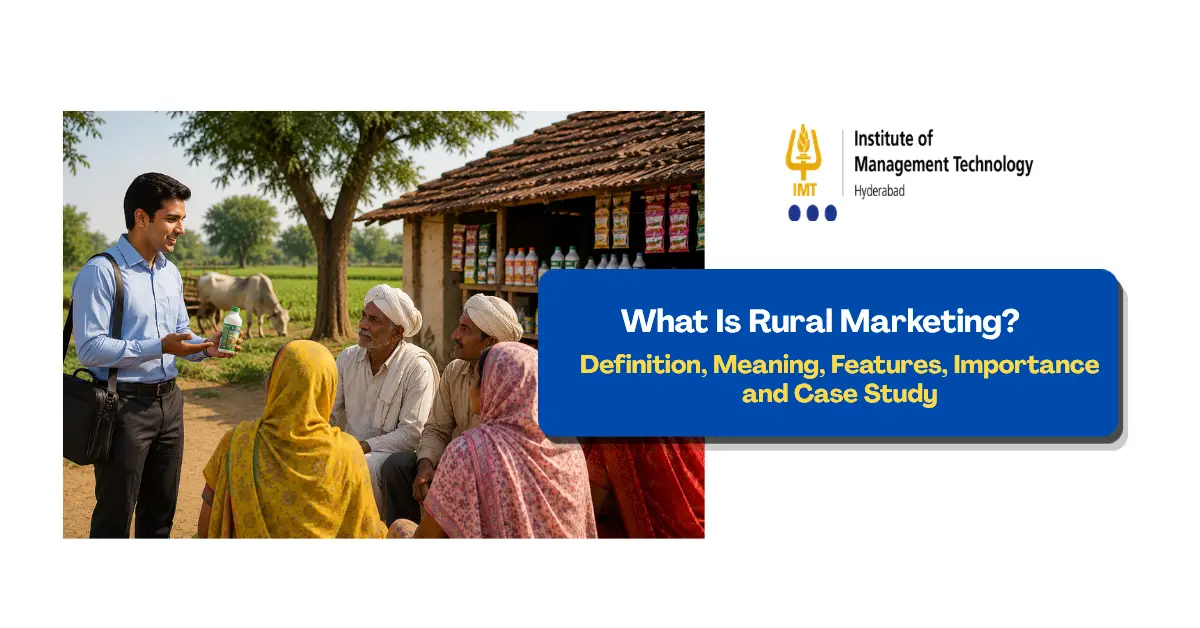
India’s rural markets are no longer defined only by low income or limited access. Rising aspirations, better roads, smartphone adoption, digital payments, improved connectivity and changing consumption patterns are creating new opportunities for businesses. However, reaching rural consumers requires more than simply selling the same products through a different channel. Companies must understand local needs, purchasing power, culture, distribution challenges and the role of community influence.
This is where rural marketing becomes important. The meaning of rural marketing extends beyond advertising products in villages. It involves designing, pricing, distributing and promoting products and services in ways that are relevant and accessible to rural consumers. From FMCG and banking to automobiles, agriculture, healthcare and digital services, businesses increasingly use rural marketing strategies to build sustainable demand.
What Is Rural Marketing?
Rural marketing refers to the process of identifying, understanding and satisfying the needs of consumers, households, businesses and institutions located in rural or semi-rural markets. It includes all marketing activities involved in product development, pricing, distribution, promotion and customer engagement for rural consumers.
A simple rural marketing definition is: rural marketing is the planning and execution of marketing strategies designed to reach and serve consumers in rural areas while considering their unique economic, social, cultural, geographic and infrastructural conditions.
The meaning of rural marketing is therefore broader than selling products in villages. A successful strategy considers questions such as: What does the consumer need? Can the product be made affordable? Is it available at the right outlet? Does the communication fit local culture? Can the distribution network reach remote locations? And can the business create long-term trust?
For example, a company selling agricultural equipment may need to consider crop cycles, seasonal income, local dealers, financing options and regional languages. Similarly, an FMCG brand may use smaller pack sizes, village retailers, mobile vans, local influencers and regional communication to increase penetration.
Features of Rural Marketing
Rural marketing has several characteristics that make it different from conventional urban marketing:
- Large and geographically dispersed markets: Rural consumers are spread across numerous villages and small settlements, making distribution and market coverage challenging.
- Agriculture-driven income: In many rural households, income is directly or indirectly connected to agriculture, creating seasonal fluctuations in purchasing power.
- Diverse consumer needs: Rural India is not a single homogeneous market. Consumer behaviour varies across states, regions, languages, occupations and income groups.
- Strong community influence: Family members, local leaders, retailers and community networks can influence purchase decisions.
- Price sensitivity: Consumers often compare value carefully, making affordability and product utility important factors.
- Infrastructure constraints: Roads, transportation, electricity, warehousing and internet access can affect availability and distribution costs.
- Growing digital adoption: Smartphones, digital payments, social media and e-commerce are increasingly connecting rural consumers with brands.
- Seasonal demand patterns: Festivals, harvest cycles, monsoons and agricultural income can influence when and how consumers purchase.
Importance of Rural Marketing
Rural markets represent an important growth opportunity for businesses because consumption is expanding beyond major cities. Companies that understand rural consumers can develop new sources of revenue, strengthen distribution and build long-term brand loyalty.
- Market expansion: Rural marketing enables businesses to reach new consumers beyond saturated urban markets.
- Revenue growth: Rising aspirations and improving access to products can create demand across FMCG, automobiles, consumer durables, financial services and digital services.
- Better customer understanding: Rural marketing research helps companies identify local needs and design more relevant products.
- Employment and entrepreneurship: Rural distribution models can create opportunities for retailers, agents, micro-entrepreneurs and local service providers.
- Inclusive growth: Businesses can support financial inclusion, access to essential products and rural entrepreneurship while expanding their markets.
- Long-term brand building: Consistent availability, relevant communication and community engagement can help brands build trust.
Rural Marketing Mix: The 4Ps
The traditional 4Ps of marketing—Product, Price, Place and Promotion—remain relevant in rural marketing. However, each element must be adapted to local conditions.
1. Product
Products should solve real consumer problems and be suitable for local usage conditions. Smaller pack sizes, durable designs, simplified features and region-specific variations can improve product acceptance. For example, a company may offer low-unit-price packs to make regular consumption more affordable.
2. Price
Affordability is critical because income can be irregular or seasonal. Companies may use smaller packs, flexible payment options, financing, value pricing and product bundles. The objective is not simply to offer the lowest price, but to create a strong value proposition.
3. Place
Distribution is often one of the biggest challenges. Businesses may use village retailers, local distributors, self-help groups, mobile vans, weekly markets, direct selling networks and digital commerce to improve availability. Designing and operating these networks draws on the same last-mile planning that shapes careers in supply chain management.
4. Promotion
Communication should be simple, locally relevant and culturally sensitive. Regional languages, demonstrations, local events, community engagement, radio, outdoor media, mobile campaigns and digital platforms can all play a role.
Rural Marketing vs Urban Marketing
| Basis of Comparison | Rural Marketing | Urban Marketing |
|---|---|---|
| Market size and spread | Roughly two-thirds of the population dispersed across more than six lakh villages. | Roughly one-third of the population concentrated in cities and towns. |
| Consumer profile | Fairly homogeneous within a village, highly heterogeneous across regions and languages. | Heterogeneous within a city but broadly comparable across metros. |
| Income pattern | Irregular and seasonal, linked to harvest, minimum support prices, wages and remittances. | Regular and monthly, linked to salaries and business receipts. |
| Purchase decision | Community and family influenced; retailer and opinion leader recommendation carries high weight. | Individual and brand influenced; reviews and advertising carry high weight. |
| Product expectation | Durability, ruggedness, multi-use functionality and repairability. | Features, design, convenience and premium positioning. |
| Pack size and price points | Low unit packs and sachets sized to cash in hand. | Larger packs and bundles sized to the monthly stock-up. |
| Distribution structure | Long multi-tier chains: carrying and forwarding agent, distributor, sub-stockist, wholesaler, village retailer. | Short chains: distributor to modern trade, quick commerce or direct to consumer. |
| Retail format | Kirana stores, weekly haats, seasonal melas and mobile vans. | Supermarkets, modern trade, e-commerce and quick commerce. |
| Media and communication | Vernacular, audio-visual, folk media, wall paintings, van campaigns and community events. | Mass media, digital display, social platforms and streaming. |
| Cost to serve | High per unit, driven by distance, small order sizes and fragmented demand. | Low per unit, driven by density and volume. |
| Brand switching | Low once trust is established; slower adoption but stickier loyalty. | High; frequent switching driven by promotion and novelty. |
| Sales cycle | Slower; awareness to trial can span multiple seasons. | Faster; awareness to trial can span days. |
| Key success factor | Availability and trust. | Differentiation and share of voice. |
Factors Affecting Rural Marketing
Rural marketing decisions are influenced by a combination of internal business capabilities and external market conditions. Understanding these factors helps companies select the right products, pricing, channels and communication strategies.
Economic Factors
- Rural income: Income levels influence affordability, product choice and willingness to spend.
- Agricultural dependence: Where households depend heavily on farming, demand may be linked to crop performance and agricultural cycles.
- Seasonal purchasing power: Harvest seasons, festivals and agricultural income can create peaks and troughs in demand.
- Employment: Local employment opportunities, migration and non-farm income affect household spending capacity.
Demographic Factors
- Population size: The size and density of rural populations influence market potential and distribution economics.
- Age: Younger consumers may be more open to smartphones, digital services and new brands.
- Family structure: Joint families and household decision-making patterns can influence product demand.
- Literacy: Literacy levels affect communication design, product information and media choices.
Socio-Cultural Factors
- Customs: Local customs can influence product usage and buying occasions.
- Traditions: Festivals and cultural practices often create seasonal demand.
- Community influence: Recommendations from community members, retailers and local leaders can affect adoption.
- Local values: Marketing communication must respect regional beliefs, language and social norms.
Infrastructure Factors
- Roads: Poor road connectivity can increase delivery time and logistics costs.
- Transportation: Limited transport options may affect distribution frequency.
- Electricity: Reliable power supports refrigeration, retail operations and digital access.
- Internet connectivity: Connectivity improves digital communication, online discovery and e-commerce.
- Retail infrastructure: The availability and quality of village shops, distributors and storage facilities directly influence product availability. This makes retail management capability central to rural distribution planning.
Technological Factors
- Smartphones: Mobile access enables brands to communicate directly with consumers.
- Internet: Digital connectivity supports product discovery, education and customer engagement.
- Digital payments: UPI and other digital payment systems can make transactions more convenient.
- E-commerce: Online platforms can improve access to products that may not be available in local stores, although rural delivery economics differ sharply from the dense urban model examined in this quick commerce case study.
Government and Policy Factors
- Government schemes and rural development initiatives can influence income, infrastructure and consumer access.
- Financial inclusion programmes can improve access to bank accounts, credit and digital payments.
- Infrastructure development can improve roads, electricity, internet access and logistics.
- Policies supporting agriculture, rural employment, entrepreneurship and self-help groups can indirectly influence purchasing power and market participation.
Four A’s of Rural Markets
The Four A’s framework—Availability, Affordability, Acceptability and Awareness—provides a practical way to evaluate whether a company is ready to serve a rural market. A product may have strong demand potential, but it will struggle if consumers cannot find it, afford it, accept it or understand its value.
1. Availability
Availability means ensuring that the product is present at the right place and time. This is important because consumers cannot buy a product that is not accessible through local retailers or suitable distribution channels.
Practical example: An FMCG company may use local distributors, village retailers, mobile vans or micro-entrepreneurs to reach remote consumers.
2. Affordability
Affordability refers to whether the target consumer can purchase the product without excessive financial pressure. Smaller pack sizes, value pricing and flexible payment options can improve access.
Practical example: A shampoo brand offering a low-priced sachet allows consumers to try and purchase the product within a smaller budget.
3. Acceptability
Acceptability means that the product fits local needs, preferences, culture and usage conditions. Product design, language, taste, packaging and communication may need regional adaptation.
Practical example: A food brand may adapt flavours or product communication to suit regional preferences.
4. Awareness
Awareness means that consumers know the product exists, understand its benefits and trust the brand enough to consider purchase.
Practical example: Demonstrations, local events, regional-language communication, retailer education and digital campaigns can improve awareness.
Case Study on Rural Marketing: Project Shakti – Hindustan Unilever Limited
Project Shakti is one of the most widely discussed examples of rural marketing and inclusive distribution in India. The initiative demonstrates how a company can address a distribution challenge while also creating opportunities for rural women entrepreneurs. It sits alongside other PGDM case studies that examine how Indian companies solve distribution and market access problems.
The Rural Marketing Challenge
Reaching consumers in remote villages can be difficult because of geographical dispersion, limited retail infrastructure and the high cost of last-mile distribution. Traditional distribution systems may not efficiently reach every small village. HUL therefore needed a model that could improve product availability while creating stronger connections with rural communities. Last-mile design of this kind is the central concern of logistics and supply chain management.
The Project Shakti Model
Project Shakti works with rural women entrepreneurs, commonly known as Shakti Ammas, who sell HUL products in their communities. The model creates a local distribution network while providing women with an opportunity to operate a micro-enterprise. HUL states that its Shakti initiative continues to support women entrepreneurs and that its Shakti Ammas help make products available in deep rural areas.
The programme illustrates an important principle of rural marketing: local people can become an effective bridge between brands and consumers. A rural entrepreneur understands the community, knows local buying patterns and can build trust more naturally than a distant distribution system.
Project Shakti Through the Four A’s
| Four A’s | How Project Shakti Addresses It | Strategic Learning |
|---|---|---|
| Availability | Local women entrepreneurs help bring products closer to consumers in underserved communities. | Last-mile distribution can be strengthened through local networks. |
| Affordability | HUL’s broad product portfolio includes products at different price points and pack sizes. | Price architecture should reflect different income levels. |
| Acceptability | Local entrepreneurs understand community preferences and can build trust around brands. | Local relevance can improve product acceptance. |
| Awareness | Direct community interaction can support product communication and consumer education. | Trust-based communication can complement mass media. |
Key Lessons from the Case Study
- Distribution can be a source of competitive advantage, not merely a logistics function.
- Local entrepreneurship can help companies overcome last-mile access challenges.
- Rural marketing can create both business value and social impact.
- A successful rural strategy should connect product availability with affordability, acceptability and awareness.
- Community trust can be a valuable marketing asset in markets where formal retail infrastructure is limited.
The Project Shakti example shows that rural marketing is most effective when companies design solutions around the realities of rural consumers. Rather than simply taking an urban strategy and transferring it to villages, businesses must build models that combine commercial objectives with local access, trust and relevance.
Conclusion
Rural marketing is a strategic approach to understanding and serving consumers in rural markets. Its importance is increasing as rural consumers become more connected, aspirational and digitally enabled. However, successful rural marketing requires more than geographic expansion. Businesses must understand income patterns, agriculture, culture, community influence, infrastructure and technology adoption.
The 4Ps provide the foundation for planning rural marketing strategies, while the Four A’s—Availability, Affordability, Acceptability and Awareness—offer a practical framework for evaluating market opportunities. The Project Shakti case study further demonstrates how an innovative distribution model can improve market access while creating rural entrepreneurship opportunities.
For businesses, the future of rural marketing lies in combining local insight with technology, inclusive distribution and customer-centric innovation. Companies that understand the diversity of rural markets and build strategies around real consumer needs will be better positioned to achieve sustainable growth.
For students and managers who want to build this capability formally, rural marketing is taught within the analytical marketing area of the PGDM in Marketing at IMT Hyderabad, alongside consumer behaviour, marketing metrics and strategy.
Eligibility criteria and the application process are set out on the PGDM admissions page.
Frequently Asked Questions (FAQs)
1. What is rural marketing?
Rural marketing is the process of identifying, understanding and satisfying the needs of consumers in rural and semi-rural markets through appropriate products, pricing, distribution and promotion strategies.
2. What is the meaning of rural marketing?
The meaning of rural marketing includes all marketing activities designed to reach rural consumers while considering their income, culture, geography, infrastructure and purchasing behaviour.
3. Why is rural marketing important?
Rural marketing is important because it helps businesses reach new consumers, expand distribution, increase revenue, build brand loyalty and participate in inclusive economic growth.
4. What are the main features of rural marketing?
Key features include geographically dispersed consumers, seasonal income, agriculture dependence, strong community influence, price sensitivity, infrastructure challenges and growing digital adoption.
5. What are the 4Ps of rural marketing?
The 4Ps are Product, Price, Place and Promotion. Each element must be adapted to rural consumer needs, affordability, distribution conditions and local communication preferences.
6. What is the difference between rural and urban marketing?
Rural marketing generally deals with dispersed markets, seasonal income, deeper last-mile distribution and stronger community influence, while urban marketing often operates in more concentrated and digitally connected markets.
7. What are the Four A’s of rural marketing?
The Four A’s are Availability, Affordability, Acceptability and Awareness. Together, they help businesses evaluate whether a product can succeed in a rural market.
8. What factors affect rural marketing?
Economic, demographic, socio-cultural, infrastructure, technological and government or policy factors can influence rural marketing decisions.
9. How is technology changing rural marketing?
Smartphones, internet access, digital payments, social media and e-commerce are improving product discovery, communication, transactions and access to brands in rural markets.
Related Blogs

The Impact of Social Media Trends on Consumer Behaviour in Marketing
Introduction In an era of pervasive connectivity, the impact of social media trends on consumer…

Logistics Courses in India 2026: Eligibility, Fees, Career Scope & Top Colleges
Walk into a warehouse on the edge of a small Indian city at midnight and…

Information Fatigue: The age of the Infinite Scroll
Kashish Sehgal PGDM Marketing A quiet observer, she is drawn to the stories behind…

Can a PGDM Still Guarantee a Job in the AI Era?
Introduction The dedication to advanced studying and acquiring a higher educational qualification is something that…

Finance Courses with Placement in India — Colleges, Recruiters & Salary Data (2026)
1. Why is the placement record the most important metric when choosing a finance course…

Behavioral Economics in Daily Decision-Making
Abhishek Kumar Aditya This is Abhishek Kumar Aditya, a PGDM candidate at IMT Hyderabad,…