PGDM Specialisations in India: Which One Should You Choose in 2027?
Home / PGDM / PGDM Specialisations in India: Which One Should You Choose in 2027?
There is no single best PGDM specialisation. The right one matches what you are good at and the job you want five years from now. For 2027, Finance, Business Analytics and Marketing get the most offers and the strongest pay, while Supply Chain, Product Management and HR with analytics are growing fast. Pick by fit first, salary second, and check a college’s function-wise placement data before you commit.
Most students don’t really choose a specialisation. They drift into one. A senior says finance pays more, a cousin says marketing is fun, and by the end of the first year the decision has been made by whoever spoke last. This guide is here to stop that happening to you. Below, we walk through the main PGDM specialisations in India, what each one involves day to day, what freshers tend to earn, who does well in it, and a five-question test to help you decide. Where we talk about salaries, we use real function-wise numbers from IMT Hyderabad’s Batch 2023-25 placement report rather than guesswork.
What Are PGDM Specialisations in India?
PGDM specialisations in India are the functional areas, such as finance, marketing or business analytics, that you study in depth during the second year of a Post Graduate Diploma in Management. A PGDM is a two-year, AICTE-approved programme. Year one is common to everyone and covers accounting, economics, marketing, operations, statistics and organisational behaviour. Year two is where you pick your major, and sometimes a minor, and take electives in it.
If you are new to the programme itself, start with our guide to PGDM course details and the full list of PGDM course subjects at IMT Hyderabad.
When do you choose your specialisation?
At most B-schools, you lock in your specialisation towards the end of the first year. At IMT Hyderabad, the choice is made before the summer internship, so your internship can build on the area you have picked. Some schools let you choose a track, such as PGDM (Finance) or PGDM (Marketing), at the admission stage itself.
Single, dual, major and minor
A single specialisation means all your electives sit in one area. A dual specialisation splits them across two areas, usually a major (more credits) and a minor (fewer credits). Dual is now the norm at many schools because recruiters like a marketer who can read data or a finance graduate who understands technology.
Complete List of PGDM Specialisations in India for 2027
Here is how the 14 most common specialisations compare. Salary ranges are indicative fresher packages at good private B-schools. They move a lot with the institute, your prior work experience and the city, so treat them as a rough guide, not a promise.
| Specialisation | Best suited for | Typical first roles | Indicative fresher CTC | 2027 demand |
|---|---|---|---|---|
| Finance | Commerce grads, CA/CFA aspirants, engineers who follow markets | Financial analyst, credit analyst, corporate finance associate | ₹8–25 LPA | High |
| Marketing | Communicators, BBA/BCom/BA graduates | Brand executive, sales manager, digital marketer | ₹7–20 LPA | High, largest hirer |
| Business Analytics | Engineers, maths/stats/economics graduates | Business analyst, data analyst, analytics consultant | ₹9–25 LPA | Very high |
| Human Resources | People-focused students, psychology/humanities grads | HR business partner, talent acquisition, L&D | ₹6–14 LPA | Steady, rising with HR analytics |
| Operations & Supply Chain | Engineers, science grads, process thinkers | Supply chain analyst, procurement, demand planner | ₹7–18 LPA | High |
| IT & Systems Management | BTech/BCA graduates | IT consultant, project manager, business analyst | ₹8–20 LPA | High |
| International Business | Students aiming for trade or global roles | Export manager, global sourcing, international sales | ₹7–18 LPA | Moderate |
| Product Management | Tech-minded generalists | Associate product manager, product analyst | ₹10–30 LPA | Growing fast |
| Strategy & General Management | Undecided students, future founders | Management trainee, founder’s office, consulting analyst | ₹8–20 LPA | Steady |
| Banking & Insurance (BFSI) | Commerce grads who like client work | Relationship manager, credit officer, underwriter | ₹6–15 LPA | High volume |
| Healthcare & Hospital Management | Pharma, nursing, life-science graduates | Hospital administrator, healthcare consultant | ₹6–14 LPA | Growing |
| Retail & E-commerce | Students drawn to consumer businesses | Category manager, store operations, e-commerce analyst | ₹6–15 LPA | Growing |
| Rural & Agri business | Students from agriculture or development backgrounds | Rural marketing, agri-input sales, NGO/CSR roles | ₹6–12 LPA | Niche, steady |
| Entrepreneurship & Family Business | Founders and family business successors | Own venture, family firm, startup roles | Varies widely | Niche |
Indicative ranges compiled from recent published placement reports of private Indian B-schools. Always check the latest report of the institute you are considering.
Finance (including FinTech)
Finance is still the specialisation most students want and most recruiters pay well for. You study corporate finance, valuation, financial markets, risk management, portfolio management and, increasingly, financial analytics. It suits you if you like numbers that tell a story and can sit with a spreadsheet for hours. The honest downside: top roles in investment research and capital markets are competitive, and many finance offers are in banking sales rather than pure analysis.

Read more in PGDM in Finance, the PGDM finance syllabus and our guide to courses for financial analysts.
Marketing (including Digital Marketing)
Marketing is far more than sales now. You study consumer behaviour, brand management, digital campaigns, pricing, sales and distribution, and marketing analytics. It is usually the biggest hiring function on campus because FMCG, consumer durables, BFSI, IT and e-commerce all need marketers. It suits curious, persuasive people who are comfortable with targets. Field sales roles in the first year or two are common, and some students find that tougher than expected. See PGDM in Marketing and our explainer on customer relationship management.
Business Analytics
Analytics teaches you to turn data into decisions, using Excel, SQL, a visualisation tool such as Power BI or Tableau, basic Python and statistics. You do not need to be a programmer. Most analytics roles in management want someone who can ask the right business question and explain the answer to people who don’t read code. It suits engineers and anyone comfortable with numbers, though commerce and arts graduates who are willing to practise do well too.
Human Resource Management
HR covers hiring, performance, pay, learning and development, labour law and organisational culture. Starting salaries are lower on average than finance or analytics, but HR roles in technology firms and global capability centres pay well, especially if you add HR analytics. It suits people who are good listeners, fair under pressure and interested in why people behave the way they do.
Operations and Supply Chain Management
Every product has to be sourced, made, stored and delivered on time. That is the job. You study procurement, inventory, logistics, quality, demand planning and supply chain analytics. Quick commerce, e-commerce, pharma and manufacturing hire heavily here, and the work is easy to measure, which helps your career. It suits engineers and anyone who enjoys fixing messy processes. Read our guide to the PG diploma in logistics.
IT and Systems Management
This specialisation sits between business and technology: digital transformation, IT project management, enterprise systems, cloud, and AI for managers. It suits BTech and BCA graduates who would rather manage technology than write it. Hyderabad, with its large concentration of IT firms and global capability centres, is a natural place for it.
Product Management
Product managers decide what a company should build, for whom and why. It blends marketing, analytics and technology. Pay is high, but true product manager roles for freshers are limited; many people get there after a year or two as an analyst or consultant. Our article on product management in PGDM covers the path in detail.
International Business and Strategy
International Business covers trade policy, global sourcing, foreign exchange and cross-border marketing. It suits students aiming for export houses, logistics firms or global sales. Strategy and General Management keeps your options open across functions and leads to management trainee programmes, consulting and founder’s office roles. It is a sensible choice if you are honestly undecided.
Niche specialisations worth knowing
Healthcare and hospital management
Hospitals, diagnostic chains, health-tech and pharma firms need managers who understand both care and cost. Best for students with a life-science or pharmacy background.
Retail and e-commerce
Category management, merchandising and marketplace operations. Good for students who like fast feedback and consumer data.
Rural management and agri-business
Rural marketing, agri-inputs, microfinance and development work. A smaller field, but one with real purpose and steady demand.
Entrepreneurship and family business
Useful if you plan to start up or take over a family firm. Outcomes depend almost entirely on you, so placement numbers mean little here.
Which PGDM Specialisation Pays the Most?
Highest-Paying PGDM Specialisations in India for Freshers
Across most B-schools, the highest-paying PGDM specialisations in India for freshers are Finance, Business Analytics, and IT or Product roles, followed by Marketing. But averages hide a lot. Here is what one real campus looks like, using IMT Hyderabad’s official final placement report for Batch 2023-25.
| Function | Share of offers | Highest CTC | Average CTC |
|---|---|---|---|
| Marketing | 45% | ₹31.00 LPA | ₹11.55 LPA |
| Finance | 28% | ₹31.00 LPA | ₹12.30 LPA |
| IT & Analytics | 14% | ₹20.30 LPA | ₹13.52 LPA |
| Operations | 7% | ₹16.90 LPA | ₹10.80 LPA |
| HR | 1% | ₹13.55 LPA | ₹13.05 LPA |
Three things stand out. IT and Analytics had the highest average pay. Marketing produced by far the most jobs. And the HR average looks high only because very few students went into HR, so one or two good offers lift it. You can see the full sector and recruiter breakdown in the IMT Hyderabad Placement Report 2025.
Why Ranking PGDM Specialisations in India by Salary Alone Misleads You
When you compare PGDM specialisations in India, look at the average and the share of offers, not the highest package. A ₹31 LPA headline offer goes to one person. The average tells you what a normal student in that specialisation earned, and the share of offers tells you how many jobs actually exist. Salary also tracks performance: a finance student who hates finance will rarely out-earn a marketing student who loves marketing.
Read More: Why ROI matters more than ranking
How to Choose Your Specialisation: A 5-Question Test
Answer these honestly, ideally on paper. Most students find that two or three specialisations drop out quickly.
- Which subjects did you actually enjoy? Not the ones you scored well in. The ones you would read about on a Sunday. Interest keeps you going in the second year, when electives get hard.
- Numbers or people? Finance, analytics and operations lean on numbers. Marketing and HR lean on people. Product and strategy need both.
- Which industry do you see yourself in at 30? Banking points to finance. FMCG points to marketing. Tech and consulting point to analytics, IT or strategy. E-commerce and manufacturing point to supply chain.
- What does the placement data say at your college? Check the function-wise share of offers and average CTC. A specialisation can be strong nationally and thin at a particular campus.
- Will it still matter in 2032? Roles that combine judgement with data, such as analytics-backed marketing or risk, are more resilient to AI than purely routine work.
| If you mostly answered | Shortlist |
|---|---|
| Numbers + banking or markets | Finance, with a minor in analytics |
| Numbers + tech or consulting | Business Analytics, IT Management, Strategy |
| People + consumer brands | Marketing, with a minor in analytics or digital |
| People + organisations | HR, with HR analytics electives |
| Processes + physical products | Operations and Supply Chain |
| Still unsure | General Management with a major you can add later |
Best Specialisation by Academic Background
Your degree does not lock any door, but it does make some paths smoother.
| Background | Natural fit | Worth considering |
|---|---|---|
| Engineering (BTech/BE) | Business Analytics, Operations & SCM, IT Management | Finance (if you follow markets), Product Management |
| Commerce (BCom, CA/CS inter) | Finance, BFSI | Marketing, Business Analytics |
| BBA / BMS | Marketing, Finance | Strategy, HR |
| Arts and humanities | Marketing, HR | Business Analytics (with practice) |
| Science / pharmacy | Healthcare Management, Operations | Analytics, Marketing in pharma |
| 2+ years of work experience | Build on your current function | Strategy, Product Management |
Not sure you meet the entry criteria? See PGDM eligibility and the guides to the XAT exam and GMAT for PGDM.
Should You Take a Dual Specialisation?
For most students, yes, as long as the two areas support each other. A good dual specialisation makes you useful to more recruiters without spreading you too thin. These pairings work well in today’s job market:
| Major + Minor | Where it leads |
|---|---|
| Marketing + Business Analytics | Marketing analytics, growth, consumer insights |
| Finance + Business Analytics | Risk, FP&A, financial research |
| Operations + Business Analytics | Supply chain analytics, demand planning |
| HR + Business Analytics | People analytics, HR in tech firms |
| Marketing + Finance | Category management, product marketing, BFSI sales |
| IT Management + Strategy | Digital transformation, consulting |
Avoid pairings that don’t talk to each other, such as HR with International Business, unless you have a very specific job in mind.
Specialisation Trends to Watch in 2027
- Analytics is becoming the baseline: Recruiters in marketing, finance and HR increasingly expect you to work with data. Whatever your major, take at least one analytics elective.
- Global capability centres are growing in Hyderabad and Bengaluru: They hire PGDM graduates for finance operations, analytics, HR and supply chain roles.
- FinTech keeps expanding: Digital lending, payments and wealth platforms want finance graduates who understand technology. Our UPI case study shows how fast this space has moved.
- Quick commerce and D2C brands are creating supply chain and digital marketing roles that barely existed five years ago.
- Sustainability and ESG roles are appearing in finance, operations and strategy teams, though still in small numbers.
Common Mistakes Students Make When Choosing
- Chasing the headline package. One ₹30 LPA offer does not mean the specialisation pays that to everyone.
- Following the batch. If 60% of your section picks finance, you are competing with all of them for the same roles.
- Ignoring the internship link. Your summer internship is usually your best route to a pre-placement offer. Pick a specialisation that fits the internships you can realistically get.
- Thinking it is permanent. Plenty of finance graduates end up in product, and marketers move into strategy. Your first job matters more than the label on your diploma.
- Not checking faculty depth. Look at who teaches the electives. A specialisation with two faculty members is very different from one with eight.
How IMT Hyderabad Approaches Specialisation
IMT Hyderabad runs a two-year, full-time residential PGDM with a common first year and specialisation tracks in the second. You can join the PGDM (General Management) and pick your major later, or apply directly to PGDM (Finance), PGDM (Marketing) or PGDM (Logistics and Supply Chain Management). The institute has also offered an IT specialisation with a curriculum developed alongside HCL-Tech.
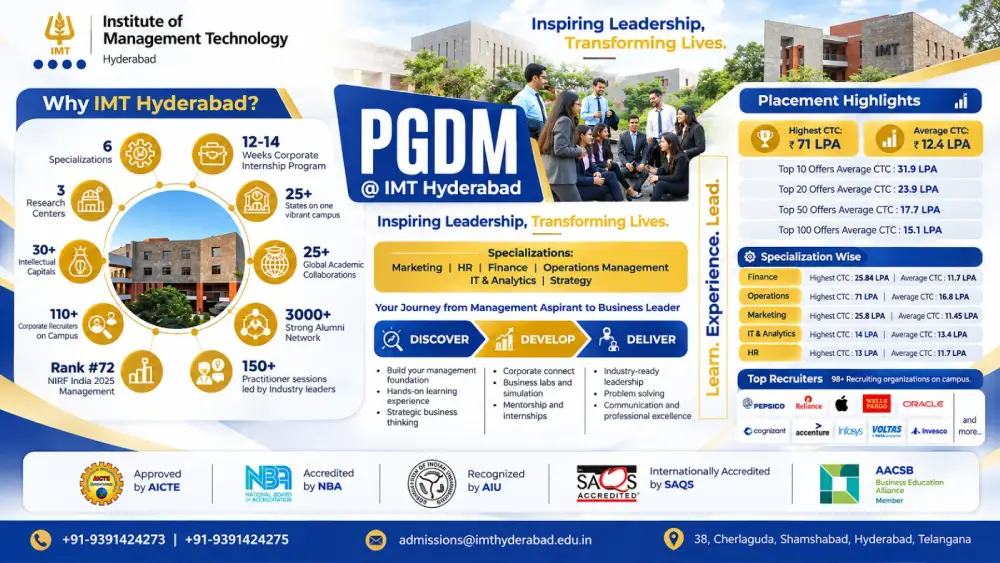
- Approvals: AICTE-approved, NBA-accredited, SAQS-accredited, with AIU equivalence to an MBA. Member of AACSB and EFMD.
- Placements (Batch 2023-25): average CTC ₹12.2 LPA, highest ₹31 LPA, 93% placed, 78+ recruiters. As of 27 March 2026, the interim highest offer for Batch 2024-26 was ₹71.2 LPA. See the official placement data.
- Recruiters across functions: Goldman Sachs, D.E. Shaw, Morgan Stanley, Deloitte, EY, Salesforce, Oracle, PepsiCo and Schneider Electric, among others.
- Learning beyond the classroom: a summer internship, the Centre for Digital Transformation, the Centre for Sustainability and the Global Immersion Programme.
- Admissions: CAT, XAT, CMAT and GMAT scores are accepted. The indicative two-year fee is about ₹16 lakh; confirm the current figure on the PGDM admissions page.
Meet the people who teach each area in the faculty directory, and if you have a shortlist ready, our guide on how to crack WAT-PI at IMT Hyderabad will help with the next step. You can also compare institutes in our list of top PGDM colleges in India.
Conclusion
Choosing between PGDM specialisations in India comes down to three honest questions: what you enjoy, what you are good at, and where the jobs really are at the college you join. Finance, Business Analytics and Marketing remain the strongest bets for 2027, with supply chain, product and HR analytics close behind. Use the five-question test, look at real function-wise placement data rather than headline packages, and consider a dual specialisation that pairs your main interest with analytics.
If you want a broader view of programmes, read which PGDM course is best, and when you are ready, explore the PGDM at IMT Hyderabad.
Frequently Asked Questions
Which PGDM specialisation is best for the future?
Business Analytics, Finance with FinTech, and Marketing with digital skills look strongest for the next five years. Supply Chain and Product Management are also growing. Whatever you choose, adding analytics as a minor will make you more employable.
Which PGDM specialisation has the highest salary in India?
Finance and Business Analytics usually pay the most to freshers, followed by IT or product roles and marketing. At IMT Hyderabad, IT and Analytics recorded the highest function-wise average CTC of ₹13.52 LPA for Batch 2023-25.
How many specialisations are there in a PGDM?
Most B-schools offer between five and fifteen. The core ones are Finance, Marketing, HR, Operations and Business Analytics. Larger schools add IT, International Business, Product Management, Healthcare, Retail and Rural Management.
Can I change my specialisation after joining a PGDM?
Usually yes, during the first year, because the first year is common to all students. Once you pick electives in the second year, switching is harder. Your first job matters more than the specialisation name, so a later career shift is still possible.
Is Business Analytics hard for non-engineers?
Not if you are willing to practise. Most programmes teach Excel, SQL, a visualisation tool and basic Python from scratch. Commerce and arts graduates who are comfortable with numbers often do very well.
Is HR a good specialisation in PGDM?
Yes, if you enjoy working with people. Starting pay is often lower than finance or analytics, but HR roles in technology firms and global capability centres pay well, especially if you add HR analytics skills.
What is the difference between a major and a minor in PGDM?
A major is your main specialisation, with the larger share of elective credits. A minor is a second area with fewer credits. Together they form a dual specialisation, such as Marketing major with an Analytics minor.
Which PGDM specialisation is best for engineers?
Engineers usually do well in Business Analytics, Operations and Supply Chain, and IT Management because these build on logical and quantitative skills. Engineers who follow the stock market can do well in Finance too.
Is a PGDM equal to an MBA?
For jobs, a PGDM from a well-accredited, AICTE-approved institute is treated on par with an MBA. IMT Hyderabad’s PGDM also carries AIU equivalence to an MBA, which matters for doctoral study or roles that specify a degree.
When do students choose their specialisation at IMT Hyderabad?
Students choose their specialisation before the summer internship, at the end of the first year, so the internship can build on it. Students can also apply directly to the Finance, Marketing or LSCM tracks.
Related Blogs

Services Marketing: A Complete Guide to Marketing the Intangible
Services marketing is the branch of marketing that focuses on promoting and selling intangible offerings,…

PGDM Best Colleges in India: Top Institutes, Fees & Placements
By NIRF 2025 Management rank, the leading PGDM-awarding institutes are IMT Hyderabad (72), MDI Gurgaon…

PGDM Duration in India: How Long a PGDM Takes, Term by Term (2027 Guide)
A full-time PGDM in India takes 2 years. Most AICTE-approved B-schools split it into 6…
Why Hyderabad Is India’s Best City for MBA/PGDM in 2026: A Complete Guide
Introduction: The City You Choose Could Define Your Career When it comes to pursuing a…
UPI, India’s Own Payment Method: A Modern Lesson for PGDM Courses and Future Business Leaders
Summary The Unified Payments Interface, known widely as UPI, has become the defining symbol of…

Best Finance Courses in India 2026 — Complete Guide by IMT Hyderabad
1. Introduction — Why Finance Education Matters Right Now in India India’s financial ecosystem is…