Wealth Management Course in India: A 2026 Guide to Skills, Certifications, and a High-Growth Finance Career
Home / Academic / Wealth Management Course in India: A 2026 Guide to Skills, Certifications, and a High-Growth Finance Career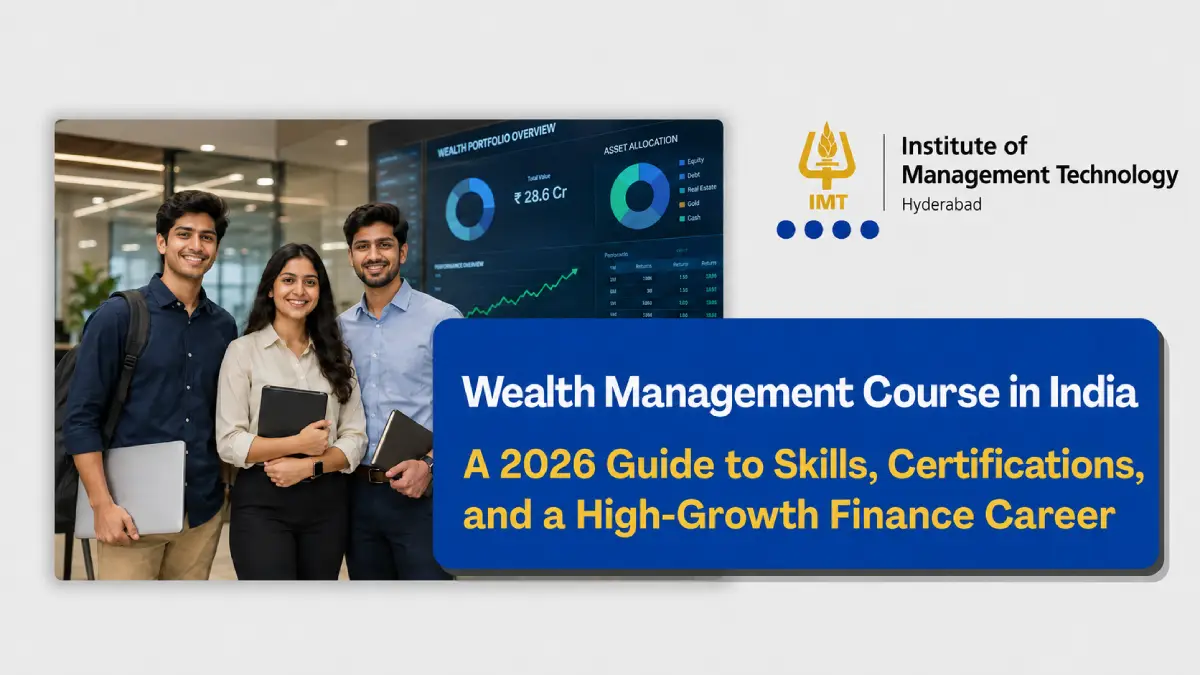
India is in the middle of one of the largest wealth-creation waves in its history, and the professionals who know how to grow and protect that wealth are in short supply. If you are a management student or a recent graduate weighing your next move, a wealth management course can be one of the smartest career bets you make this decade. This guide explains exactly what a wealth management course covers, the degree and certification pathways available in India, the careers and salaries you can realistically expect, and how to pick the path that fits your goals.
Here is the headline opportunity in one line: the India wealth management market was valued at roughly USD 171 billion in 2025 and is projected to more than double to about USD 436 billion by 2034 (IMARC Group), while there is roughly one registered investment adviser for every 200,000 investors. Strong demand, thin supply, and a long runway for trained talent.
In This Guide
- What is a wealth management course?
- Why wealth management is one of India’s fastest-growing careers
- Types of wealth management courses in India (degrees vs certifications)
- What you actually learn and the skills you build
- Career paths and indicative salaries
- How to choose the right course for your goals
- Where IMT Hyderabad fits in: PGDM (Finance) as a launchpad
- How AI is reshaping wealth management
- Frequently asked questions
What Is a Wealth Management Course?
A wealth management course is a structured program, ranging from a full-time degree or diploma to a focused professional certification, that teaches you how to help individuals and families grow, protect, and transfer their wealth. It blends investment management with financial planning, tax planning, estate planning, and risk management into a single advisory discipline.
Unlike a narrow trading or mutual-fund selling course, wealth management is holistic. It looks at a client’s entire financial life, their goals, income, risk appetite, taxes, and legacy, and builds a long-term plan around it. The discipline rests on five core pillars.
The Five Pillars of Wealth Management
| Pillar | What It Covers | Why It Matters |
|---|---|---|
| Financial Planning | Goal mapping, cash flow, budgeting, and savings strategy | The foundation of every client relationship |
| Investment & Portfolio Management | Asset allocation across equity, debt, gold, and alternatives | The engine that grows wealth over time |
| Tax Planning | Tax-efficient investing, deductions, and structuring | Protects returns from being eroded by tax |
| Estate Planning | Wills, trusts, succession, and wealth transfer | Preserves wealth across generations |
| Risk Management | Insurance, diversification, liquidity, downside protection | Shields wealth from market and life shocks |
Why Wealth Management Is One of India’s Fastest-Growing Careers
Wealth management is booming in India for a simple reason: the country is getting richer faster than the supply of qualified advisers can keep up.
The numbers tell the story:
- Market size: the India wealth management market grew to about USD 171 billion in 2025 and is projected to reach USD 436 billion by 2034, a CAGR of roughly 10.6%, with human advisory the largest segment at around 46% share (IMARC Group).
- A trillion-dollar opportunity: Deloitte estimates the financial wealth of affluent Indian households will roughly double from about USD 1.1 trillion (FY24) to USD 2.3 trillion (FY29), a USD 1.6 trillion growth opportunity.
- The advisory gap: official data shows only about 1,042 Registered Investment Advisers serving an investor base of nearly 20 crore, roughly one adviser per 200,000 investors.
- Huge underpenetration: wealth managers in India professionally manage only about 4% of HNI wealth, against a global average closer to 25%, leaving enormous headroom.
- A new client base: the emerging ‘mass affluent’ segment, investors with roughly Rs. 10 lakh to Rs. 5 crore in assets, is now seeking professional advice, widening demand well beyond traditional HNIs.
- Shift to financial assets: as Indians move from gold and real estate to financial products, mutual fund assets grew at about 16% annually from FY17 to FY24 (Deloitte).
For a finance-minded management graduate, that combination, soaring demand and a structural shortage of trained advisers, is exactly the kind of market you want to enter at the start of your career.
Types of Wealth Management Courses in India
Broadly, a wealth management course in India falls into two buckets. The first is a full-time management degree or diploma, such as a PGDM or MBA in Finance, that gives you a broad, employer-recognised foundation and access to campus placements. The second is a set of focused professional certifications, such as CFP, NISM, CWM, or CFA, that validate specialised expertise. The strongest careers usually combine both: a degree for the foundation, certifications stacked on top.
Wealth Management Course Options in India Compared
| Course / Credential | Type | Typical Duration | Best For | Recognised By |
|---|---|---|---|---|
| PGDM / MBA (Finance) | Full-time PG diploma / degree | 2 years | Building a complete management + finance foundation and entering top firms via campus placements | AICTE / AIU, recruiters |
| Certified Financial Planner (CFP) | Certification | 6-12 months | Personal financial planning and advisory roles | FPSB India |
| NISM (e.g. Investment Adviser, PMS) | Regulatory certification | Weeks-months | SEBI-mandated advisory and distribution roles | SEBI / NISM |
| Chartered Wealth Manager (CWM) | Certification | 6-12 months | Specialised wealth-management practitioners | AAFM India |
| CFA | Global charter | 2-4 years | Investment management, research, and global roles | CFA Institute |
Think of the PGDM (Finance) as the broad base that makes you employable and promotable, and the certifications as the specialist badges that deepen your credibility with clients and employers.
What You Learn and the Skills You Build
A strong wealth management curriculum is far more than memorising product features. It builds a toolkit you can apply from day one:
- Portfolio construction and asset allocation across asset classes
- Financial planning, goal mapping, and cash-flow analysis
- Equity, debt, and mutual fund analysis, plus financial modelling
- Tax-efficient investing and the basics of estate and succession planning
- Risk profiling, insurance, and downside protection
- Client relationship management and behavioural finance
- Regulatory knowledge (SEBI framework) and ethics
- Increasingly, comfort with AI, analytics, and wealth-tech tools
Notice how many of these are management skills, not just finance skills. That is why a finance-focused management programme is such a natural fit: it develops the analytical depth and the communication, relationship, and decision-making abilities that real advisory work demands.
Career Paths and Indicative Salaries
Graduates move into a wide range of roles across banks, asset management companies, wealth-tech firms, brokerages, and family offices. Common destinations include wealth manager, financial planner, portfolio manager, investment adviser, private banker, and research analyst.
Wealth Management Career Roles and Indicative Salaries in India
| Role | What You Do | Indicative Salary (per year)* |
|---|---|---|
| Wealth / Relationship Manager | Manage portfolios and relationships for affluent and HNI clients | Rs. 4-12 LPA |
| Financial Planner / Adviser | Build holistic, goal-based financial plans | Rs. 3.5-9 LPA |
| Portfolio Manager | Construct and actively manage investment portfolios | Rs. 8-25+ LPA |
| Investment / Research Analyst | Analyse securities, sectors, and markets | Rs. 5-15 LPA |
| Private Banker | Serve UHNI clients with bespoke solutions | Rs. 8-20+ LPA |
*Indicative ranges only. Actual compensation varies widely by employer, city, credentials, performance, and experience, and senior or specialist roles can pay considerably more.
How to Choose the Right Wealth Management Course
The best wealth management course for you depends on where you are starting from and where you want to go. A few questions to guide the decision:
- Are you a fresher or a working professional? Freshers and management students usually benefit most from a full-time PGDM (Finance) for the foundation and placements, then layering certifications. Working professionals often go certification-first.
- What is your career goal? Advisory and relationship roles lean toward CFP and CWM; research and investment-management roles lean toward CFA; SEBI-regulated roles require the relevant NISM certifications.
- How important is recognition and placement? A reputed degree opens campus-placement doors that self-study certifications do not.
- Foundation or niche skill? A degree gives breadth; a certification gives depth in one area. Most successful advisers eventually have both.
- What is the return on investment? Weigh fees against the roles, salary trajectory, and network the programme realistically opens up.
Where IMT Hyderabad Fits In: PGDM (Finance) as a Wealth Management Launchpad
If you are a management student who wants the strongest full-time foundation for a wealth management career, IMT Hyderabad’s PGDM (Finance) is a standout choice in South India. Whether you ultimately pursue a dedicated wealth management course or a finance-focused PGDM, the institute is built to give you both the analytical depth and the industry exposure that advisory careers demand.
What makes it a strong fit for aspiring wealth professionals:
- A dedicated finance pathway. The PGDM (Finance) specialisation develops exactly the portfolio management, financial planning, valuation, and analytics foundation that wealth management roles require, which you can then complement with NISM, CFP, CWM, or CFA certifications.
- A proven finance placement record. Finance has consistently been among IMT Hyderabad’s strongest streams, with the specialisation recording one of the highest average packages in recent placement seasons and recruiters such as BNY Mellon, Moody’s, ICICI Bank, and Federal Bank hiring on campus.
- A financial-services location. The 30-acre Hyderabad campus sits in one of India’s fastest-growing financial-services and technology hubs, close to major employers.
- Accreditation and credibility. IMT Hyderabad is AICTE-approved and carries respected accreditations, a trust signal that matters to both recruiters and clients.
- Future-ready, AI-aware learning. Through initiatives like its Centre for Digital Transformation, the programme exposes students to the analytics and AI tools reshaping modern advisory work.
You can verify the latest numbers on the official placement data page, explore the full PGDM programme, or head straight to PGDM admissions to begin your application.
How AI Is Reshaping Wealth Management
Artificial intelligence is changing advisory work, but, as industry analysts note, it is acting as an enhancer rather than a replacement. AI is improving productivity through portfolio analytics, research summarisation, reporting automation, and risk diagnostics, while human judgment remains central to interpreting behavioural, political, and macro signals that algorithms struggle with.
The practical takeaway for your course choice: pick a programme that builds strong financial fundamentals and gives you hands-on comfort with AI and analytics tools. The advisers who thrive will be those who pair human trust and judgment with technological fluency, which is why modern, future-ready management programmes are weaving AI directly into the finance curriculum.
Frequently Asked Questions
What is a wealth management course?
A wealth management course is a degree, diploma, or professional certification that trains you to help individuals and families grow, protect, and transfer their wealth. It combines investment and portfolio management with financial planning, tax planning, estate planning, and risk management.
Which wealth management course is best in India?
It depends on your goal. For a broad, employer-recognised foundation with campus placements, a PGDM or MBA in Finance is ideal. For specialised expertise, certifications such as CFP, CWM, NISM, or CFA work well. The strongest careers usually combine a finance degree with one or more certifications.
What is the eligibility for a wealth management course?
Most certifications require a bachelor’s degree in any discipline. A full-time PGDM (Finance) typically requires a graduate degree with around 50% marks and a valid entrance score such as CAT, XAT, or GMAT.
What salary can I earn after a wealth management course?
Entry-level roles such as relationship manager or financial planner often start in the Rs. 3.5-12 LPA range, while experienced portfolio managers and private bankers can earn significantly more. Pay varies by employer, city, credentials, and performance.
Do I need a finance background to study wealth management?
No. Management programmes welcome graduates from diverse backgrounds, including engineering and commerce, and teach the finance fundamentals from the ground up.
Is wealth management a good career in India?
Yes. With the market projected to more than double by 2034 and a severe shortage of qualified advisers, demand for trained wealth professionals is strong and growing.
The Bottom Line
India’s wealth-creation story has decades to run, and it needs a new generation of skilled, trustworthy advisers to guide it. Choosing the right wealth management course is the first step. For most management students, the smartest route is a strong finance-focused degree for the foundation and placements, complemented by targeted certifications as you specialise. If that path appeals to you, explore IMT Hyderabad’s PGDM (Finance) and take the first step toward a high-growth career in wealth management.
Related Blogs

HOW TO BECOME A FINANCIAL MANAGER?
Introduction The terms “finance” and “financial markets” are quite popular, even in public discourse, despite…
Top 10 PGDM Colleges in India 2026: Fees, Placements, and How to Get In
Every management aspirant who starts researching the top PGDM colleges in India runs into the…

Ephemeral Teams and Leadership: Leading Teams That Disappear After Projects
Modern work operates through pop-up teams: groups that assemble rapidly, deliver a result, and disband….

Top PGDM Institutes in India 2026: Courses, Fees, Placements & Career Scope
By NIRF 2025 Management rank, the leading PGDM institutes are MDI Gurgaon (9), XLRI Jamshedpur…

Top PGDM Colleges in South India: Find the Right B-School for You
The top colleges for PGDM in South India include IMT Hyderabad, Great Lakes Institute of…

FROM CLASSROOM TO C-SUITE: HOW MODERN MANAGEMENT SHAPES TOMORROW’S LEADERS
Introduction The aspiration to become a businessman is a common dream among many schoolgoers. However,…