
Pepsi Vs Coca-Cola: The Cola Wars and What They Teach Future Business Leaders
Home / Case Study / Pepsi Vs Coca-Cola: The Cola Wars and What They Teach Future Business Leaders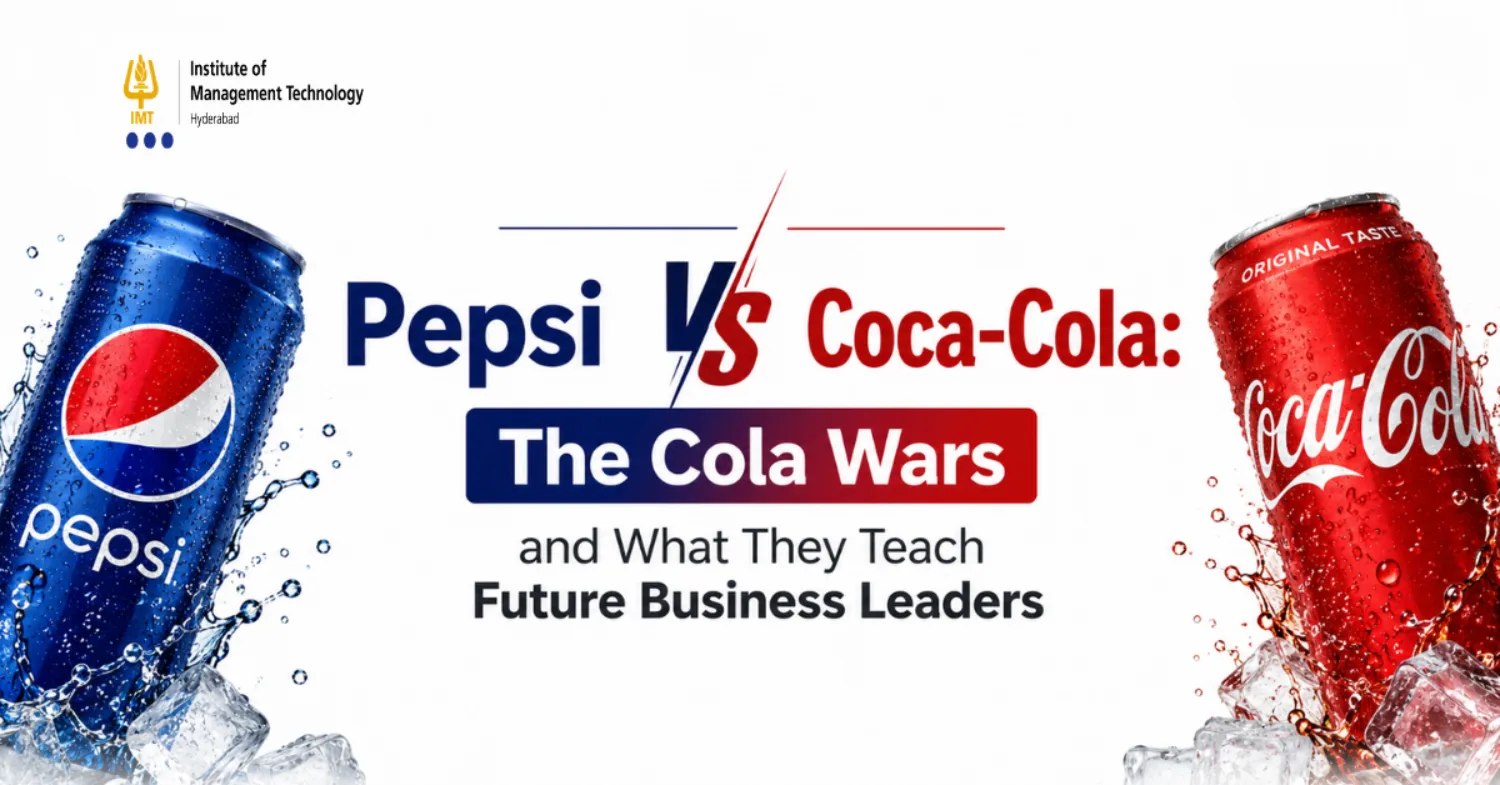
Summary
The rivalry between Pepsi and Coca-Cola, widely known as the Cola Wars, is one of the most studied competitive battles in business history. This case study traces the conflict from its origins in the United States to its localised version in India, examining advertising strategy, brand positioning, pricing decisions, and major acquisitions. It presents verified market data and financial figures, and then draws out the management lessons that prospective students should understand. The final section explains how a structured postgraduate diploma in management equips learners to analyse such rivalries through specialisations in finance, marketing, information technology, and logistics and supply chain management.
Introduction
Few corporate rivalries have shaped modern marketing as deeply as the contest between Pepsi and Coca-Cola. For more than a century, the two companies have competed for the attention, loyalty, and spending of consumers around the world. Their battle has produced famous advertisements, bold pricing moves, and strategic acquisitions that are now taught in business schools in India and abroad. For students exploring PGDM courses, the Cola Wars offer a clear window into competitive strategy. This article explains the key events, supports each one with credible data, and then connects these ideas to the skills that quality management education aims to build.
How Did the Cola Wars Begin?
Coca-Cola was created in 1886 by John Pemberton, a pharmacist in Atlanta, while Pepsi-Cola was developed in 1893 by Caleb Bradham in North Carolina. For several decades, Coca-Cola held a commanding lead. By 1950, Coca-Cola controlled close to 47 percent of the United States cola market, while Pepsi held about 10 percent, a gap recorded in the long industry history examined by the Harvard Business School case on the rivalry. Pepsi responded by lowering prices and targeting value-conscious families, and it slowly began to close the distance. The competition grew sharper through the 1960s and 1970s as both firms expanded their bottling networks and raised their advertising budgets. Over time, the contest became less about the drink itself and more about brand image, lifestyle, and emotion.
What Were the Defining Marketing Battles?
The most famous early strike was the Pepsi Challenge, launched in 1975. Pepsi set up blind taste tests in shopping centres, and many participants chose Pepsi over Coca-Cola. The campaign questioned the core strength of its rival, which was taste, and it forced Coca-Cola to respond. In 1985, Coca-Cola reformulated its flagship product and released New Coke. The public reaction was strongly negative, and the company returned to its original recipe within three months under the name Coca-Cola Classic. This episode is now a standard lesson in brand loyalty and the emotional bond between a consumer and a product.
Marketing positioning then split along clear lines. Pepsi presented itself as the choice of a younger generation, using slogans such as “The Choice of a New Generation” and “Live for Now”, and it signed global music and sports icons. Coca-Cola leaned on heritage, consistency, and shared happiness, and it later ran the personalised “Share a Coke” campaign, which replaced its logo with popular names. According to the Harvard Business School case, the United States carbonated soft drink industry was worth around 60 billion dollars, and the average American consumed about 53 gallons of these drinks each year. Those figures explain why both firms invested so heavily in winning attention.
| Aspect | Coca-Cola | Pepsi |
|---|---|---|
| Brand promise | Heritage, authenticity, shared happiness | Youth, energy, modern culture |
| Signature campaign | Share a Coke | The Pepsi Challenge, Live for Now |
| Core audience | Broad and multi-generational | Younger consumers |
| Strategic focus | Consistency and emotional memory | Reinvention and cultural relevance |
How Did the Cola Wars Reach India?
The Indian chapter of the Cola Wars is equally instructive. Coca-Cola left India in 1977 after a disagreement with the government over ownership and the disclosure of its formula. In its absence, the home-grown brand Thums Up, launched by Parle in 1977, grew rapidly and held close to 85 percent of the Indian cola market by the early 1990s. Pepsi entered India in 1989 through a joint venture and operated under the name Lehar Pepsi in order to meet local rules on foreign branding. After the economic reforms of 1991, Coca-Cola returned in 1993 and quickly acquired Thums Up, Limca, Gold Spot, and other Parle brands for about 60 million dollars. This single acquisition reshaped the market in one move.
Today the Indian carbonated soft drink market is large and tightly contested. According to a Business Today report, the category is valued at around 50,000 crore rupees, with Coca-Cola holding close to 60 percent share and PepsiCo holding just over 30 percent. Thums Up, once a rival, is now the largest brand in Coca-Cola’s India portfolio and has crossed one billion dollars in annual sales. The Indian experience shows how local taste, pricing, and acquisitions can matter as much as global brand power.
| Year | Event |
|---|---|
| 1977 | Coca-Cola exits India; Thumbs Up is launched by Parle |
| 1989 | Pepsi enters India as Lehar Pepsi through a joint venture |
| 1991 | Economic liberalisation opens the market to foreign firms |
| 1993 | Coca-Cola returns and acquires Thums Up and other Parle brand |
What Does the Financial Scoreboard Look Like Today?
The two companies remain global giants with very different strengths. For the full financial year 2023, The Coca-Cola Company reported that net revenues grew 6 percent for the year, reaching about 45.8 billion dollars, and that cash flow from operations was 11.6 billion dollars. PepsiCo, which also owns large snack businesses such as Frito-Lay, recorded net revenue of approximately 92 billion dollars in the same period. PepsiCo earns far more in total because its portfolio extends well beyond drinks. In advertising, Coca-Cola has spent just over 5 billion dollars in recent years to protect its brand, which signals the scale of the contest.
Within the cola category itself, market research data shows that Coca-Cola remains the leader, holding roughly 44 percent of the United States carbonated soft drink market against a share of about 25 percent for Pepsi. The contrast between category leadership and total revenue is a key lesson: a brand can lead one category and still earn less overall than a more diversified rival.
| Measure (2023) | Coca-Cola | PepsiCo |
|---|---|---|
| Net revenue (approximate) | 45.8 billion dollars | 92 billion dollars |
| Main strength | Beverage brand power | Diversified food and drinks |
| United States cola share (approximate) | About 44 percent | About 25 percent |
| Recent advertising spend | Just over 5 billion dollars | Lower than Coca-Cola |
What Management Lessons Can Students Learn From the Cola Wars?
This rivalry is taught in management programmes because it brings together many subjects at the same time. Five lessons stand out for prospective students.
- Brand positioning shapes choice. Pepsi and Coca-Cola sold similar products, yet they built very different identities. Clear positioning can matter more than the product itself.
- Listening to customers protects value. The New Coke episode showed that ignoring emotional loyalty can be expensive, even for a market leader.
- Local strategy decides global success. In India, taste preferences, pricing, and distribution mattered as much as global advertising.
- Acquisitions can reshape a market. The purchase of Thums Up changed the competitive balance in a single decision.
- Diversification reduces risk. The food business of PepsiCo shows how a broad portfolio can support steady revenue when one category slows.
These lessons connect directly to subjects taught in PGDM courses, including marketing, finance, strategy, operations, and analytics. Understanding them well requires structured study, reliable data, and guided practice, which is exactly what strong business schools in India aim to provide.
How Does the IMT Hyderabad PGDM Connect to These Lessons?
A case study such as the Cola Wars is best understood through a programme that teaches strategy, finance, marketing, and operations together. The Post Graduate Diploma in Management at IMT Hyderabad is offered as an industry-driven, two-year, full-time programme, and the institute positions itself among the leading PGDM colleges in India with a focus on strong placements and an active alumni network. It was ranked 97th in the Management category by the National Institutional Ranking Framework in 2024.
The PGDM offers several specialisations that map closely to the lessons above. A student interested in the financial scoreboard of these companies can study finance and accounting, which places the institute among focused PGDM finance colleges. A student drawn to the supply and distribution side, which decides the Indian battle, can study a PGDM in logistics and supply chain management. A student interested in digital systems and data can follow a postgraduate diploma in information technology through the analytics and information technology track. Marketing, human resource management, strategy, and operations management complete the range.
| Feature | Detail |
|---|---|
| Programme | Two-year, full-time Post Graduate Diploma in Management (PGDM) |
| Specialisations | Marketing, Finance and Accounting, Analytics and Information Technology, Operations, Human Resource Management, Strategy, and Logistics and Supply Chain Management |
| Eligibility | Bachelor’s degree with at least 50 percent marks and a valid CAT, XAT, or GMAT score [VERIFY accepted exams on the official site] |
| Selection | Entrance score followed by a personal interview |
| Ranking | NIRF Management rank 97 (2024) [VERIFY current rank] |
| Teaching method | Case studies and business simulations as a core part of the classroom |
Admission seekers usually look for clear information on eligibility, fees, specialisations, placements, and teaching methods. Because the programme uses case studies and simulations as a core method, rivalries like the Cola Wars are analysed in the classroom rather than only read about. Prospective students should confirm the current fee structure, the seat intake, and the latest placement figures directly on the official IMT Hyderabad pages before they apply, so that every decision rests on verified and current data.
Conclusion
The Cola Wars show that business success depends on far more than a good product. Positioning, customer insight, local strategy, finance, and well-timed acquisitions all play a part. For students who want to understand and lead in such markets, a well-structured PGDM prepares the ground. The story of Pepsi and Coca-Cola is, in the end, a living textbook of management in action.
References
- Harvard Business School. “Cola Wars Continue: Coke and Pepsi in the Twenty-First Century.” Industry size and consumption data. Available at: https://www.hbs.edu/faculty/Pages/item.aspx?num=28760
- The Coca-Cola Company. “Fourth Quarter and Full-Year 2023 Results.” Net revenue growth and cash flow data. Available at: https://investors.coca-colacompany.com/news-events/press-releases/detail/1101/coca-cola-reports-fourth-quarter-and-full-year-2023-results
- Statista. “Coca-Cola Company: Statistics and Facts.” Advertising spend, PepsiCo revenue, and brand value data. Available at: https://www.statista.com/topics/1392/coca-cola-company
- Business Today. “How Coca-Cola turned Thums Up, Sprite into billion-dollar brands.” India market size and share data. Available at: https://www.businesstoday.in/interactive/longread/how-coca-cola-turned-thums-up-sprite-into-billion-dollar-brands-230-09-01-2023
- Cognitive Market Research. “Coke vs. Pepsi: A Market Research Deep Dive into the Cola Wars.” United States cola market share data. Available at: https://www.cognitivemarketresearch.com/blog/coke-vs-pepsi-a-market-research-deep-dive-into-the-cola-wars
- IMT Hyderabad. “Admissions: PGDM.” Official programme and admission information. Available at: https://www.imthyderabad.edu.in/admissions/PGDM
- IMT Hyderabad. “PGDM Placements.” Official placement information. Available at: https://www.imthyderabad.edu.in/admissions/PGDM#placements
Related Blogs
The Apple Comeback Under Tim Cook: A Business Case Study for PGDM Courses and Future Managers
Summary When Tim Cook became chief executive of Apple in 2011, many people doubted that…
How Titan Became One of the World’s Largest Watch Manufacturers
Summary This case study examines how Titan, a joint venture between the Tata Group and…
How Reliance Jio Revolutionized India’s Telecom Industry: Strategic Lessons for PGDM Students
Summary This case study examines how Reliance Jio transformed India’s telecommunications industry within a few…