Strategic Marketing Management: Concepts, Frameworks, Career Scope, and Industry Applications
Home / Academic / Strategic Marketing Management: Concepts, Frameworks, Career Scope, and Industry Applications
Strategic marketing management is the discipline that separates marketers who run campaigns from marketers who run businesses. For a PGDM student, it is arguably the most career-defining subject in the marketing curriculum, because it answers the questions every recruiter will eventually ask you: which market should we compete in, which customers should we serve, how should we position our brand, and where should we put our money? This guide explains strategic marketing management from the ground up. You will find the core concepts, the frameworks used in classrooms and boardrooms, real industry applications, and the career scope and salaries that await you after your PGDM.
What Is Strategic Marketing Management?
Strategic marketing management is the process of analysing markets, setting long-term marketing objectives, selecting target segments, crafting a positioning, and allocating resources so that marketing builds a lasting competitive advantage. In simple words, it is the thinking that happens before any advertisement is made.
The word “strategic” matters here. Tactical marketing asks how to run this quarter’s campaign. Strategic marketing management asks whether the company is even fighting in the right market, with the right product, for the right customer. It connects marketing decisions directly to business goals such as market share, revenue growth and profitability.
What Are the Core Concepts of Strategic Marketing Management?
Before the frameworks, you need the building blocks. The table below summarises the concepts that appear in every strategic marketing management course and in almost every marketing interview:
| Concept | What It Means | Why It Matters |
|---|---|---|
| Segmentation | Dividing a market into groups with similar needs | No brand can serve everyone profitably |
| Targeting | Choosing which segments to serve | Focus decides where budgets and effort go |
| Positioning | The distinct place a brand occupies in the customer’s mind | It shapes pricing, communication and product design |
| Value Proposition | The clear promise of value to the chosen customer | Customers buy benefits, not features |
| Competitive Advantage | What a firm does better than rivals, sustainably | It protects margins over the long term |
| Brand Equity | The commercial value of brand recognition and trust | Strong brands charge more and retain customers longer |
| Customer Lifetime Value (CLV) | Total profit a customer generates over the relationship | It shifts focus from one sale to long-term loyalty |
| Marketing Mix (4Ps/7Ps) | Product, Price, Place, Promotion, plus People, Process and Physical Evidence | It converts strategy into visible market action |
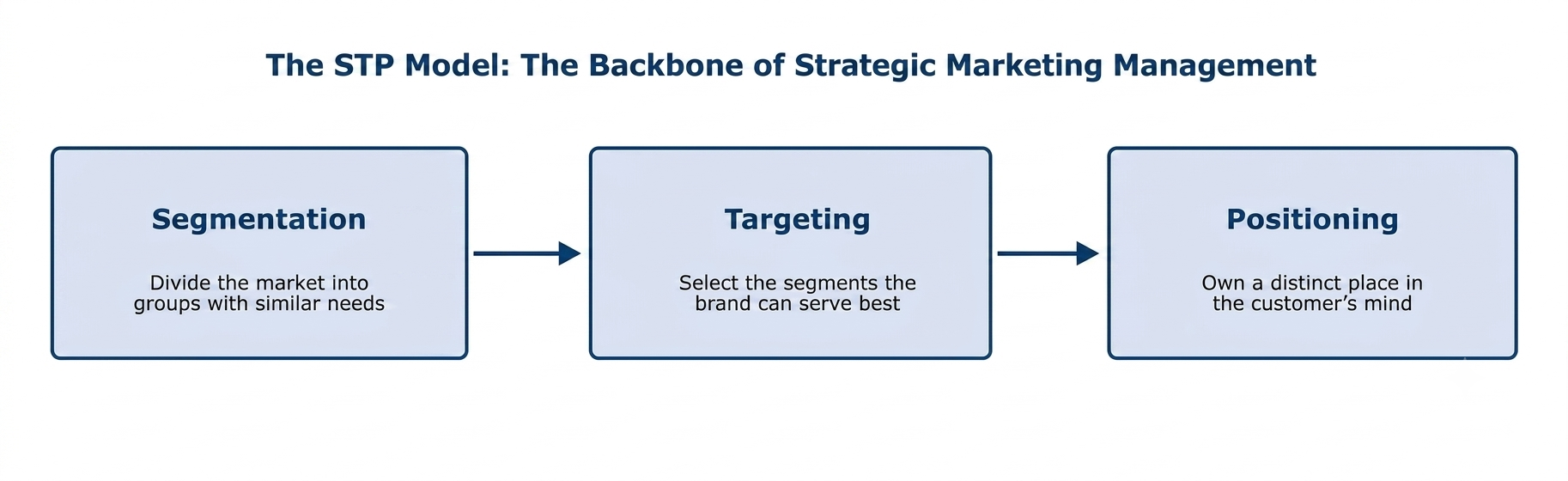
Of these concepts, the segmentation, targeting and positioning sequence deserves special attention, because it is the backbone on which every strategy is built:
Which Frameworks Are Used in Strategic Marketing Management?
Frameworks are the working instruments of strategic marketing management. They do not give you answers, but they make sure you ask the right questions in the right order. These are the frameworks you will use most often, both in your PGDM classroom and in industry:
| Framework | Purpose | Typical Use Case |
|---|---|---|
| SWOT Analysis | Assess internal strengths and weaknesses against external opportunities and threats | Annual brand planning and case interviews |
| PESTLE Analysis | Scan political, economic, social, technological, legal and environmental forces | Market entry and long-range planning |
| Porter’s Five Forces | Measure industry attractiveness and competitive intensity | Deciding whether to enter or exit a market |
| STP Model | Segment the market, select targets, define positioning | The backbone of every marketing strategy |
| Ansoff Matrix | Choose between market penetration, market development, product development and diversification | Growth strategy decisions |
| BCG Matrix | Classify products as stars, cash cows, question marks or dogs | Portfolio and budget allocation |
| 7Ps Marketing Mix | Design the complete offer, including service elements | Translating strategy into execution |
| Balanced Scorecard | Track financial, customer, process and learning metrics together | Measuring whether the strategy is working |
A practical tip for PGDM students: examiners and interviewers are rarely impressed by a framework alone. They are impressed when you use one to reach a clear recommendation. Always end your analysis with a decision.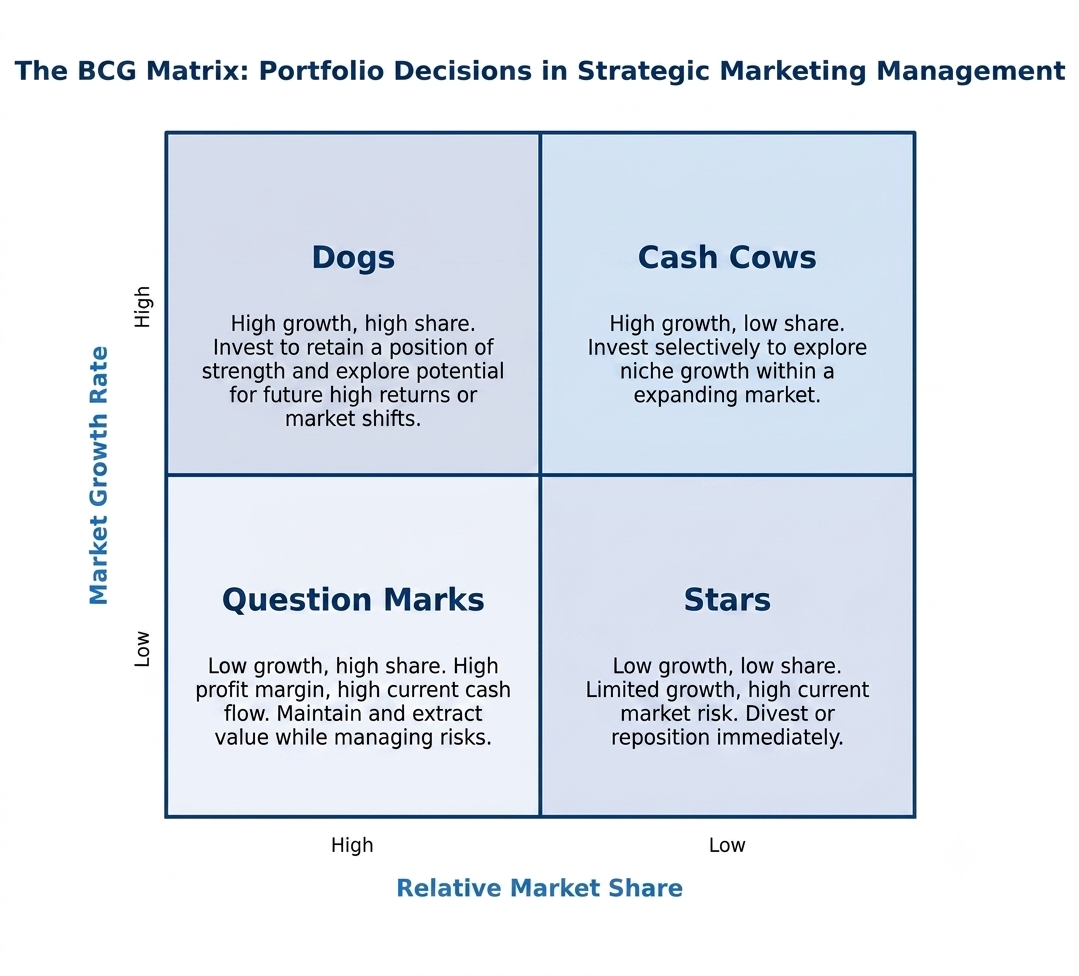
Figure 2: The BCG Matrix turns portfolio analysis into investment decisions
What Is the Strategic Marketing Management Process?
The process runs in five stages, and it is a cycle rather than a straight line, because market feedback keeps reshaping the plan. The flowchart below shows how the stages connect:
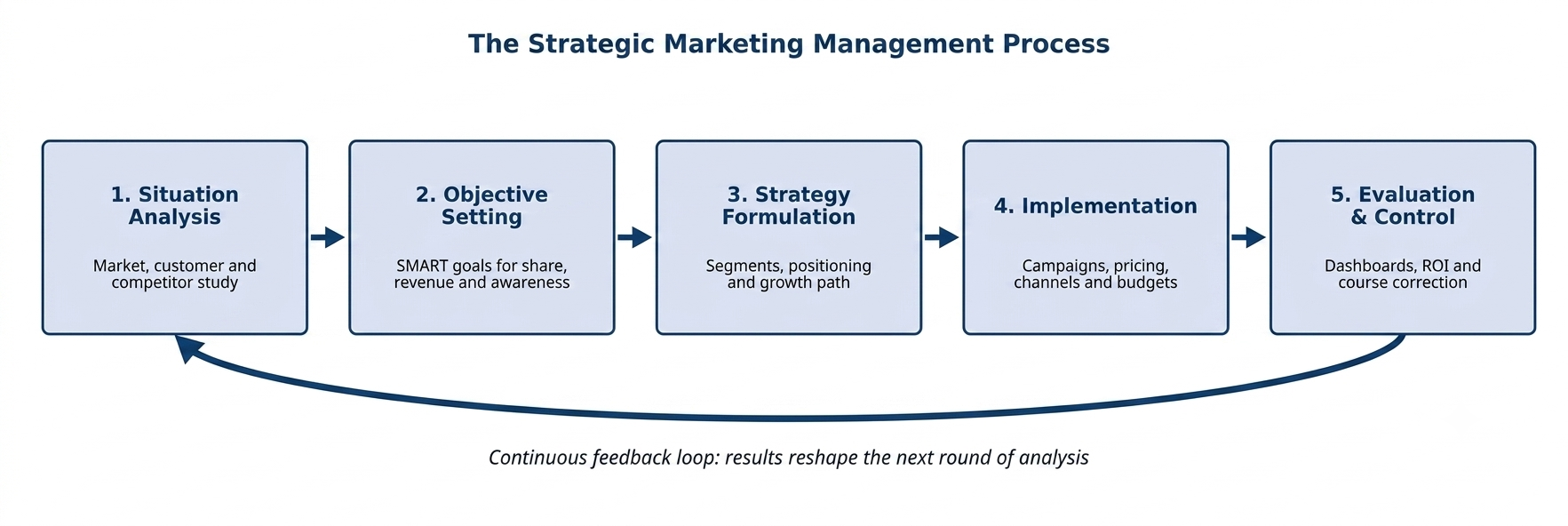
Figure 3: The five-stage strategic marketing management process with its continuous feedback loop
Each stage feeds the next, and the table below details what happens inside each one:
| Stage | What Happens | Key Tools |
|---|---|---|
| 1. Situation Analysis | Study the market, customers, competitors and the company’s own capabilities. | SWOT, PESTLE, Five Forces, customer research |
| 2. Objective Setting | Define measurable goals such as market share, revenue or brand awareness targets. | SMART objectives, benchmarking |
| 3. Strategy Formulation | Select segments, finalise positioning and choose the growth path. | STP, Ansoff Matrix, BCG Matrix |
| 4. Implementation | Convert strategy into campaigns, pricing, channels and product plans with budgets and owners. | 7Ps, media planning, sales enablement |
| 5. Evaluation and Control | Measure results, compare against objectives and correct course. | Balanced scorecard, marketing dashboards, ROI analysis |
Notice how the frameworks slot into specific stages of the strategic marketing management process. This is exactly how case interviews expect you to structure an answer: analyse first, decide second, execute third, measure last.
How Is Strategic Marketing Management Applied Across Industries?
Strategic marketing management becomes valuable only when you can see it working in the market. The industry relevance of this subject is easiest to appreciate through examples of how different sectors apply the same strategic logic:
| Industry | Strategic Marketing in Action |
|---|---|
| FMCG | Brands use segmentation and price-pack architecture to serve premium urban buyers and value-seeking rural buyers with the same product line |
| E-commerce and quick commerce | Platforms use customer lifetime value and retention analytics to decide how much to spend acquiring each customer segment |
| Banking and BFSI | Banks position separate offerings for salaried professionals, businesses and high-net-worth clients, each with distinct channels and pricing |
| Technology and SaaS | Firms use product-led growth and land-and-expand strategies, targeting individual users first and enterprise contracts later |
| Pharmaceuticals and healthcare | Companies balance doctor-focused scientific positioning with patient-focused awareness campaigns under strict regulation |
| Automotive | Manufacturers manage brand portfolios across hatchback, SUV and electric segments, deciding where each rupee of promotion earns the most |
| Higher education | Institutions position programmes around outcomes such as placements and industry exposure to attract the right applicant segments |
Across all of these sectors, the pattern is identical: analyse the market, pick the battles worth fighting, position sharply and measure relentlessly. That pattern is strategic marketing management at work.
What Is the Career Scope After Studying Strategic Marketing Management?
The career scope is wide because every company that sells anything needs strategic marketers. PGDM graduates typically begin as management trainees or executives and move into brand or product ownership within two to four years. The table below maps the common career path with indicative salary ranges in India:
| Role | What the Role Involves | Indicative Salary (INR) |
|---|---|---|
| Marketing Executive / Management Trainee | Campaign execution, market research and sales coordination | 6 to 10 LPA |
| Digital Marketing Manager | Performance marketing, SEO and marketing automation strategy | 8 to 15 LPA |
| Brand Manager | Full ownership of a brand’s positioning, P&L and communication | 12 to 25 LPA |
| Product Manager | Product strategy, roadmap and go-to-market planning | 15 to 30 LPA |
| Category Manager | Portfolio strategy across a product category in retail or e-commerce | 12 to 25 LPA |
| Marketing Strategist / Consultant | Advisory work on growth, positioning and market entry | 12 to 30 LPA |
| Head of Marketing / CMO | Enterprise-level marketing strategy and leadership | 40 LPA and above |
Compensation varies with the sector, the city and the strength of the B-school’s placement support. FMCG, consulting and technology firms consistently pay the highest premiums for strategic marketing talent.
What Skills Do Strategic Marketing Professionals Need in 2026?
Strategic marketing management has evolved well beyond textbooks, and so have recruiter expectations. Alongside the classic frameworks, employers now look for this combination:
- Marketing analytics: Comfort with Excel, SQL basics, Google Analytics and dashboard tools to back every recommendation with data.
- Digital and performance marketing: A working grasp of paid media, SEO and conversion funnels, since most budgets now flow through digital channels.
- AI literacy: Familiarity with AI tools for customer insight, content generation and predictive targeting, which are becoming standard in marketing teams.
- Consumer psychology: The ability to translate research into insight, because strategy built on a wrong insight fails no matter how elegant the framework.
- Storytelling and communication: Strategies must be sold internally before they are sold externally. Clear decks and confident presentation win resources.
- Financial fluency: Understanding margins, CLV and ROI, because the strongest marketers speak the language of the CFO.
Strategic Marketing vs Traditional Marketing: What Is the Difference?
Students often use the terms interchangeably, but the distinction is important and interviewers love asking about it:
| Parameter | Traditional Marketing | Strategic Marketing Management |
|---|---|---|
| Time horizon | Short term, campaign to campaign | Long term, typically one to five years |
| Core question | How do we promote this product? | Which markets and customers should we win? |
| Focus | Execution of the marketing mix | Direction, positioning and resource allocation |
| Success measure | Sales, reach and engagement | Market share, brand equity and sustained profitability |
| Decision level | Functional and operational | Business and leadership level |
The two are partners, not rivals. Strategy without execution stays on paper, and execution without strategy burns budgets. A good PGDM education deliberately trains you in both.
How Does a PGDM Programme Teach Strategic Marketing Management?
A well-designed PGDM course in Hyderabad or anywhere else teaches strategic marketing management through practice rather than lectures alone. Expect four learning methods:
- Case studies: Real business dilemmas where you must analyse, decide and defend your recommendation in class.
- Business simulations: Tools such as MarkStrat let you run a virtual brand over several periods and watch your strategic choices play out against classmates.
- Live projects and internships: The summer internship is where frameworks meet messy reality, and it is often the doorway to a pre-placement offer.
- Industry interaction: Guest sessions with brand managers and CMOs show how strategy is actually debated inside companies.
When choosing where to study, check the institute’s recognition and business school rankings, the depth of its marketing electives, and its record of converting internships into offers. These three markers predict how well the classroom will translate into a career.
Read More: UPI Case Study: How India Built the World’s Largest Real-Time Payment Network
Conclusion: Make Strategic Marketing Management Your Career Edge
Marketing jobs are plentiful, but marketing leadership is scarce, and the difference between the two is strategy. Strategic marketing management gives PGDM students the frameworks to analyse any market, the concepts to position any brand and the commercial vocabulary to sit at the leadership table early. Master the STP model, practise the frameworks on live cases, build your analytics muscle and treat every internship as a strategy laboratory. If you are planning your management education, choose a structured programme that teaches this subject through cases, simulations and real industry projects, and speak to the admissions team about how the marketing specialisation is delivered. The brands of the next decade will be built by strategists. There is no reason you should not be one of them.
Frequently Asked Questions
1. What is strategic marketing management in simple words?
It is the process of deciding which market to compete in, which customers to serve, how to position your brand and where to invest resources, so that marketing builds long-term competitive advantage rather than only short-term sales.
2. Why is this subject important for PGDM students?
Because recruiters test it directly. Internship interviews, case competitions and brand management roles all demand segmentation, positioning and competitive analysis skills.
3. Which frameworks should I master first?
Start with STP and SWOT, then add Porter’s Five Forces, the Ansoff Matrix and the BCG Matrix. Together they cover most classroom and interview situations.
4. What salary can I expect after my PGDM in marketing?
Graduates from reputed B-schools typically start between INR 6 and 10 LPA, brand and product managers earn INR 12 to 25 LPA, and senior leadership roles can exceed INR 40 LPA.
5. Is strategic marketing only for FMCG careers?
No. E-commerce, banking, technology, pharma, automotive and consulting firms all apply strategic marketing management and hire for it, which is what makes the career scope so broad.
6. How is AI changing strategic marketing management?
AI is accelerating research, targeting and content, but the strategic decisions about markets, positioning and investment still need trained human judgement. AI-literate strategists are simply more valuable.
Related Blogs

Why Luxury Costs More?
Shruti Mishra Bringing fresh perspective to ideas, exploring the world and writing about…

Information Fatigue: The age of the Infinite Scroll
Kashish Sehgal PGDM Marketing A quiet observer, she is drawn to the stories behind…

Courses for Financial Analyst: Best Programs, Eligibility, Skills and Careers in India
Choosing the right courses for financial analyst jobs can feel confusing. There are degrees, diplomas,…
Top Career Paths After PGDM in Logistics & Supply Chain Management for a Successful Future in 2026
Think about the last time you ordered something online and it arrived the next morning….

Top PGDM Colleges in South India: Find the Right B-School for You
The top colleges for PGDM in South India include IMT Hyderabad, Great Lakes Institute of…
PGDM vs PGPM: Key Differences, Eligibility, Fees & Career Scope (2026 Guide)
The PGDM vs PGPM decision is settled by career stage, not by prestige. A PGDM…