
Flipkart Big Billion Days 2026 Case Study: How BBD Became India’s Biggest Shopping Event
Home / Case Study / Flipkart Big Billion Days 2026 Case Study: How BBD Became India’s Biggest Shopping Event
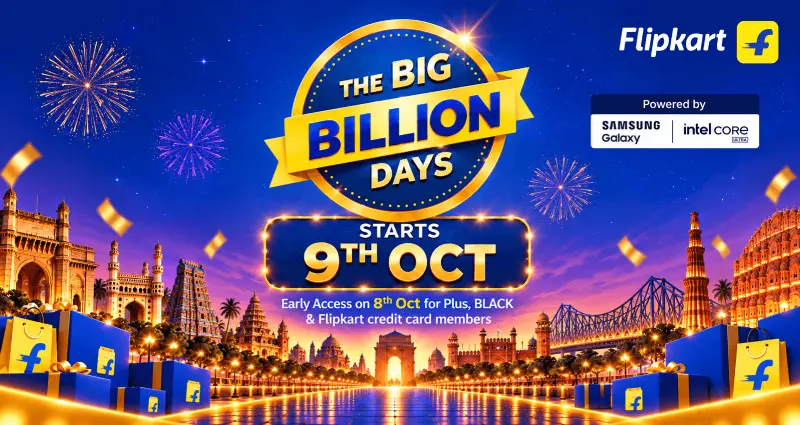
Flipkart Big Billion Days (BBD) is Flipkart’s annual festive sale, first held on 6 October 2014. It became India’s biggest shopping event by combining weeks of pre-sale hype, time-limited deals that create urgency, easy credit through no-cost EMI and bank discounts, member-only early access, brand-funded offers and fast delivery into smaller towns. The 2026 edition opens to everyone on 9 October, with early access on 8 October.
At midnight on 9 October 2026, millions of Indians will open the same app at the same moment. Flipkart Big Billion Days is back, and for the next week a large share of the country’s festive shopping will run through one sale.
It wasn’t always this smooth. The first Big Billion Day, in October 2014, broke so badly that Flipkart’s founders had to apologise to customers the next day. Twelve years on, BBD fires the starting gun for India’s festive season, and Amazon now plans its own sale around it.
So what changed? This case study breaks down how Flipkart Big Billion Days went from a public embarrassment to a repeatable playbook, and what PGDM students can learn from it.
What Is Flipkart Big Billion Days?
Flipkart Big Billion Days is a multi-day sale that Flipkart runs every year before Diwali, timed around Navratri and Dussehra, when Indian families traditionally make big purchases. Phones, TVs, appliances, fashion and home products are discounted, and paying members get in a day early.
For Flipkart, it’s far more than a sale. Redseer estimated India’s festive-month e-commerce sales at roughly ₹1.15 lakh crore in 2025, growing 20–25% and calling it the strongest season in five years. BBD is how Flipkart tries to take the biggest piece of that on day one.
Source: https://stories.flipkart.com/announcement/flipkart-announces-big-billion-days-2026-with-luck-badal-sakta-hai-campaign
Big Billion Days 2026 at a glance
| Detail | Big Billion Days 2026 |
|---|---|
| Early access | 8 October 2026, for Plus, VIP/Black members and Flipkart credit card holders |
| Open to all | 9 October 2026, from 12 AM |
| Campaign | ‘Luck Badal Sakta Hai, Yahan Kuch Bhi Ho Sakta Hai’, created by Leo Burnett |
| Campaign faces | Rohit Sharma, Sreeleela, Jackie Shroff, Aneet Padda, Samay Raina |
| Title sponsors | Samsung Galaxy and Intel Core Ultra (associate partners: Acer, JBL, Aristocrat, TCL) |
| Bank offers | Up to 10% instant discount on Axis Bank and ICICI Bank cards; extra savings via the Flipkart Axis Bank card, super.money and Paytm |
| Deal formats | Price Crash, BBD Specials, Tick Tock Deals, Brand Hours, Double Discount, Rush Hours |
| End date | Not confirmed by Flipkart at the time of writing |
The Origin Story: Big Billion Day 2014
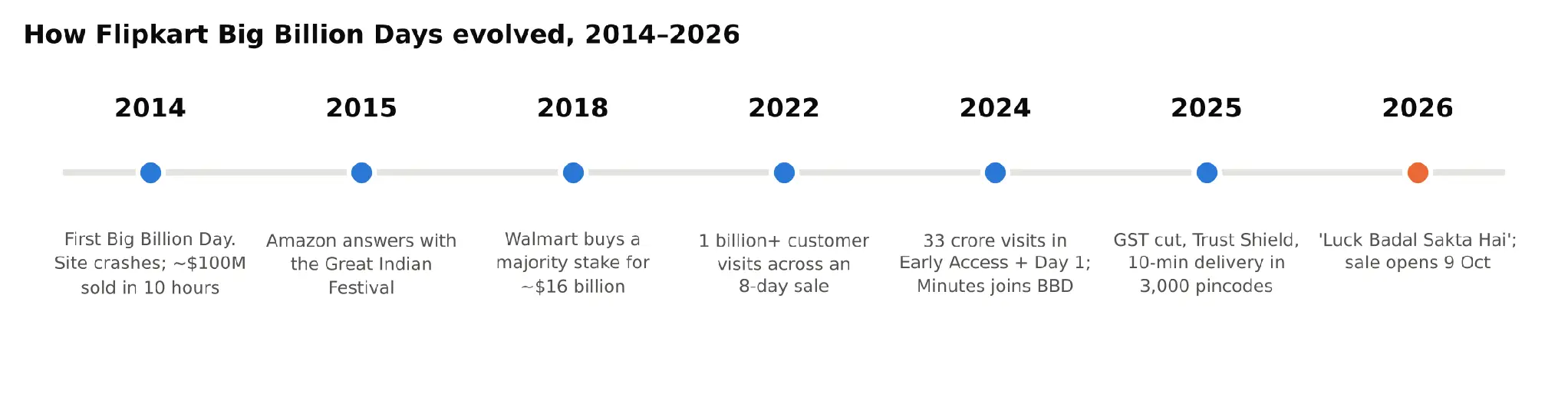
Flipkart launched the first Big Billion Day on 6 October 2014. The build-up was clever. Sachin and Binny Bansal emailed registered users personally, in a note titled ‘A special message from Sachin and Binny’. Even the date was symbolic: 6/10 matched flat number 6‑10, where the founders had started Flipkart in 2007.
Then the day arrived, and almost everything that could go wrong did. The site buckled under traffic. Products sold out in minutes. Prices changed mid-sale. Shoppers posted screenshots claiming some prices had been raised before the ‘discount’, and many moved to rival sites that had been riding on Flipkart’s advertising.
Here’s the odd part: commercially, it still worked. Flipkart sold more than $100 million worth of goods in about 10 hours, to almost 1.5 million shoppers. Datum Intelligence estimates India’s entire online retail market was about $6 billion that year, which means nearly 2% of 2014’s online sales happened on a single day.
The founders apologised publicly, and the company ran a long internal post-mortem. That apology matters to this story, because nearly every big BBD decision since then reads like a fix for something that broke in 2014.
The 2014 lesson: demand was never Flipkart’s problem. Readiness was.
How Big Billion Days Evolved (2014 to 2026)
 From one day to a festival week
The single day turned into a multi-day event. By 2022 the ninth edition ran for eight days, and Flipkart reported more than 1 billion customer visits. Spreading the sale out did two jobs at once: it eased the load on servers and warehouses, and it created more ‘moments’ to pull people back into the app.
Amazon answers back
Flipkart’s biggest rival didn’t wait long. Amazon held the first edition of its Great Indian Festival in 2015, and the two sales have been scheduled against each other ever since. From then on, every BBD has been planned with one eye on Amazon’s dates and offers.
Walmart and a bigger war chest
In 2018 Walmart bought a majority stake in Flipkart for about $16 billion. That brought money for logistics and technology, and BBD began showing up in Walmart’s earnings commentary.
From metros to Bharat
Early BBDs were mostly a big-city affair. Later editions leaned hard into smaller towns, with Shopsy for value buyers, local-language shopping and large-scale seller recruitment outside the metros. By 2025, Flipkart said it had more than 1.4 million sellers, including those on Shopsy.
From next-day to next-10-minutes
In 2024, Flipkart Minutes, the company’s quick-commerce service, became part of BBD. For the 2025 sale, Flipkart expanded it to 3,000 pincodes, and Minutes drew more than 45 lakh unique visitors during Early Access alone. To handle that peak, Flipkart also announced about 2.2 lakh seasonal jobs across its supply chain for BBD 2025.
The 7-Part Strategy Behind Flipkart Big Billion Days
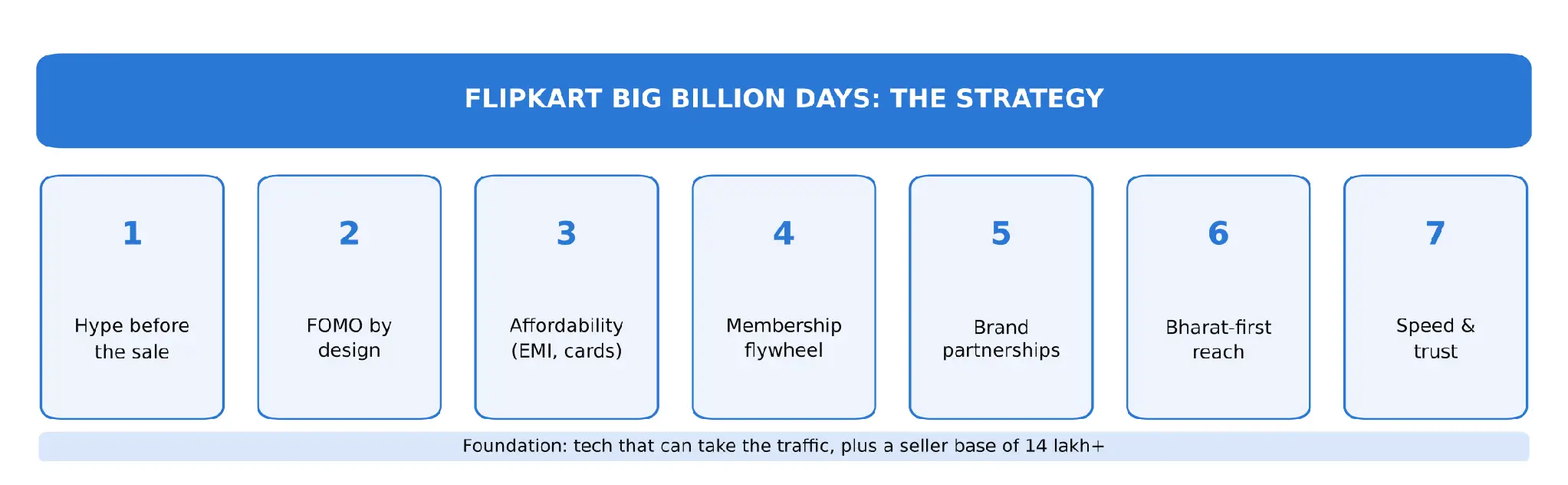
BBD rests on seven connected moves. None is new on its own; what makes BBD hard to copy is running all seven at once, at national scale.
1. Build hype weeks before the sale
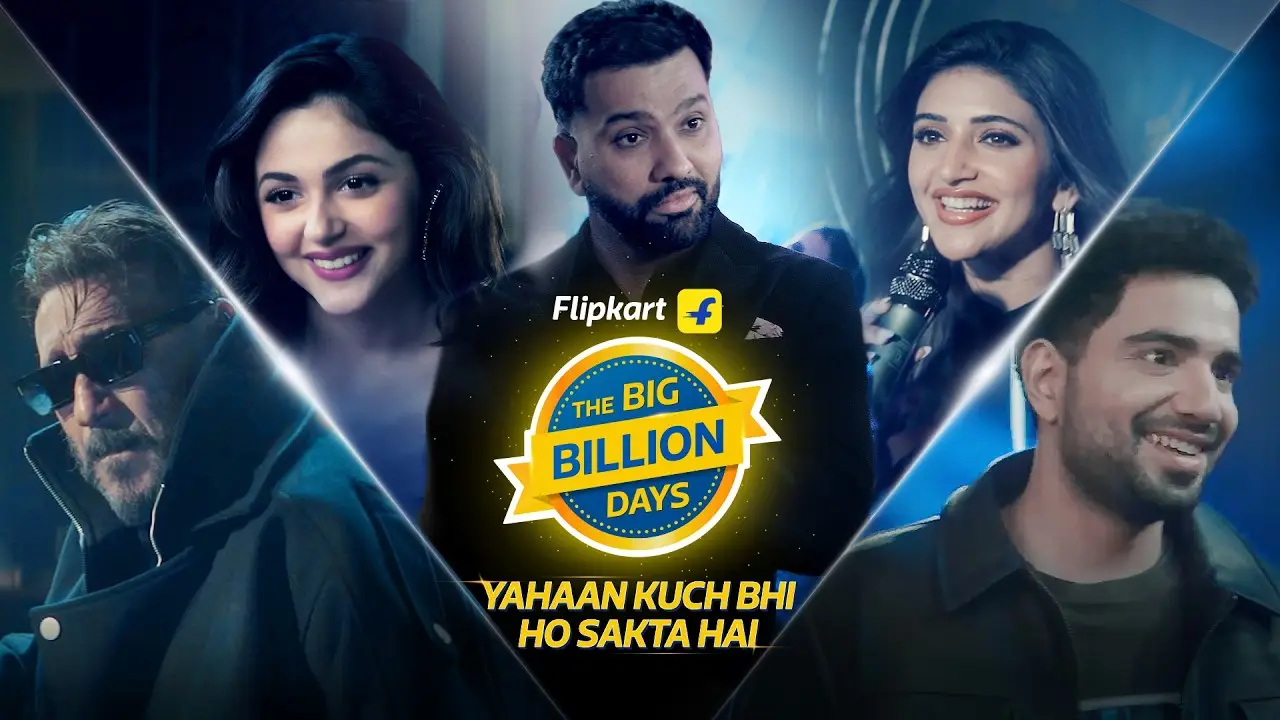
BBD starts long before the sale opens, with a microsite, teasers and a heavy TV and digital campaign. This year’s film uses a time loop: an ordinary young man relives a day of bad luck, and each time his BBD purchases turn a mishap into a lucky break, with cameos from Rohit Sharma, Jackie Shroff, Sreeleela, Samay Raina and Aneet Padda.
It builds on 2025’s ‘Yahaan Kuch Bhi Ho Sakta Hai’ line, a sign that Flipkart treats BBD as a brand platform, not a one-off ad. The budget backs it up. Flipkart Internet’s advertising spend rose about 42% to ₹1,586 crore in FY25, according to its filings as reported by Inc42.
2. Engineer urgency (FOMO by design)
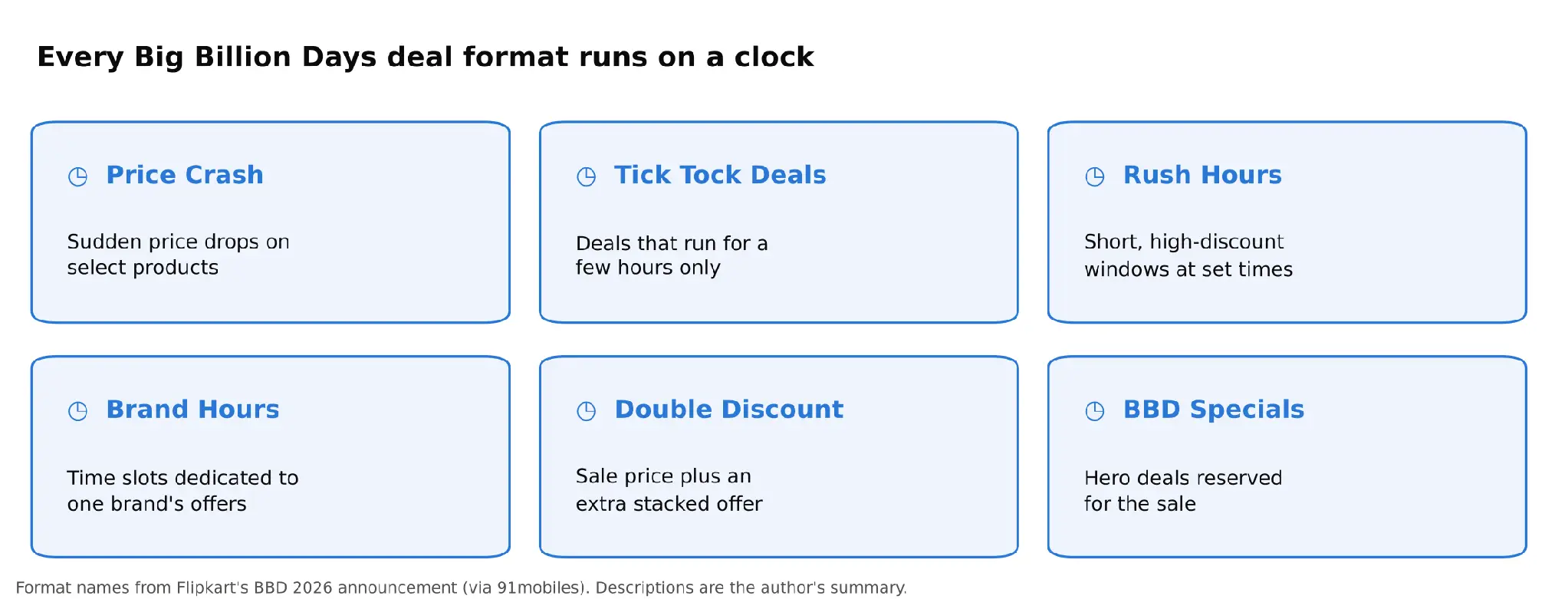
Look at the deal names: Tick Tock Deals, Rush Hours, Price Crash, Brand Hours. Every one carries a clock. Short windows and limited stock push shoppers to decide now instead of comparing for a week. It’s Black Friday scarcity, rebuilt for people who check the app several times a day.
3. Make expensive things feel affordable
BBD’s real product isn’t the discount. It’s the monthly instalment. Bank cards knock off up to 10%, no-cost EMI turns a ₹70,000 phone into a manageable monthly bill, and Flipkart’s own credit and super.money offers stack on top. During the first two days of BBD 2024, Flipkart said third-party EMI usage was 27 times higher than on normal days. That one number explains why phones and TVs dominate the sale.
4. Turn early access into a membership engine
A 24-hour head start sounds like a small perk. It isn’t. The best-priced phones often sell out early, so early access gives people a real reason to join a membership or apply for a co-branded card, and that relationship outlasts the sale.
5. Let brands share the cost
Samsung Galaxy and Intel Core Ultra are this year’s title sponsors, with Acer, JBL, Aristocrat and TCL as associate partners. Brands fund part of the discounts, use BBD for launches and buy ad space inside the app, which turns them into co-marketers instead of just suppliers.
6. Win Bharat, not just the metros
India’s next wave of online shoppers lives outside the big cities, and BBD is built for them: cash on delivery, EMI even on smaller purchases, Shopsy for value buys, and sellers from smaller towns. In BBD 2024, Shopsy saw a 70% jump in customer visits and 2.8 times more transactions than in the pre-festive period.
7. Deliver fast, and close the trust gap
2014 taught Flipkart that hype without execution destroys trust. In 2025 it launched Trust Shield, which makes Flipkart the single point of contact for product problems within 30 days of delivery, with resolution targeted within two working days. For someone buying a washing machine online for the first time, that removes a real fear: being bounced between the brand, the seller and the service centre.
Flipkart Big Billion Days by the Numbers
Flipkart has never published BBD’s total sales figure, so be careful with any article that states one as fact. Here’s what the company and credible media have actually reported.
Reported Big Billion Days figures
| Year | Metric | Figure | Reported by |
|---|---|---|---|
| 2014 | Sales on the first Big Billion Day | $100M+ in about 10 hours | ICMR case study |
| 2022 | Customer visits across the 8-day sale | 1 billion+ | Flipkart |
| 2024 | Visits in Early Access + Day 1 | 33 crore+ | Flipkart |
| 2024 | Third-party EMI use, first two days | 27x normal days | Business Standard |
| 2025 | Flipkart Minutes visitors during Early Access | 45 lakh+ | Flipkart |
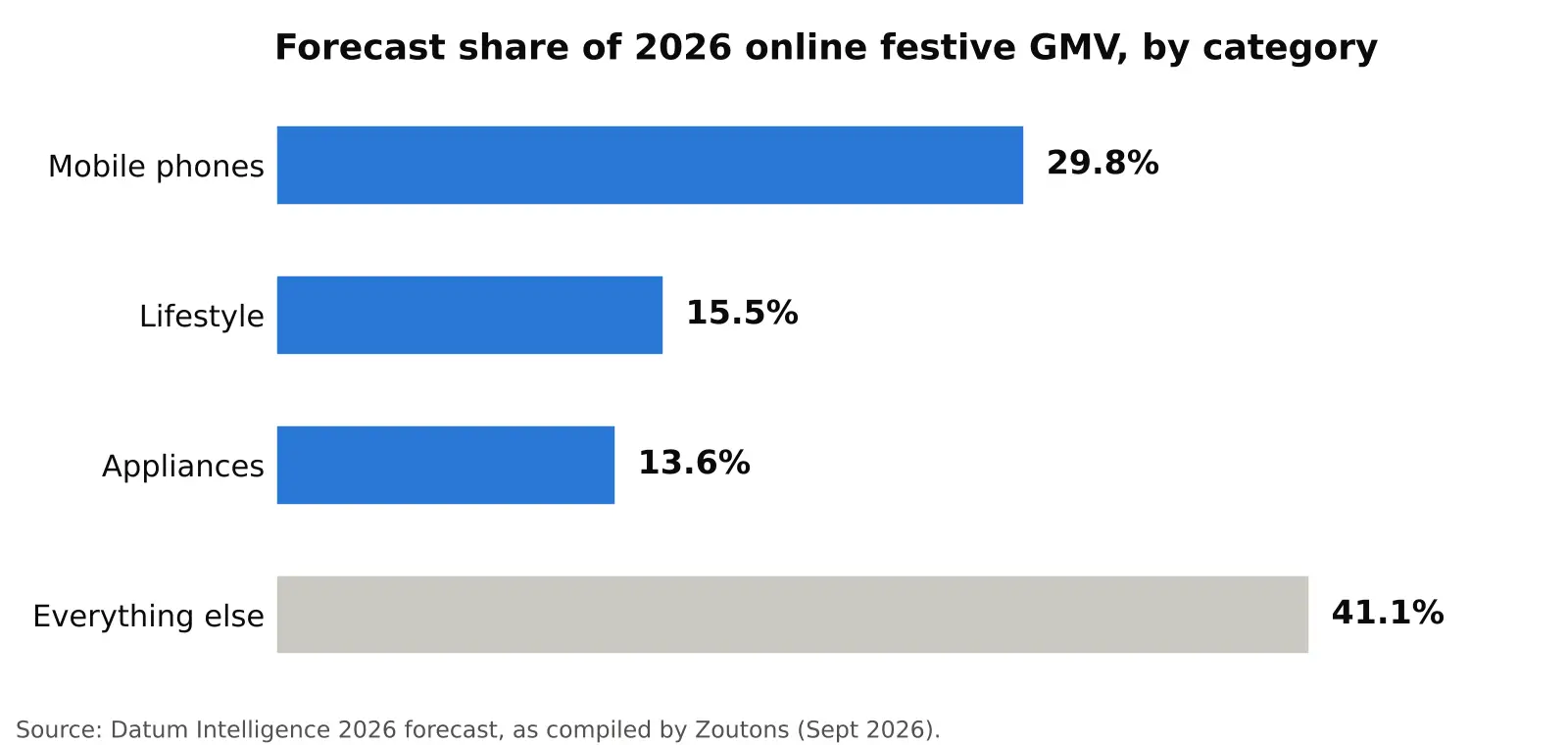
The wider market shows where the money goes. Datum Intelligence forecasts India’s 2026 online festive sales at ₹1.5–1.55 lakh crore, up 25–29%, and expects mobile phones alone to make up almost 30% of that. This is why every BBD headline is about phones.
The fastest-growing piece is quick commerce. Its share of online festive sales rose from 8% in 2024 to 12% in 2025, and Datum expects it to approach 16% this year. That shift explains why Flipkart pulled Minutes into BBD rather than leaving instant delivery to Blinkit, Zepto and Swiggy Instamart.
Flipkart Big Billion Days vs Amazon Great Indian Festival 2026
BBD 2026 vs Great Indian Festival 2026
| Feature | Flipkart Big Billion Days | Amazon Great Indian Festival |
|---|---|---|
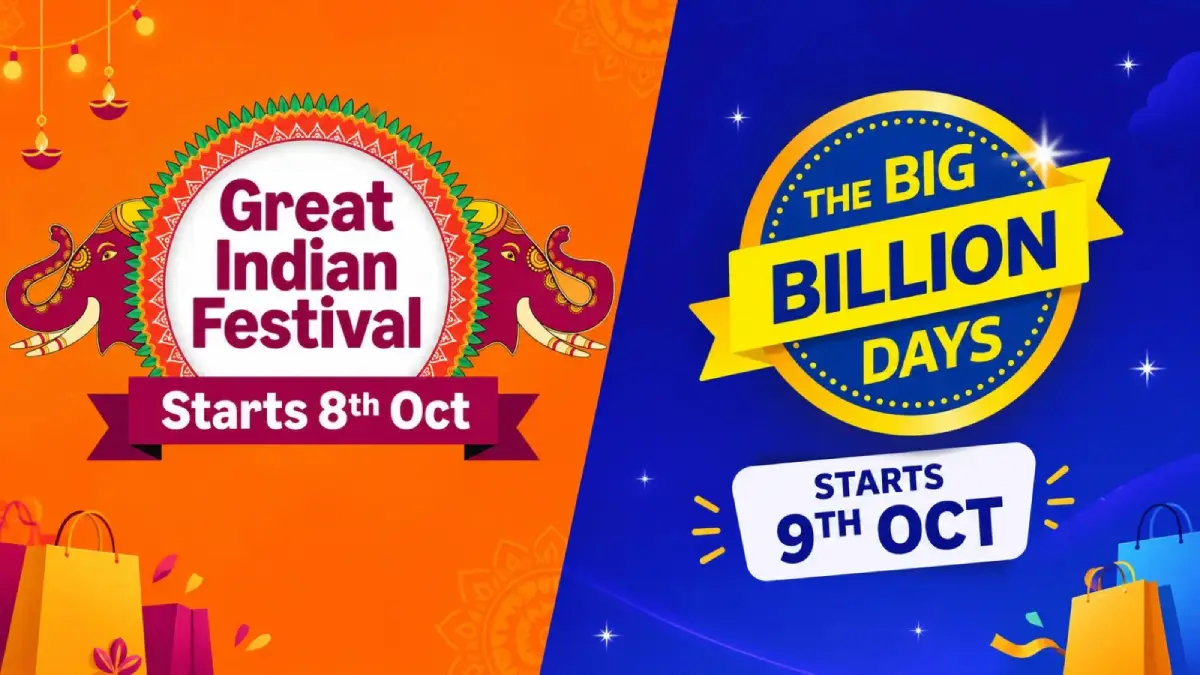
| Opens to everyone | 9 October | 8 October |
| Early access | 8 October (Plus, VIP/Black, Flipkart card holders) | Not confirmed by Amazon at the time of writing (some outlets report 7 October) |
| Main bank offer | Up to 10% on Axis Bank and ICICI Bank cards | 10% on SBI cards and EMI |
| Member extra | Early access and member offers | Up to 10% extra for Prime members |
| Fast delivery | Flipkart Minutes | Amazon Now (60+ cities) |
Amazon opening a day earlier this year is a deliberate attempt to catch shoppers before BBD starts. Historically, Redseer’s festive trackers have put the Flipkart Group (Flipkart, Myntra and Shopsy) ahead on festive sales share. In the first festive sale week of 2022, for example, Redseer put the group’s share of GMV at 62%. For shoppers, the honest advice is simple: compare the final price after bank offers on both apps, product by product.
Who Actually Pays for a BBD Discount?
A big ‘saving’ on a BBD phone is rarely funded by one party. It is usually stacked from four sources, and the mix matters more than the headline number.
- Banks: Instant bank discounts are largely funded by the card issuer, which is paying to win new cardholders and transaction volume during the busiest week of the year.
- Brands: Price drops on hero products, exchange bonuses and the interest on no-cost EMI (paid to the lender through ‘subvention’) are often covered by the brand, which wants volume and launch visibility.
- Sellers: Marketplace sellers give up margin on deal prices in return for traffic, rankings and stock clearance.
- Flipkart: The platform funds coupons, membership perks and SuperCoins, and carries the marketing and logistics bill behind the sale.
Under India’s FDI rules for marketplaces, Flipkart cannot directly set its sellers’ prices, which is one reason so much of the discount is routed through banks, brands and sellers. The exact split is not disclosed and varies by deal. But the more of each discount that partners fund, the less BBD depends on Flipkart’s own cash, and that is the lever to watch as losses and regulators keep discounting under pressure.
Challenges and Criticism
Three criticisms keep coming back.
- Inflated ‘before’ prices: The 2014 accusation that prices were raised before discounts still resurfaces every year, which is why price-history trackers are so popular during sale season.
- Regulatory scrutiny: An investigation by the Competition Commission of India reportedly found in 2024 that Flipkart and Amazon had breached competition law, keeping deep discounting under the spotlight. Flipkart Group also published a self-audit on dark patterns in 2025, a sign that countdown timers and urgency cues are now being watched closely.
- Profitability: Flipkart Internet, the marketplace arm, still reported a net loss of ₹1,494 crore in FY25, even though that was 37% lower than the year before. Discount-led growth isn’t cheap.
SWOT Analysis of Flipkart Big Billion Days
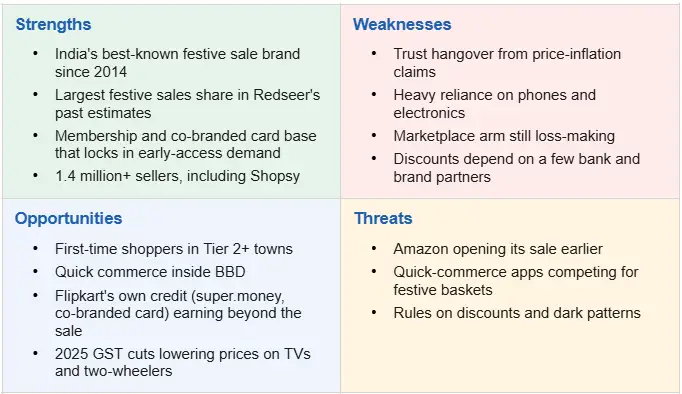
What PGDM Students Can Learn from Flipkart Big Billion Days
For a PGDM student, BBD is one of India’s best live case studies: it plays out every year on your own phone. Each specialisation reads it differently.
- Marketing: Study how a sale becomes a brand. BBD has a name, a campaign that carries over from year to year, and deal formats built on scarcity. Ask why ‘Luck Badal Sakta Hai’ extends last year’s line instead of replacing it.
- Finance: Follow the money. No-cost EMI, co-branded credit cards and bank-funded discounts shift who pays for the deal. Then set that against Flipkart Internet’s FY25 loss of ₹1,494 crore and ask whether discount-led growth can pay for itself.
- Logistics and Supply Chain (LSCM): Plan for a peak. For BBD 2025, Flipkart added about 2.2 lakh seasonal jobs and ran 10-minute delivery across 3,000 pincodes. Stocking hero products without overstocking is a forecasting problem at national scale.
- General Management: Look at the whole system: a public failure in 2014, a crisis apology, the response to Amazon, and growing regulatory scrutiny of discounts and dark patterns.
This is the kind of real-market thinking that IMT Hyderabad’s PGDM programmes in Marketing, Finance, LSCM and General Management are built around, and what students weighing a PGDM in Hyderabad should look for: cases that play out in the market while they study them. Watch this week’s sale with a strategist’s eye, and you’ll learn more than any textbook chapter on festive retail.
Conclusion: What the Flipkart Big Billion Days Story Teaches Us
Flipkart Big Billion Days began as a lesson in what happens when demand outruns readiness. Over twelve years, Flipkart turned each weak point into a system: more days to spread the load, EMI to widen the buyer base, memberships to build loyalty, Minutes for speed and Trust Shield for confidence.
The open question for 2026 and beyond is whether a model built on discounts can keep growing while regulators look harder at pricing tactics and losses still show up in the accounts. For now, though, when India starts its festive shopping, it still starts on Flipkart.
Read More: Pepsi vs Coca-Cola case study | Apple comeback case study | Why Did Silicon Valley Bank Collapse?
Frequently Asked Questions
When does Flipkart Big Billion Days 2026 start?
Flipkart Big Billion Days 2026 opens to all shoppers on 9 October 2026 at 12 AM. Flipkart Plus, VIP/Black members and Flipkart credit card holders get early access from 8 October 2026.
When did Flipkart Big Billion Days start?
The first Big Billion Day was held on 6 October 2014. The site crashed and many products sold out, but Flipkart still sold more than $100 million worth of goods in about 10 hours.
How long does the Big Billion Days sale last?
BBD usually runs for about a week. The 2022 edition ran for eight days. Flipkart had not confirmed the 2026 end date at the time of writing, so check the official microsite.
Why is Flipkart Big Billion Days a good case study for PGDM students?
BBD covers marketing, finance, supply chain and strategy in one real event that students can watch live every year. It shows crisis recovery, consumer psychology, credit-led demand, peak-season logistics and competition with Amazon, all with publicly reported data.
What bank offers are available in Big Billion Days 2026?
Shoppers can get up to 10% instant discount with Axis Bank and ICICI Bank cards, plus extra savings through the Flipkart Axis Bank credit card, super.money and Paytm.
Is Big Billion Days better than Amazon Great Indian Festival?
Neither is always cheaper. Both sales offer about 10% bank discounts and member perks. The best approach is to compare the final price, after bank offers, for the exact product you want on both apps.
Are Big Billion Days discounts genuine?
Many are, but not all. Some sellers have been accused of raising prices before the sale. Check a product’s price history before buying to see whether the deal is real.
Related Blogs
UPI Case Study: How India Built the World’s Largest Real-Time Payment Network
How did a payment system built in India go on to process nearly half of…
How Titan Became One of the World’s Largest Watch Manufacturers
Summary This case study examines how Titan, a joint venture between the Tata Group and…
Zepto vs Blinkit vs Instamart: A Strategic PGDM Case Study of India’s Quick Commerce Revolution
Why is India’s quick commerce revolution worth studying? Quick commerce is the fastest-adopted retail format…
How Reliance Jio Revolutionized India’s Telecom Industry: Strategic Lessons for PGDM Students
Summary This case study examines how Reliance Jio transformed India’s telecommunications industry within a few…
The Apple Comeback Under Tim Cook: A Business Case Study for PGDM Courses and Future Managers
Summary When Tim Cook became chief executive of Apple in 2011, many people doubted that…
Why Did Silicon Valley Bank Collapse? A Case Study of How Liquidity Risk Became a Financial Crisis
The Silicon Valley Bank collapse came on 10 March 2023 because SVB had parked most…